25 YouTube Video Ideas for Local Businesses in India to Attract More Customers

25 YouTube Video Ideas for Local Businesses in India to Attract More Customers

You don’t need a big advertising budget, expensive cameras or a professional video team to promote your local business on YouTube. You need useful video ideas, a smartphone and a clear understanding of what your customers want to know.

Whether you run a restaurant, coaching centre, salon, hotel, retail shop, bakery, gym, diagnostic centre, boutique or any other local business, YouTube can help you reach more people, build trust and attract new customers.

Think about how people choose a local business today. Before visiting a restaurant, they may watch a food video. Before joining a coaching institute, parents may want to see the classrooms and meet the teachers. Before buying clothes from a boutique, customers may want to see the latest collection.

These are opportunities for your business to get noticed.

The best part? You can create most of these videos yourself using your mobile phone.

In this ultimate guide, you will discover 25 practical YouTube video ideas for local businesses in India, learn how to create engaging videos, understand YouTube SEO and find ways to turn video views into actual enquiries and customers.

Let’s start with the basics.

Why Should Local Businesses in India Use YouTube for Marketing?

YouTube is more than an entertainment platform. It is also a place where people search for information, compare products, discover services and decide which business they should trust.

For local business owners, this creates an excellent opportunity.

Here are some important reasons to use YouTube for local business promotion.

1. Reach More Potential Customers

Your physical shop or office may serve a particular neighbourhood, but your YouTube videos can reach people across your city.

For example:

  • A restaurant in Karol Bagh can attract people searching for places to eat in Central Delhi.

  • A coaching institute in Noida can reach students and parents looking for tuition classes.

  • A beauty salon in Pune can showcase its services to people living in nearby areas.

  • A furniture shop in Jaipur can attract customers interested in home furnishing.

Your videos can introduce your business to people who may not have heard about it otherwise.

2. Build Trust Before Customers Visit

People are more comfortable contacting a business when they know what to expect.

Videos allow potential customers to see your products, premises, staff, services and working methods.

Instead of simply telling people that your business offers quality services, show them what you actually do.

3. Promote Your Products and Services Without Spending a Fortune

You don’t have to pay for every customer interaction.

You can create videos using your smartphone and publish them on your YouTube channel. These videos can continue attracting viewers long after you upload them.

Paid YouTube advertising is also available, but it is not compulsory to start promoting your business.

4. Appear in More Online Searches

YouTube is a major search platform. People regularly search for products, services, tutorials, reviews and businesses.

A well-optimised video can appear in YouTube search results and may also appear in Google search results.

For local businesses, using relevant service names, city names and neighbourhood names can make videos more useful to nearby customers.

5. Give Customers a Reason to Choose You

A business listing or advertisement may tell customers what you sell. A video can demonstrate why your business deserves their attention.

You can show your experience, explain your services, answer questions and highlight what makes your business different.

That personal connection can make a difference when customers are comparing several local businesses.

Before You Start: Understand What Makes a Good Business Video

You don’t need to become a professional YouTuber. Your goal is not to entertain millions of people. Your goal is to reach the right audience and encourage potential customers to take action.

Keep these basic principles in mind.

Know Your Target Customers

Think about the people who are most likely to buy from you.

For example:

  • A playschool should create videos for parents of young children.

  • A restaurant should target local food lovers, families and office workers.

  • A coaching centre should address students and parents.

  • A clothing boutique should showcase collections that appeal to its target customers.

  • A fitness centre should create videos for people interested in exercise and healthy lifestyles.

When you understand your audience, choosing video topics becomes much easier.

Focus on Helping, Informing or Showing

Every business video should serve a purpose.

It should do at least one of these things:

  1. Answer a customer’s question.

  2. Demonstrate a product or service.

  3. Solve a common problem.

  4. Introduce your business.

  5. Build confidence in your business.

  6. Encourage someone to visit, call or enquire.

Avoid making every video a sales pitch. People are more likely to watch and share content that provides something useful.

Keep Your Videos Simple

You can start with:

  • A smartphone with a decent camera.

  • Good natural lighting.

  • A quiet place to record.

  • A basic mobile editing application.

  • A clear and understandable voice.

You don’t need expensive equipment to make a useful video.

Use Both YouTube Shorts and Regular Videos

YouTube offers two useful video formats for business promotion.

YouTube Shorts: Short vertical videos that are useful for quick product demonstrations, offers, tips, behind-the-scenes clips and customer questions.

Regular YouTube videos: Longer videos that allow you to explain services, demonstrate products, introduce your business and answer detailed questions.

Use Shorts to capture attention and regular videos to provide more information and build trust.

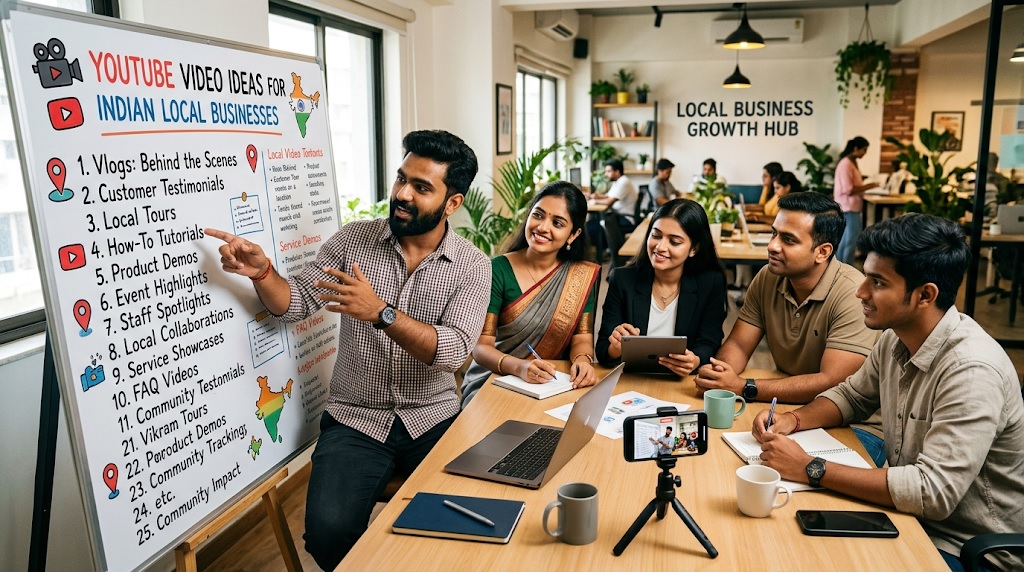
25 YouTube Video Ideas for Local Businesses in India

Here are 25 practical video ideas that businesses across India can use to attract attention, reach local customers and generate enquiries.

You don’t have to create all 25 videos at once. Start with the ideas that best match your business and gradually build your YouTube channel.

A. Videos That Introduce Your Business

These videos help people discover your business, understand what you offer and become familiar with your brand.

1. Introduce Your Business and Tell Your Story

Video title idea: Meet the People Behind [Business Name] in [City]

People like knowing who they are buying from. Introduce yourself, explain how your business started and tell viewers what you offer.

You can talk about:

  • When and why you started your business.

  • What products or services you provide.

  • Who your customers are.

  • What makes your business different.

  • What customers can expect when they visit.

For example, a restaurant owner can share how the restaurant started, what inspired the menu and why the family decided to open it.

This video gives your business a personal identity and helps potential customers connect with you.

2. Take Viewers on a Tour of Your Business

Video title idea: Take a Tour of Our [Shop/Office/Restaurant] in [Location]

Show people what your business looks like before they visit.

Depending on your business, you can show:

  • Your shop entrance and interiors.

  • Reception and waiting areas.

  • Classrooms and facilities.

  • Restaurant seating arrangements.

  • Product displays.

  • Customer facilities and parking.

A coaching institute can show its classrooms, study areas and teaching facilities. A hotel can give viewers a tour of its rooms, reception and dining area.

Keep the video natural. Walk around your premises and explain what viewers are seeing.

3. Showcase Your Best-Selling Products

Video title idea: Our 10 Most Popular Products at [Business Name]

Customers often want to know what other people are buying.

Showcase your most popular products and explain what makes them special.

For example:

  • A clothing boutique can showcase its best-selling outfits.

  • A bakery can introduce its most popular cakes and pastries.

  • An electronics shop can demonstrate its bestselling gadgets.

  • A furniture store can show its most popular furniture designs.

Show the products clearly, mention their important features and explain who might find them useful.

If prices are important to customers, include them or explain how viewers can enquire about current prices.

4. Introduce Your Team and Staff

Video title idea: Meet Our Team at [Business Name]

Your employees are an important part of your business. Introduce the people who work behind the scenes and explain what they do.

A salon can introduce its hairstylists and beauticians. A diagnostic centre can introduce its support staff and explain the roles of its qualified professionals. A coaching institute can introduce its teachers and academic team.

This makes your business feel more approachable and helps customers know who they will interact with.

5. Show How Your Products Are Made or Services Are Delivered

Video title idea: Behind the Scenes at [Business Name] – How We Work

People enjoy watching how things are made and how services are delivered.

Examples include:

  • A bakery showing how a cake is prepared.

  • A restaurant showing how a popular dish is cooked.

  • A furniture maker showing how a piece of furniture is crafted.

  • A boutique showing how an outfit is stitched.

  • A printing shop showing how customised products are made.

  • A salon showing the steps involved in a hair treatment.

Such videos demonstrate your work and give customers a better understanding of the effort and skill involved.

B. Videos That Showcase Products and Services

These videos are especially useful for businesses that want customers to understand their offerings before making a purchase.

6. Demonstrate How Your Product Works

Video title idea: How to Use [Product Name] – A Simple Demonstration

Don’t just show customers a product. Demonstrate how it works.

For example:

  • An electronics store can demonstrate a new home appliance.

  • A kitchenware shop can show how a product makes cooking easier.

  • A mobile shop can demonstrate the features of a smartphone.

  • A hardware store can show how a particular tool is used.

Explain the features in simple language and show the product from different angles.

A good demonstration can answer questions that customers would otherwise need to ask in person.

7. Showcase Your Services Step by Step

Video title idea: What Happens When You Book Our [Service]?

Many customers hesitate to try a service because they don’t know what to expect.

Use a video to explain the complete process.

For example:

  • A salon can explain what happens during a facial or hair treatment.

  • A car service centre can show the steps involved in vehicle servicing.

  • A diagnostic centre can explain how customers prepare for a particular test.

  • A travel agency can explain how it helps customers plan a holiday.

  • A home cleaning service can demonstrate its cleaning process.

Be clear about what is included, how long the service generally takes and how customers can book it.

8. Showcase New Arrivals and Latest Collections

Video title idea: New Arrivals at [Business Name] – Latest Collection in [City]

If your business regularly receives new products, make videos about them.

This works particularly well for:

  • Fashion boutiques.

  • Shoe shops.

  • Jewellery stores.

  • Furniture showrooms.

  • Gift shops.

  • Electronics stores.

  • Home furnishing businesses.

Show the latest arrivals, explain their features and mention relevant price ranges.

You can make a new arrivals video every week or whenever you receive fresh stock.

9. Compare Different Products and Help Customers Choose

Video title idea: Which [Product] Should You Buy? Compare These 3 Options

Customers often struggle to choose between similar products.

Help them make an informed decision by comparing different options.

For example:

  • A mobile shop can compare three smartphones in different price ranges.

  • A furniture store can compare different mattress types.

  • A clothing shop can explain the differences between fabric options.

  • A kitchen appliance store can compare different models.

Discuss features, quality, suitability and price.

Honest comparisons can position your business as a helpful source of information rather than just another seller.

10. Explain Your Pricing and Available Packages

Video title idea: What Does [Product/Service] Cost in [City]?

Price is one of the first things potential customers want to know.

Create a video explaining your pricing, packages and what customers get for their money.

For example:

  • A gym can explain its monthly and annual membership options.

  • A coaching centre can introduce its course fees and available programmes.

  • A salon can explain the prices of popular services.

  • A hotel can discuss room categories and facilities.

  • A photography studio can explain its different packages.

Be transparent. If prices change depending on requirements, explain the factors that affect the final cost.

This helps attract customers who are genuinely interested in your offerings.

C. Educational Videos That Attract Potential Customers

Educational videos are particularly valuable because people often search YouTube to solve problems or learn something new.

By answering their questions, you can introduce your business to people who may eventually become customers.

11. Share Expert Tips Related to Your Industry

Video title idea: 7 Useful Tips Every [Target Customer] Should Know

Share practical advice based on your experience.

Examples:

  • A dentist can share tips for maintaining oral hygiene.

  • A fitness trainer can demonstrate basic exercise techniques.

  • A beauty salon can share hair care tips.

  • A travel agency can explain how to plan a budget-friendly holiday.

  • A computer shop can share tips for maintaining laptops.

  • A coaching institute can offer study and revision tips.

Choose topics that your customers regularly ask about.

Make sure your advice is accurate and easy to understand.

12. Answer the Most Frequently Asked Customer Questions

Video title idea: 10 Questions Customers Ask Us About [Product/Service]

Think about the questions people ask before purchasing from you.

For example, a hotel may receive questions about check-in times, parking, room facilities and food options.

A coaching centre may receive questions about class timings, batches, subjects, teaching methods and fees.

A salon may receive questions about treatments, appointment timings and pricing.

Prepare a list of frequently asked questions and answer them in one video or create separate videos for each question.

This is one of the easiest ways to generate useful video content because you already know what your customers want to learn.

13. Explain Common Mistakes Customers Should Avoid

Video title idea: 7 Common Mistakes to Avoid When Choosing a [Product/Service]

People appreciate advice that helps them avoid wasting money or making poor decisions.

For example:

  • A travel agency can explain common mistakes when booking holiday packages.

  • A furniture shop can discuss mistakes when buying a mattress.

  • A fitness centre can explain common beginner workout mistakes.

  • A computer shop can explain what to check before purchasing a laptop.

  • A coaching institute can discuss mistakes students make while preparing for examinations.

Focus on genuinely helpful advice rather than criticising competitors.

14. Create a Beginner’s Guide to Your Product or Service

Video title idea: A Beginner’s Guide to [Product/Service] – Everything You Need to Know

Some customers may be interested in your products or services but know very little about them.

Create beginner-friendly videos that explain the basics.

Examples:

  • A gym can create a beginner’s guide to joining a fitness programme.

  • A travel agency can explain how to plan a first international trip.

  • A boutique can explain how to choose clothes for different occasions.

  • A computer training institute can introduce basic computer skills.

  • A bakery can explain the differences between popular cake varieties.

Avoid technical language. Explain things as if you were speaking to a first-time customer.

15. Discuss Industry Trends and What’s New

Video title idea: What’s New in [Industry]? Latest Trends You Should Know

Customers want to know what is changing and what is worth trying.

Use your industry knowledge to discuss relevant developments.

For example:

  • A fashion boutique can discuss current clothing trends.

  • A mobile shop can introduce new smartphone features.

  • A beauty salon can discuss popular hair and beauty trends.

  • A fitness centre can explain new workout methods.

  • A travel agency can discuss emerging travel destinations.

  • A coaching institute can explain changes in examination patterns.

Choose trends that are relevant to your customers rather than discussing every new development.

D. Videos That Build Trust and Encourage Customers to Visit

These videos show potential customers that your business is genuine, active and committed to providing a good experience.

16. Share Customer Testimonials and Reviews

Video title idea: What Our Customers Say About [Business Name]

Positive customer feedback can influence purchasing decisions.

Ask satisfied customers if they would be comfortable sharing their experience on camera.

You can ask them:

  • Why did they choose your business?

  • What product or service did they use?

  • What did they like about the experience?

  • Would they recommend your business to others?

Keep testimonials natural. Don’t make customers read scripted praise.

Always obtain their permission before recording or publishing their videos.

17. Show a Real Customer Experience

Video title idea: A Day at [Business Name] – See What Our Customers Experience

Take viewers through a typical customer experience.

For example:

  • A restaurant can show a family enjoying a meal.

  • A salon can show the customer journey from appointment to completed service.

  • A hotel can demonstrate the check-in experience.

  • A boutique can show how customers explore and select outfits.

  • A fitness centre can show a typical training session.

Make sure you have permission from anyone who appears in the video.

This type of content helps potential customers imagine themselves visiting your business.

18. Introduce Your Special Offers and Seasonal Deals

Video title idea: Special Offers This Month at [Business Name] in [City]

Promote offers that give customers a reason to contact you.

Indian businesses have several opportunities throughout the year:

  • Diwali and Dhanteras offers.

  • Holi promotions.

  • Eid specials.

  • Christmas and New Year deals.

  • Independence Day offers.

  • Wedding season packages.

  • Summer and winter discounts.

  • School reopening offers.

A restaurant can promote a festive menu, a boutique can showcase a wedding collection, and a coaching institute can announce new admission batches.

Mention the offer clearly, including its validity, conditions and how customers can avail it.

19. Celebrate Your Business Milestones

Video title idea: Celebrating [Number] Years of Serving Customers in [City]

Have you completed five years in business? Served 1,000 customers? Opened a new branch? Introduced a new product range?

Share these milestones with your audience.

You can include old photographs, memorable moments, team celebrations and customer appreciation messages.

This is a good way to demonstrate your business journey and recognise the people who have supported you.

20. Show Your Work Through Before-and-After Videos

Video title idea: Before and After – See the Difference Our [Service] Makes

Before-and-after videos are highly visual and can communicate results quickly.

They are particularly useful for:

  • Salons showing permitted hair transformations.

  • Interior designers showcasing room makeovers.

  • Furniture restoration businesses showing repaired furniture.

  • Car detailing centres showing vehicle cleaning results.

  • Cleaning services showing transformed spaces.

  • Landscaping businesses showcasing garden improvements.

Use genuine photographs or video footage and avoid misleading editing.

For businesses dealing with health, beauty or other regulated services, follow applicable advertising and professional guidelines when showing results.

E. Local Videos That Help Customers Find Your Business

One of the biggest advantages of YouTube marketing for local businesses is the ability to target people in your city, neighbourhood or surrounding areas.

These video ideas are especially useful for businesses that depend on customers visiting their physical locations.

21. Create a Video About Your Local Area

Video title idea: Best Places to Shop, Eat or Visit in [Locality], [City]

Create useful videos about your neighbourhood and naturally introduce your business.

For example:

  • A restaurant can make a video about popular food options in its locality.

  • A hotel can introduce nearby tourist attractions and shopping areas.

  • A boutique can showcase popular shopping destinations in its city.

  • A coaching centre can explain how students can reach its location.

  • A fitness centre can introduce nearby residential areas it serves.

Make the video genuinely useful. Include relevant local information and explain where your business fits in.

22. Show Customers How to Reach Your Business

Video title idea: How to Reach [Business Name] in [Location] – Complete Directions

People may be interested in your business but unsure about its exact location.

Create a simple video showing:

  • The nearest main road.

  • Nearby landmarks.

  • The nearest metro station or bus stop, if relevant.

  • The building entrance.

  • Parking arrangements, if available.

  • Your shop or office entrance.

For example, a coaching institute in Rohini can make a video explaining how students can reach it from the nearest metro station.

This is a practical video that can help turn online interest into physical visits.

23. Create a Video About Local Customer Problems

Video title idea: Looking for [Product/Service] in [City]? Here’s What You Should Know

Think about the problems people in your area face and create videos that address them.

Examples:

  • A pest control business can explain common pest problems in local homes.

  • A water purifier shop can discuss what customers should consider when choosing a purifier.

  • A travel agency can explain popular weekend trips from its city.

  • A computer repair shop can discuss common laptop problems.

  • A playschool can explain what parents should look for when choosing a preschool.

Include your business name and location naturally so local viewers know where they can find help.

24. Cover Local Events and Community Activities

Video title idea: Highlights from [Local Event] in [City]

If your business participates in local events, festivals, exhibitions, trade fairs or community activities, create videos about them.

For example:

  • A boutique can showcase its participation in a local fashion exhibition.

  • A restaurant can cover a festive food event.

  • A fitness centre can share highlights from a local fitness competition.

  • A coaching institute can share photographs and highlights from its annual function.

  • A retail shop can showcase its festive decorations and celebrations.

Local event videos can help your business connect with people in your community.

Always obtain permission before filming people or using event footage.

25. Make a Video Introducing Your Latest Business News

Video title idea: What’s New at [Business Name]? New Services, Products and Updates

Keep customers informed about what’s happening at your business.

You can announce:

  • A new branch opening.

  • New products or services.

  • New facilities.

  • New courses or admission batches.

  • Updated business timings.

  • New delivery options.

  • New payment facilities.

  • Special customer services.

This type of video is particularly useful for businesses that regularly introduce something new.

It gives existing customers a reason to stay connected and helps potential customers discover your latest offerings.

How to Create YouTube Videos for Your Local Business: A Step-by-Step Guide

Having video ideas is a good start. But how do you actually create and publish videos?

The process is much simpler than most business owners imagine.

You can start without hiring a professional videographer or purchasing expensive equipment.

Step 1: Choose One Topic Your Customers Care About

Don’t start by asking yourself, “What should I post on YouTube today?”

Instead, ask:

“What would my customers like to know about my business?”

For example, if you own a restaurant, you could start with:

  • A tour of your restaurant.

  • Your most popular dishes.

  • How your food is prepared.

  • Your menu and prices.

  • Your restaurant’s location.

If you run a coaching centre, you could start with:

  • An introduction to your institute.

  • A tour of your classrooms.

  • An introduction to your teachers.

  • Subjects and courses offered.

  • Admission information.

Choose one topic for each video. Avoid trying to explain everything in a single recording.

Step 2: Write a Simple Video Script

You don’t need a complicated script. Just prepare a few points so you know what to say.

A simple business video can follow this structure:

Opening: Introduce the topic and tell viewers what they will learn.

Main content: Explain the product, service or information.

Business introduction: Tell viewers who you are and where your business is located.

Call to action: Tell viewers what they should do next.

For example, a bakery owner creating a video about popular cakes could say:

“Looking for a delicious birthday cake in Jaipur? At ABC Bakery, we offer a variety of cakes for birthdays, anniversaries and special occasions. In this video, we’ll show you some of our most popular designs. Visit our bakery or contact us to discuss your requirements.”

Keep your language natural. Speak as if you are talking to a customer standing in front of you.

Step 3: Record Videos Using Your Smartphone

Your smartphone is enough to get started.

Follow these simple recording tips:

  • Clean your camera lens before recording.

  • Record in a well-lit area.

  • Face a window or another natural light source.

  • Keep your phone steady.

  • Record in a quiet environment.

  • Speak clearly and avoid rushing.

  • Keep unnecessary background activity to a minimum.

For videos where you are speaking directly to the camera, position your phone at eye level.

For product demonstrations, make sure the product is clearly visible.

If you record videos regularly, consider purchasing an inexpensive tripod and a basic external microphone. Clear audio is often more important than having a very expensive camera.

Step 4: Keep the Video Length Appropriate

There is no single perfect video length for every business.

The ideal length depends on the topic and how much information you need to share.

Here is a useful starting point:

Video type Suggested length
Quick product showcase 30–60 seconds
YouTube Short Up to 3 minutes
Business introduction 1–3 minutes
Product demonstration 2–5 minutes
Customer FAQ 2–5 minutes
Detailed educational video 5–10 minutes
Business or showroom tour 2–5 minutes

These are suggested starting points, not strict rules.

Don’t stretch a short topic into a long video. Similarly, don’t leave out useful information just to make a video shorter.

Step 5: Edit Your Video Before Uploading

Basic editing can make your videos look more professional.

You can:

  • Remove unnecessary pauses.

  • Cut mistakes and repeated sentences.

  • Add your business name.

  • Include short text explaining important points.

  • Add captions or subtitles.

  • Include contact information where appropriate.

  • Add a simple closing message.

There are several beginner-friendly mobile video editing applications available. Choose one that you find easy to use.

Avoid excessive transitions, distracting effects and loud background music.

The objective is to make your video easy to watch and understand.

Step 6: Create an Attractive Thumbnail

Your thumbnail is one of the first things people notice when browsing YouTube.

A good thumbnail should immediately communicate what the video is about.

For example:

  • Restaurant: Show an appetising dish with the words “5 Must-Try Dishes”.

  • Coaching centre: Show a classroom with the words “Inside Our Institute”.

  • Boutique: Show an attractive outfit with the words “Latest Festive Collection”.

  • Salon: Show a hairstyle with the words “New Hair Transformations”.

  • Gym: Show a workout area with the words “Tour Our Fitness Centre”.

Use a clear photograph, readable text and a simple layout.

Avoid overcrowding the thumbnail with too many words or design elements.

For regular YouTube videos, create a custom thumbnail in the recommended 16:9 format, ideally 1280 × 720 pixels.

For Shorts, pay attention to the video frame and cover image that appears on your channel.

YouTube SEO for Local Businesses: How to Get More Views

Creating a good video is only half the job. You also need to make it easy for people to discover your content.

This is where YouTube SEO becomes important.

YouTube SEO means optimising your videos so they can appear for relevant searches.

For local businesses, the goal is to attract viewers who are interested in your products or services, particularly those in your service area.

1. Use Relevant Keywords in Your Video Title

Think about what a potential customer would type into YouTube.

For example:

Business Useful video title keywords
Restaurant Best restaurant in Karol Bagh
Coaching centre Maths tuition in Noida
Beauty salon Best beauty salon in Rohini
Hotel Budget hotel in Paharganj
Boutique Designer boutique in South Delhi
Gym Gym in Baner Pune
Bakery Birthday cakes in Jaipur
Playschool Preschool in Indirapuram

Include your main keyword naturally in the video title.

Don’t stuff multiple locations and keywords into one title. Write for people first.

2. Write a Useful, Keyword-Rich Video Description

Your video description should explain what viewers will find in the video.

Include:

  • Your business name.

  • Your main product or service.

  • Your city and locality.

  • Important information about your offering.

  • Your contact details or enquiry method.

  • Your business website or relevant business listing, where available.

For example:

“Looking for a family-friendly restaurant in Karol Bagh, Delhi? Visit ABC Restaurant for delicious food, comfortable seating and a variety of dishes. We serve customers looking for quality dining options in Karol Bagh and nearby areas. Contact us for reservations and enquiries.”

Write naturally. Don’t repeat the same keyword unnecessarily.

3. Use Your City and Locality in the Video

Local keywords can help YouTube understand the location your video is relevant to.

Mention your city or neighbourhood naturally while speaking.

For example:

“Welcome to our coaching institute in Sector 15, Noida.”

You can also display your address or locality on screen when appropriate.

The idea is to give viewers and search engines clear information about your business location.

4. Add Relevant YouTube Tags

YouTube tags can help provide additional context about your video, including common spelling variations.

For example, a video about a restaurant in Delhi could use:

restaurant in Delhi, restaurant in Karol Bagh, family restaurant Delhi, best food in Karol Bagh, dining in Delhi

Don’t spend too much time collecting hundreds of tags. Your video title, description, content and viewer response are more important.

5. Add Captions and Subtitles

Captions make your videos easier to understand, particularly when viewers watch without sound.

They can also help people who are more comfortable reading than listening.

For Indian audiences, consider subtitles in Hindi or other regional languages where relevant.

For example, a business in Chennai may benefit from Tamil subtitles, while a business serving customers across India may choose English and Hindi.

Always check automatically generated captions for mistakes, especially business names, addresses and product details.

6. Organise Videos into Playlists

Playlists help viewers discover more of your content.

Instead of putting every video into one long collection, organise videos by topic.

For example, a restaurant can create:

  • Restaurant Tours.

  • Popular Dishes.

  • Food Preparation.

  • Customer Reviews.

  • Special Offers.

A coaching centre can create:

  • Faculty Introductions.

  • Course Information.

  • Study Tips.

  • Classroom Tours.

  • Student Guidance.

This makes your YouTube channel easier to navigate.

7. Add Your Business Contact Details

Your video should make it easy for interested viewers to contact you.

Use your channel profile and video descriptions to provide appropriate contact details.

Depending on your business, you can include:

  • Business phone number.

  • WhatsApp contact.

  • Website.

  • Business location.

  • Enquiry details.

  • Booking information.

You can also pin a relevant comment explaining how viewers can enquire.

Remember to keep your contact information updated.

How to Turn YouTube Views into Actual Customers

Getting thousands of views is not necessarily the same as getting customers.

For a local business, even 100 relevant views from people living nearby may be more valuable than thousands of unrelated views from other parts of the country.

Your objective should be to convert interested viewers into enquiries, visits and sales.

Here are practical ways to do that.

1. Include a Clear Call to Action in Every Video

A call to action tells viewers what they should do next.

Examples:

  • Visit our store in [Location].

  • Call us for product details.

  • WhatsApp us for enquiries.

  • Book your appointment today.

  • Contact us for course information.

  • Visit our showroom to explore the collection.

  • Enquire about our latest offers.

Don’t use too many calls to action in one video. Choose the action that matters most.

2. Make Your Business Easy to Find

A customer who likes your video should not have to search repeatedly to find your address.

Clearly mention your business location and provide accurate contact information.

If you have a valid Google Business Profile, make sure your business details, address, phone number and operating hours are up to date.

Your YouTube channel, website and business listing should present consistent business information.

3. Promote Your Videos on WhatsApp

WhatsApp is widely used by Indian customers and is a practical way to distribute your videos.

Share your videos through:

  • WhatsApp Status.

  • Relevant customer conversations.

  • Business groups where promotional posts are permitted.

  • Your business WhatsApp profile.

For example, a boutique can share a new collection video with interested customers. A restaurant can share a video introducing its festive menu.

Avoid sending repeated promotional messages to people who have not agreed to receive them.

4. Share Videos on Facebook and Instagram

Don’t restrict your video promotion to YouTube.

You can share suitable videos or shorter edited versions on:

  • Facebook business pages.

  • Instagram Reels.

  • Instagram Stories.

  • Relevant local community groups.

  • LinkedIn, where appropriate for your business.

This allows you to reach people who may not regularly use YouTube.

Always make sure the video format suits the platform.

5. Embed Videos on Your Website and Business Pages

If your business has a website, add relevant YouTube videos to suitable pages.

For example:

  • Add your restaurant tour to your restaurant information page.

  • Add teacher introduction videos to your coaching institute’s website.

  • Add product demonstrations to relevant product pages.

  • Add a hotel room tour to your accommodation page.

Videos can help visitors understand your business without having to read lengthy descriptions.

You can also use relevant videos on your business listing pages, where the platform supports video content.

6. Use YouTube Videos in Your Customer Enquiries

Many businesses answer the same questions repeatedly.

Instead of explaining everything from the beginning each time, create videos that answer common questions.

For example, if customers regularly ask about your restaurant’s menu, share your menu video.

If parents want to know about your coaching institute, share a classroom tour or teacher introduction.

This saves time and gives customers a clearer understanding of your business.

YouTube Marketing Strategy for Different Types of Local Businesses in India

Not every business should create the same type of content. A restaurant needs different videos from a coaching institute or a diagnostic centre.

Here are some practical content ideas based on popular Indian business categories.

Business category Videos worth creating
Restaurants and cafés Food preparation, menu tours, popular dishes, customer experiences
Hotels and guest houses Room tours, facilities, nearby attractions, booking information
Coaching institutes Teacher introductions, classroom tours, study tips, course details
Playschools Classroom tours, activities, facilities, learning methods
Tuition teachers Subject tutorials, teaching demonstrations, exam tips
Beauty salons Hair transformations, service demonstrations, beauty tips
Designer boutiques New collections, styling tips, festive wear, fabric guides
Retail shops New arrivals, product demonstrations, price comparisons
Gyms and fitness centres Workout demonstrations, facility tours, trainer introductions
Diagnostic centres Facility tours, test preparation information, patient guidance
Medical stores Health product information, medicine storage guidance, general awareness
Bakeries Cake making, new products, custom orders, baking demonstrations
Travel agencies Destination guides, travel tips, holiday packages
Furniture stores Furniture demonstrations, room makeovers, buying guides
Real estate agencies Property tours, neighbourhood guides, buying tips

Choose video topics that match your customers’ needs and the services you actually provide.

For healthcare-related businesses, ensure that all information is accurate, professionally appropriate and compliant with applicable advertising rules.

How Often Should Local Businesses Upload Videos on YouTube?

Consistency is more important than uploading a large number of videos in a short period and then disappearing.

You don’t need to publish videos every day.

A realistic starting schedule for a small business could be:

  • Two YouTube Shorts every week.

  • One regular YouTube video every week.

  • One promotional or business update video every month.

If you are just starting, even one good video every week is a reasonable target.

As you become more comfortable with recording and editing, you can increase your frequency.

A Simple 4-Week YouTube Content Calendar for Local Businesses

Here is an example of how you can plan your first month of YouTube marketing.

Week Video 1 Video 2 Video 3
Week 1 Business introduction Product or service showcase Customer FAQ
Week 2 Behind the scenes Expert tips YouTube Short featuring a popular product
Week 3 Business tour Customer testimonial Common mistakes to avoid
Week 4 New arrivals or offers Customer experience Local business location guide

You can adjust this calendar to suit your business category.

For example, a restaurant can replace the expert tips video with a recipe demonstration, while a coaching institute can publish a study tips video.

How to Get More YouTube Views Without Spending Money

You don’t have to depend entirely on YouTube search to attract viewers.

There are several ways to promote your videos organically.

1. Share Your Videos with Existing Customers

Your existing customers can become your first audience.

Share relevant videos with them through your social media pages, WhatsApp Status and other communication channels.

A satisfied customer may also share your video with friends and family.

2. Ask Customers to Subscribe to Your Channel

When customers visit your business, politely invite interested people to subscribe to your YouTube channel.

You can display a small QR code at your reception, billing counter or shop entrance that opens your channel.

Don’t pressure customers. Give them a genuine reason to subscribe by explaining what useful content you publish.

3. Collaborate with Other Local Businesses

Look for businesses that serve a similar audience but do not directly compete with you.

For example:

  • A wedding photographer can collaborate with a boutique.

  • A restaurant can collaborate with a local food creator.

  • A fitness centre can collaborate with a sports shop.

  • A travel agency can collaborate with a hotel.

  • A playschool can collaborate with a children’s activity centre.

You can create joint videos, introduce each other’s services or conduct interviews.

This exposes your business to a new audience.

4. Participate in Local Online Communities

Share helpful videos in relevant local online communities where business promotion is permitted.

For example, a video about choosing a good playschool may be useful to a local parents’ group.

A video about popular food options may interest people living in the neighbourhood.

Always follow group rules and avoid posting repetitive advertisements.

5. Turn One Video into Multiple Pieces of Content

You don’t have to create completely new content for every platform.

One regular YouTube video can give you several smaller content pieces.

For example, a five-minute restaurant tour can be divided into:

  • A 30-second video showing the interiors.

  • A Short showcasing popular dishes.

  • A short introduction to the restaurant.

  • A video about the restaurant’s location.

  • A few photographs for social media.

This approach saves time and helps you maintain a consistent online presence.

How to Measure the Success of Your YouTube Marketing

Don’t judge your YouTube marketing only by the number of views.

For a local business, the real objective is to attract relevant customers and generate business enquiries.

YouTube Studio provides useful information about how people discover and watch your videos.

Here are the important things to monitor.

1. Views

Views indicate how many times people watched your content.

Look at which topics attract the most attention.

For example, if your restaurant tour receives more views than your business introduction, you may want to create more videos showcasing your premises and customer experience.

2. Watch Time and Audience Retention

These metrics help you understand whether people continue watching your videos or leave after a few seconds.

If viewers leave quickly, your introduction may be too long or the video may not be delivering what the title promises.

Start with the most interesting information and avoid unnecessary introductions.

3. Subscribers

Check whether your videos are encouraging viewers to subscribe.

If a particular type of video brings more subscribers, consider creating similar content.

4. Comments and Questions

Comments can reveal what potential customers want to know.

For example, viewers may ask about:

  • Product prices.

  • Service availability.

  • Business location.

  • Appointment timings.

  • Course fees.

  • Delivery options.

These questions can become your next video topics.

5. Actual Business Enquiries

This is one of the most important measures.

Track how many calls, WhatsApp messages, appointment requests and store visits come through your YouTube marketing.

You can ask new customers how they discovered your business.

You can also use a separate enquiry message or promotional code to understand which videos are generating interest.

Over time, you will learn which video topics attract genuine potential customers rather than just casual viewers.

10 Common YouTube Marketing Mistakes Local Businesses Should Avoid

Many business owners create videos but struggle to get results because they overlook a few important things.

Avoid these mistakes when promoting your business on YouTube.

1. Making Every Video an Advertisement

If every video says “Buy from us” or “Visit our shop”, viewers may lose interest.

Mix promotional content with useful information, demonstrations, tips and customer guidance.

2. Using Unclear Video Titles

Titles such as “Our New Video” or “Watch This” tell viewers very little.

Use descriptive titles that explain exactly what the video offers.

3. Ignoring Local Keywords

If your business serves a particular city or neighbourhood, include relevant location information where appropriate.

A title such as “Best Birthday Cakes in Jaipur” is more useful to local searchers than simply “Our Latest Cakes”.

Only use location claims that accurately describe your service area.

4. Poor Audio and Lighting

People may tolerate an ordinary-looking video, but unclear audio makes it difficult to understand your message.

Record in a quiet environment, use sufficient lighting and check your audio before publishing.

5. Uploading Videos Without Descriptions

Your video description is an opportunity to explain your business, products, services and location.

Don’t leave it blank.

6. Forgetting to Tell Viewers What to Do Next

A viewer may enjoy your video but not know how to contact you.

Include a clear call to action and accurate business contact information.

7. Buying Fake Views and Subscribers

Fake engagement does not bring genuine customers.

It can also damage your channel’s credibility and violate YouTube policies.

Focus on attracting real viewers who are interested in your products and services.

8. Uploading Inconsistently

Publishing five videos in one week and then remaining inactive for three months is not a good content strategy.

Create a manageable schedule and follow it.

9. Ignoring Comments

If viewers ask questions, respond politely and provide useful answers.

Your comments section can become another way to communicate with potential customers.

10. Giving Up Too Early

YouTube marketing takes time.

Some videos may receive very few views initially, while others may attract attention months later.

Study your results, improve your content and continue publishing useful videos.

Frequently Asked Questions About YouTube Marketing for Local Businesses

1. Is YouTube good for promoting a small business in India?

Yes. YouTube can help small businesses introduce their products and services, reach local audiences, build trust and generate enquiries.

Restaurants, coaching institutes, salons, boutiques, hotels, gyms and retail shops can all benefit from creating useful videos.

2. Can I promote my local business on YouTube for free?

Yes. You can create a YouTube channel, upload videos, publish Shorts and share your content without paying for advertising.

You will need time and effort to create and promote your videos, but you don’t need an advertising budget to get started.

3. Do I need a professional camera to make YouTube videos?

No. A smartphone with a decent camera is sufficient for most small business videos.

Good lighting, clear audio, useful information and stable recording matter more than expensive equipment.

4. How many YouTube videos should a small business upload per week?

Start with one regular video and two Shorts per week if you can manage that consistently.

If this is too much, begin with one video every week and gradually increase your frequency.

Quality and consistency are more important than uploading videos simply to meet a target.

5. How long does it take to get customers from YouTube?

There is no fixed timeline.

Some businesses may receive enquiries soon after publishing their first few videos, while others may need several months of consistent content creation.

Results depend on your industry, competition, video quality, audience interest and promotional efforts.

6. Should I create YouTube Shorts or long videos for my business?

Ideally, use both.

Shorts are useful for quick demonstrations, product showcases, tips and announcements.

Longer videos are better for business tours, detailed explanations, customer questions and educational content.

Use the format that best suits the topic.

7. How can I make my YouTube videos appear in Google search results?

Create useful videos around topics people actually search for. Use descriptive titles, relevant keywords, clear descriptions and accurate business information.

You can also embed relevant videos on your website.

However, appearing in Google search results is not guaranteed.

8. Can YouTube help my business attract customers from nearby areas?

Yes. Create videos featuring your city, locality, products, services and directions to your business.

For example, a salon in Rohini can create videos around beauty services in Rohini and nearby areas.

This can help your content reach people searching for relevant local services.

9. Should I speak in English, Hindi or my regional language?

Choose the language your target customers understand best.

You can use English, Hindi or regional languages such as Tamil, Bengali, Marathi, Telugu, Kannada and Malayalam.

For businesses serving customers across different regions, subtitles can help make videos accessible to a wider audience.

10. Can YouTube really help increase sales for a local business?

Yes, when used strategically.

Videos can introduce your products, explain your services, demonstrate quality, answer customer questions and encourage people to contact or visit your business.

However, views alone do not guarantee sales. You also need good products, reliable service, competitive offerings and an easy enquiry process.

Final Thoughts: Start Creating YouTube Videos for Your Business Today

You don’t need to be a professional content creator to use YouTube for business promotion.

You already have something valuable to share: your products, services, knowledge, experience and the story behind your business.

Start by answering the questions your customers ask most often. Show your products. Introduce your team. Give people a tour of your premises. Share useful tips and demonstrate what makes your business worth visiting.

Most importantly, create videos that help customers make informed decisions.

Don’t wait until you have the perfect camera, editing software or marketing budget. Start with your smartphone and one useful video.

Remember, your competitors may already be using YouTube to attract customers. The sooner you establish your presence, the sooner potential customers can start discovering your business through video.

Your next customer could be watching your next YouTube video. Make sure your business gives them a reason to contact you.

Bonus: Your First 7 Days of YouTube Marketing

If you are unsure where to begin, follow this simple seven-day action plan.

Day What to do
Day 1 Create or optimise your business YouTube channel.
Day 2 Record a short video introducing your business.
Day 3 Record a product or service demonstration.
Day 4 Create a video answering a frequently asked customer question.
Day 5 Record a tour of your shop, office or premises.
Day 6 Create a YouTube Short showcasing your best offering.
Day 7 Publish your videos, share them on social media and review the initial response.

After the first week, continue with a weekly content schedule.

The most important thing is to keep going and improve with every video.

Related Posts

A Beginner’s Guide to Google Ads, Facebook & Instagram Ads

25 Creative Social Media Post Ideas for Small Businesses in India

How to Promote Your Local Business on Quora, Reddit & Facebook Groups
How to Create Business Marketing Content Using Free Tools: Images, Posters, Videos and Social Media Posts

How to Promote Your Local Business on LinkedIn

How to Promote Your Local Business on LinkedIn

LinkedIn is no longer just a platform for finding jobs or connecting with professionals. It has become a powerful place to promote businesses, build trust, connect with potential customers and generate new business opportunities.

Whether you run a coaching centre, restaurant, hotel, retail shop, digital marketing agency, consultancy, playschool, fitness centre or any other local business, LinkedIn can help you reach people who may need your products or services.

The best part? You don’t need a big marketing budget to get started.

With a well-maintained LinkedIn presence, useful content and consistent activity, you can promote your local business online, attract potential customers and build valuable business connections.

This guide explains how to use LinkedIn for local business marketing in India, starting with the basics and moving towards practical strategies that you can implement yourself.

1. Why Should Local Businesses Use LinkedIn for Marketing?

Many small business owners in India focus their online marketing efforts on Instagram, Facebook and WhatsApp. These platforms are useful, but LinkedIn offers something different.

LinkedIn connects businesses with professionals, company owners, decision-makers, entrepreneurs, employees and people looking for specific products and services.

This makes it particularly useful for businesses that want to attract professional customers, corporate clients, institutional buyers and local business enquiries.

Key Benefits of LinkedIn Marketing for Small Businesses

1. Reach potential customers

Your LinkedIn content can introduce your business to people who may not have discovered you through traditional advertising.

2. Build business credibility

A professional LinkedIn presence helps customers understand what your business offers, how it operates and why they should consider choosing you.

3. Generate business enquiries

You can use your profile, company page, posts and direct conversations to encourage interested people to contact you.

4. Connect with other local businesses

LinkedIn gives you opportunities to connect with suppliers, service providers, business owners, consultants and potential partners.

5. Promote your products and services

You can showcase your products, explain your services, share customer success stories and announce special offers.

6. Market your business without spending heavily

Creating a LinkedIn profile, setting up a company page and publishing regular posts are free. You can start building your presence without paying for advertisements.

7. Build long-term relationships

Unlike one-time advertising, LinkedIn allows you to maintain professional relationships and stay connected with potential customers over time.

2. Start with the Basics: Create a Professional LinkedIn Presence

Before promoting your business, make sure people can easily understand what you do when they find you on LinkedIn.

You should ideally have two things:

  • A personal LinkedIn profile representing you as the business owner.
  • A LinkedIn Company Page representing your business.

Both serve different purposes and should work together.

A. Optimise Your Personal LinkedIn Profile

Your personal profile is often the first place people visit when they see your business-related posts or receive a connection request from you.

Don’t treat it like a job-seeking profile. Use it to establish your identity as a business owner and explain what your company offers.

Important Sections to Update

Profile photograph: Use a clear, professional photograph. People are more comfortable connecting with a real person than an incomplete profile.

Headline: Don’t simply write “Business Owner” or “Founder”. Explain what you do and whom you help.

For example:

Founder at ABC Coaching Centre | Helping Students Prepare for Competitive Exams | Online and Classroom Coaching in Delhi

About section: Write a short introduction explaining:

  • What your business does.
  • Which products or services you offer.
  • Who your customers are.
  • Which locations you serve.
  • How people can contact you.

Experience: Add your current business under the Experience section. Include a clear description of your responsibilities and services.

Featured section: Use this space to showcase your business website, important articles, service information, product presentations or useful posts.

Contact information: Include your business website and professional contact details where appropriate.

B. Create a LinkedIn Company Page

A LinkedIn Company Page gives your business a dedicated professional identity.

It allows people to discover your business, understand your offerings, follow your updates and learn more about your brand.

How to Create a LinkedIn Company Page

  1. Log in to your personal LinkedIn account.
  2. Open the For Business menu.
  3. Select Create a Company Page.
  4. Choose the appropriate page type.
  5. Enter your business name and website.
  6. Select your industry and company size.
  7. Add your business logo and cover image.
  8. Write a clear company description.
  9. Add your location and contact information.
  10. Complete the setup and publish your page.

What Should Your Company Description Include?

Your description should answer four basic questions:

  • What does your business offer?
  • Who are your customers?
  • Where do you operate?
  • Why should customers choose you?

For example:

“ABC Digital Solutions is a digital marketing company helping small businesses in Delhi improve their online visibility. We offer website development, local SEO, Google Business Profile optimisation and social media marketing services to help businesses attract more customers.”

Keep the description simple, specific and customer-focused.

C. Add Your Business Location

This is particularly important for local businesses.

If you operate from a physical location, mention your city and service area clearly in your company information.

For example:

  • Coaching Centre in Rohini, Delhi
  • Restaurant in Karol Bagh, Delhi
  • Digital Marketing Agency in Noida
  • Playschool in Gurgaon
  • Fitness Centre in Baner, Pune

People should immediately understand where your business operates.

If you serve multiple cities, mention your main operating locations and service areas.

3. Make Your LinkedIn Page Search-Friendly

Creating a company page is only the beginning. You also need to make it easier for people to discover your business.

LinkedIn search can help people find businesses, professionals, products and services.

Use Relevant Keywords

Include the words your potential customers are likely to search for.

For example, if you run a coaching centre in Delhi, relevant keywords might include:

  • Coaching centre in Delhi
  • Competitive exam coaching
  • Online coaching classes
  • UPSC preparation
  • SSC coaching
  • Classroom coaching in Delhi

A restaurant might use:

  • Restaurant in Karol Bagh
  • Family restaurant in Delhi
  • North Indian food
  • Vegetarian restaurant
  • Catering services

Where Should You Add Keywords?

Include relevant keywords naturally in:

  • Company name, where appropriate.
  • Company description.
  • Personal profile headline.
  • About section.
  • Experience description.
  • LinkedIn posts.
  • Article titles and content.

Avoid stuffing the same keywords repeatedly. Write for people first.

Choose the Right Industry and Business Category

Select the industry that most accurately describes your business.

A correct industry selection helps visitors understand your business and makes your company page more relevant to its intended audience.

4. Create Content That Attracts Potential Customers

This is where most of your LinkedIn marketing effort should go.

Simply creating a company page and waiting for customers to find you is unlikely to produce meaningful results.

You need to publish content that makes people notice your business, understand your expertise and become interested in what you offer.

The key is to avoid turning every post into an advertisement.

Instead, share information that is useful, interesting or relevant to your potential customers.

10 Types of LinkedIn Content Local Businesses Should Publish

1. Introduce Your Business

Start by telling people who you are, what you do and what makes your business useful.

For example:

A coaching centre can introduce its courses, teaching approach and subjects offered.

A restaurant can introduce its cuisine, speciality dishes and dining experience.

A digital marketing agency can explain the services it provides to local businesses.

2. Showcase Your Products and Services

People need to know what you sell.

Publish posts explaining your products, services, features, benefits and pricing wherever appropriate.

For example:

  • A furniture shop can showcase its latest collection.
  • A bakery can introduce its speciality cakes.
  • A beauty salon can highlight its services.
  • A diagnostic centre can explain the tests it offers.

Make your posts informative rather than simply writing “Contact us today”.

3. Share Helpful Tips and Advice

Useful content attracts attention because it solves real problems.

Examples:

Business type Useful LinkedIn content
Coaching centre Exam preparation tips
Restaurant Food storage and cooking tips
Digital marketing agency Local SEO advice
Fitness centre Beginner workout tips
Playschool Early learning activities
Travel agency Travel planning tips
Retail shop Product selection advice
Consultancy Business improvement tips

Think about the questions your customers regularly ask. Turn those questions into posts.

4. Share Customer Reviews and Testimonials

Customer feedback helps establish trust.

Share genuine customer experiences, positive reviews and testimonials, with permission where required.

For example:

“Thank you to our customers for trusting us with their learning journey. Your feedback motivates our team to keep improving.”

You can also explain how your product or service helped solve a customer’s problem.

Never publish fabricated reviews or misleading customer claims.

5. Publish Before-and-After Results

If your business produces visible results, showcase them.

Examples include:

  • Interior design transformations.
  • Website redesigns.
  • Fitness progress, with customer permission.
  • Home renovation projects.
  • Beauty and salon transformations.
  • Business branding projects.

Explain the work involved and the value delivered.

6. Introduce Your Team

People like knowing who is behind a business.

Introduce your employees, teachers, chefs, designers, consultants and other team members.

You can share their experience, expertise and contribution to the business.

This gives your brand a more personal identity.

7. Announce New Products and Services

Whenever you launch something new, share it on LinkedIn.

You can announce:

  • New product collections.
  • New courses and batches.
  • New service packages.
  • New business locations.
  • Seasonal products.
  • Special events.
  • New partnerships.

Explain what is new and how interested customers can enquire.

8. Share Business Milestones

Celebrate genuine achievements.

For example:

  • Completing five years in business.
  • Opening a new branch.
  • Serving your 1,000th customer.
  • Launching a new product.
  • Receiving an industry award.
  • Expanding into a new city.

Milestone posts help people understand your business journey and build familiarity with your brand.

9. Publish Educational Carousels

LinkedIn document posts can be useful for presenting information in a series of slides.

For example, a coaching centre could publish:

“7 Mistakes Students Should Avoid Before Board Exams”

A digital marketing agency could publish:

“10 Ways to Get More Local Customers Through Google”

A restaurant could publish:

“5 Things to Check Before Choosing a Caterer”

Keep the slides simple, readable and useful. Avoid filling them with too much text.

10. Share Links to Your Website and Blog Articles

If your business has a website, use LinkedIn to bring visitors to it.

Share links to:

  • Product pages.
  • Service pages.
  • Business listings.
  • Blog articles.
  • Customer case studies.
  • Event registration pages.
  • Contact pages.

Don’t simply paste a link without context.

Explain what readers will learn or why they should visit the page.

For example:

“Want to attract more customers to your local business? Here are practical ways to improve your online visibility and reach people searching for your products and services.”

Then include the relevant article link.

5. How Often Should You Post on LinkedIn?

Consistency is more important than publishing a large number of posts in a short period.

If you are a small business owner managing marketing yourself, start with three to five quality posts per week.

You can increase or reduce the frequency depending on your time and results.

A Simple Weekly LinkedIn Content Plan

Day What to post
Monday Business introduction or service highlight
Tuesday Helpful tips or educational content
Wednesday Product or service showcase
Thursday Customer testimonial or success story
Friday Blog article, business update or offer
Saturday Behind-the-scenes or team post
Sunday Optional industry-related content

You don’t need to publish every day.

A consistent schedule that you can maintain is better than posting frequently for a week and then disappearing.

Best Time to Post on LinkedIn

There is no single posting time that works for every business.

Professional audiences may be more active during working hours, while some local customer groups may engage at different times.

Start by testing:

  • Morning: 8 AM to 10 AM.
  • Lunchtime: 12 PM to 2 PM.
  • Evening: 5 PM to 7 PM.

These are starting points, not guaranteed peak times.

Use LinkedIn analytics to understand when your audience is most responsive. Compare the results over several weeks and adjust your schedule.

6. Use LinkedIn Hashtags Strategically

Hashtags can help categorise your content and make it easier for people to understand the subject of your posts.

However, adding dozens of unrelated hashtags does not make a post more effective.

Use a small number of relevant hashtags.

Examples of Hashtags for Different Businesses

Restaurants and Food Businesses

#RestaurantBusiness #FoodIndustry #RestaurantMarketing #DelhiRestaurants

Coaching Centres

#Education #OnlineEducation #CoachingClasses #ExamPreparation

Digital Marketing Agencies

#DigitalMarketing #LocalSEO #SmallBusinessMarketing #BusinessGrowth

Retail Businesses

#RetailBusiness #RetailMarketing #SmallBusiness #IndianBusinesses

Fitness Centres

#FitnessBusiness #HealthAndFitness #FitnessMarketing #GymBusiness

Travel Agencies

#TravelBusiness #TravelIndustry #Tourism #TravelPlanning

Use hashtags that genuinely relate to your content. A local keyword such as #DelhiBusiness or #PuneBusiness may also be useful when relevant.

7. Build Your LinkedIn Network to Reach More People

Publishing content is only one part of LinkedIn marketing.

You also need to build connections with people who may be interested in your business.

Who Should You Connect With?

Depending on your business, consider connecting with:

  • Local business owners.
  • Entrepreneurs.
  • Professionals in your industry.
  • Potential customers.
  • Suppliers and distributors.
  • Business consultants.
  • Industry associations.
  • Event organisers.
  • Local community leaders.
  • Potential business partners.

Don’t send random connection requests to everyone.

Focus on people who are relevant to your business goals.

How to Send a Good LinkedIn Connection Request

Personalise your message instead of sending a generic sales pitch.

For example:

“Hello, I run a business in the digital marketing industry and enjoy connecting with fellow entrepreneurs. I would be happy to connect and exchange ideas.”

For a local business owner:

“Hello, I noticed your work in the retail industry. I run a local business and would be glad to connect with other business owners in the area.”

Keep it natural and professional.

Engage With Other People’s Posts

Don’t limit your LinkedIn activity to publishing your own content.

Make time to:

  • Like relevant posts.
  • Write meaningful comments.
  • Congratulate people on achievements.
  • Participate in industry discussions.
  • Share useful insights.
  • Respond to questions.

A thoughtful comment can introduce your profile to people outside your existing network.

Avoid comments such as “Nice post” or “Great information” on every update. Add something useful to the discussion.

8. Use LinkedIn to Promote Your Business Locally

If your goal is to attract customers from a particular city or neighbourhood, your marketing should reflect your local presence.

A business serving customers in Delhi should not create every post as though it operates across India.

Make your location and service area clear.

A. Mention Your City and Locality in Posts

Use natural location references in your content.

Examples:

  • Looking for a reliable coaching centre in Rohini?
  • Searching for a family restaurant in Karol Bagh?
  • Need a digital marketing agency in Noida?
  • Looking for a playschool in Gurgaon?
  • Searching for home tuition in South Delhi?

These phrases make your content more relevant to local audiences.

B. Connect With Local Professionals and Business Owners

Build a network around your operating area.

For example, a restaurant owner in Delhi could connect with:

  • Event planners.
  • Corporate office managers.
  • Local travel agencies.
  • Wedding planners.
  • Food bloggers.
  • Nearby business owners.

These relationships may lead to referrals, partnerships and new enquiries.

C. Participate in Local Business Discussions

Join relevant professional conversations about your city, industry and local business environment.

Share practical observations and helpful information.

For example, a retailer could discuss changing customer preferences, while a coaching centre could share insights about student learning needs.

Your objective should be to become a recognisable and helpful business voice in your local network.

D. Promote Local Events and Activities

LinkedIn can help you publicise business-related activities such as:

  • Workshops.
  • Training sessions.
  • Business exhibitions.
  • Product demonstrations.
  • Seminars.
  • Networking events.
  • Educational programmes.

Mention the venue, date, target audience and registration details.

9. Use LinkedIn Articles to Establish Your Expertise

LinkedIn articles offer an opportunity to publish longer educational content.

If you have knowledge or experience in your industry, use it to create useful articles that answer customer questions.

For example:

A coaching centre could publish “How to Choose the Right Coaching Centre for Competitive Exam Preparation”.

A digital marketing agency could write “Why Local SEO Matters for Small Businesses in India”.

A restaurant consultant could publish “How Restaurants Can Improve Their Online Reputation”.

Topics That Work Well for Business Articles

  • Common problems customers face.
  • Industry trends.
  • Product comparisons.
  • Practical how-to guides.
  • Frequently asked questions.
  • Expert advice.
  • Customer education.
  • Business case studies.

Use clear titles, short paragraphs and descriptive headings.

Include relevant keywords naturally and add a link to your website when it provides additional value.

You can also repurpose your existing website articles into shorter LinkedIn posts, key takeaways and document posts.

This allows you to get more value from content you have already created.

10. Drive Traffic From LinkedIn to Your Business Website

Your LinkedIn presence should support your main business objectives.

If you have a website, use LinkedIn to bring relevant visitors to it.

Your website can provide detailed information that may be difficult to communicate in a short social media post.

What Should You Promote?

Depending on your business, share links to:

Homepage: Introduce your business and its main offerings.

Service pages: Help potential customers understand your services.

Product pages: Showcase products, specifications and prices.

Business listing pages: Give customers access to your business information and contact details.

Blog articles: Provide useful information and establish industry expertise.

Contact page: Make it easy for interested visitors to reach you.

Write Click-Worthy Introductions

Don’t use the same introduction every time you share a website link.

Instead, create a specific reason for people to click.

Examples:

  • “Want to know how to improve your Google visibility? Read our practical guide.”
  • “Looking for reliable home tuition? Explore our available tutors and subjects.”
  • “Planning an event? Discover our catering services and menu options.”
  • “Need help promoting your business online? Explore our digital marketing solutions.”

Make sure the page you link to delivers what your post promises.

Make Your Website Easy to Contact

Once visitors reach your website, don’t make them search for ways to contact you.

Include:

  • A visible phone number.
  • A WhatsApp enquiry button.
  • A clear contact form.
  • Your business address, where applicable.
  • Google Maps location, if you have a physical establishment.
  • Clear information about products and services.

The easier it is to contact you, the fewer potential enquiries you may lose.

11. Use LinkedIn to Generate Business Leads

LinkedIn can help you identify people and organisations that may need your products or services.

However, generating leads requires more than collecting names and sending sales messages.

You need to understand your potential customers and offer something relevant.

A. Identify Your Ideal Customer

Start by defining who is most likely to buy from you.

For example:

Business Potential customers
Coaching centre Students and parents
Restaurant Local residents and office teams
Web design agency Small business owners
Corporate catering HR managers and event organisers
Playschool Parents with young children
Interior designer Homeowners and property developers
Recruitment agency HR professionals and companies
Accounting firm Business owners and startups

The more clearly you define your audience, the easier it becomes to create relevant content and build connections.

B. Use LinkedIn Search

LinkedIn search can help you find professionals, companies and potential business contacts.

Try searching for relevant job titles, industries, company names and locations.

Examples:

  • Business owners in Delhi.
  • HR managers in Noida.
  • Restaurant owners in Mumbai.
  • School administrators in Gurgaon.
  • Startup founders in Bengaluru.

Use available search filters to narrow your results.

Some advanced search and prospecting features require a paid LinkedIn subscription.

C. Start Conversations Before Selling

Don’t approach every new connection with a sales message.

First, understand their work and interests.

Engage with their posts and look for genuine opportunities to start a conversation.

When appropriate, introduce your product or service and explain how it may help them.

D. Make Your Call to Action Clear

Every promotional post should tell people what to do next.

Examples:

  • Visit our website to explore our services.
  • WhatsApp us for product details.
  • Contact our team for a quotation.
  • Book a consultation.
  • Visit our store in Delhi.
  • Enquire about our latest course.

Avoid vague calls to action such as “Stay connected” when your actual objective is to generate enquiries.

12. Promote Your Business Through LinkedIn Groups and Communities

LinkedIn groups can provide opportunities to interact with people who share professional or industry interests.

Look for relevant communities related to:

  • Small businesses.
  • Entrepreneurs.
  • Digital marketing.
  • Education.
  • Retail.
  • Hospitality.
  • Startups.
  • Local business networking.

How to Participate Effectively

  1. Find groups relevant to your business.
  2. Read the group rules.
  3. Participate in discussions.
  4. Answer questions where you have useful knowledge.
  5. Share relevant information.
  6. Build relationships with members.

Don’t join groups simply to post advertisements.

A helpful contribution is more likely to build trust than repeated promotional messages.

13. Use LinkedIn Video to Showcase Your Business

Video content can make your business more personal and easier to understand.

You don’t need expensive equipment or a professional production team.

A smartphone and a clear message are enough to get started.

Video Ideas for Local Businesses

Restaurants: Show food preparation, signature dishes and the dining experience.

Coaching centres: Share short lessons, study tips and teacher introductions.

Retail shops: Demonstrate products and explain their features.

Fitness centres: Share exercise demonstrations and trainer introductions.

Beauty salons: Showcase services and explain common beauty and hair-care concerns.

Travel agencies: Present destinations, travel packages and planning tips.

Professional services: Explain common customer problems and how your services help.

Keep your videos focused on one subject. Add captions where possible so viewers can follow along even when watching without sound.

14. Should You Use LinkedIn Advertising?

LinkedIn offers paid advertising options that allow businesses to promote content and reach selected professional audiences.

However, advertising on LinkedIn is not necessary for every local business.

It is generally more useful when your target customers include:

  • Corporate decision-makers.
  • Business owners.
  • HR professionals.
  • Senior executives.
  • Institutional buyers.
  • Professionals in specific industries.

For example, a company selling corporate software or business consulting services may find LinkedIn advertising useful.

A neighbourhood bakery or small retail shop may get better value initially from organic content, local SEO, Google Business Profile and other local marketing channels.

Types of LinkedIn Advertising

Some commonly available advertising formats include:

Sponsored Content: Promote posts to reach a wider targeted audience.

Message Ads: Deliver promotional messages to selected LinkedIn members, subject to platform availability and restrictions.

Lead Gen Forms: Collect potential customer details through forms within LinkedIn.

Text and Image Ads: Display advertisements to selected professional audiences.

Before Spending Money on LinkedIn Ads

Make sure you:

  1. Have a complete company page.
  2. Know your target audience.
  3. Have a clear advertising objective.
  4. Use a strong offer or message.
  5. Have a landing page or enquiry process.
  6. Set a manageable test budget.
  7. Track leads and actual business results.

Don’t judge an advertising campaign only by likes and impressions. Focus on relevant enquiries, qualified leads and paying customers.

15. Common LinkedIn Marketing Mistakes Local Businesses Should Avoid

Many businesses create a LinkedIn account but fail to use it effectively.

Here are some mistakes to avoid.

1. Treating LinkedIn Like an Advertising Noticeboard

If every post says “Buy Now”, “Contact Us” or “Best Service Available”, people may lose interest.

Mix promotional posts with useful educational content.

2. Having an Incomplete Company Page

Missing business information, an unclear description or no contact details can make your business appear less credible.

Complete your page before starting regular promotion.

3. Ignoring the Personal Profile

Your company page represents your business, but your personal profile allows people to connect with the person behind it.

Use both.

4. Posting Without a Clear Strategy

Random posts rarely create a consistent business identity.

Decide what you want to communicate and prepare a simple weekly content plan.

5. Ignoring Comments and Messages

If someone asks a question about your product or service, respond promptly.

An unanswered enquiry can become a lost customer.

6. Sending Unwanted Sales Messages

Avoid sending the same promotional message to hundreds of people.

Build relevant connections and start genuine conversations.

7. Using Irrelevant Hashtags

Hashtags should match your content. Unrelated popular hashtags will not make your business more relevant.

8. Expecting Immediate Results

LinkedIn marketing takes time.

You need to build visibility, publish useful information, establish trust and develop relationships.

Focus on consistent activity rather than expecting instant sales.

9. Not Measuring Results

If you don’t track your performance, you won’t know which activities are helping your business.

Review your analytics and improve your approach regularly.

16. How to Measure the Success of Your LinkedIn Marketing

The number of followers is not the only measure of successful marketing.

A business with 300 relevant followers may generate more valuable enquiries than a business with 10,000 unrelated followers.

Focus on metrics that contribute to your business goals.

Important LinkedIn Metrics to Track

Metric What it tells you
Page views How many people visit your company page
Followers How your business audience is growing
Impressions How often your content is displayed
Engagement How people interact with your posts
Clicks How many people click your content
Website visits Traffic reaching your website
Enquiries Potential customers contacting you
Leads People showing genuine buying interest

Track Website Visitors

You can use Google Analytics to understand how much website traffic comes from LinkedIn.

Check your traffic acquisition reports to identify LinkedIn as a source of visitors.

You can also use UTM tracking parameters in your website links to identify which campaigns and posts are generating traffic.

For example, you could use different tracking links for:

  • Company page promotions.
  • Personal profile posts.
  • LinkedIn articles.
  • Sponsored campaigns.

This helps you identify which activities bring visitors who are actually interested in your business.

Measure Business Results, Not Just Social Media Activity

Ask yourself:

  • Did LinkedIn bring new website visitors?
  • Did anyone enquire about my services?
  • Did I receive relevant business connections?
  • Did I generate leads?
  • Did any enquiries convert into customers?
  • Which type of content attracted the most relevant audience?

Use these answers to improve your marketing strategy.

17. LinkedIn Marketing Strategy for Different Types of Indian Businesses

Not every business should use LinkedIn in the same way.

Your content should reflect your products, services and customers.

Here are practical ideas for different industries.

A. Coaching Centres and Educational Institutes

LinkedIn can help educational institutes reach parents, students, teachers and education professionals.

Content ideas:

  • Introduce teachers and their qualifications.
  • Share course details.
  • Publish examination preparation tips.
  • Announce new batches.
  • Share genuine student achievements.
  • Publish educational articles.
  • Highlight teaching methods and facilities.

B. Restaurants, Cafes and Hotels

Hospitality businesses can use LinkedIn to connect with corporate customers, event organisers, travel professionals and local businesses.

Content ideas:

  • Showcase signature dishes.
  • Introduce your restaurant or hotel.
  • Share customer experiences.
  • Announce seasonal menus.
  • Promote catering services.
  • Showcase conference and event facilities.
  • Offer corporate dining packages.

C. Retail Shops and Local Stores

Retailers can use LinkedIn to build brand awareness and connect with suppliers, distributors and customers.

Content ideas:

  • Showcase new arrivals.
  • Introduce product collections.
  • Explain product features.
  • Announce seasonal discounts.
  • Share customer feedback.
  • Highlight your store location.
  • Introduce special services.

D. Digital Marketing and IT Companies

These businesses can use LinkedIn to demonstrate their expertise and attract other businesses.

Content ideas:

  • Publish SEO tips.
  • Share website development advice.
  • Explain digital marketing strategies.
  • Showcase completed projects.
  • Share case studies.
  • Discuss industry developments.
  • Publish practical business guides.

E. Playschools and Daycare Centres

Educational businesses serving young children can use LinkedIn to connect with parents, educators and local organisations.

Content ideas:

  • Explain your learning approach.
  • Introduce teachers.
  • Showcase classroom activities.
  • Share early childhood learning tips.
  • Announce admissions.
  • Highlight safety measures and facilities.

F. Fitness Centres and Gyms

Fitness businesses can use LinkedIn to reach professionals, companies and individuals interested in improving their health and fitness.

Content ideas:

  • Introduce trainers.
  • Share workout advice.
  • Showcase facilities.
  • Announce membership plans.
  • Share fitness challenges.
  • Promote corporate wellness programmes.

G. Professional Services and Consultants

Consultants, accountants, lawyers and other professional service providers can use LinkedIn to establish expertise and connect with potential clients.

Content ideas:

  • Explain common customer problems.
  • Share practical industry advice.
  • Discuss regulatory updates relevant to your profession.
  • Publish educational articles.
  • Share anonymised case studies.
  • Introduce your services.

18. A Practical 30-Day LinkedIn Marketing Plan for Local Businesses

If you are new to LinkedIn marketing, you may find it difficult to decide where to begin.

The following 30-day plan will help you establish your presence and start promoting your business systematically.

Week 1: Set Up Your Business Presence

Day 1: Review and update your personal LinkedIn profile.

Day 2: Create or complete your company page.

Day 3: Add your business logo, cover image and description.

Day 4: Add your website, location and contact information.

Day 5: Connect your personal profile with your business identity.

Day 6: Connect with relevant professionals and local business owners.

Day 7: Publish your first business introduction post.

Week 2: Start Publishing Useful Content

Day 8: Publish a post introducing your main products or services.

Day 9: Share three useful tips related to your industry.

Day 10: Publish a product or service showcase.

Day 11: Share a frequently asked customer question.

Day 12: Introduce your team or business story.

Day 13: Share a genuine customer testimonial.

Day 14: Review engagement and respond to comments.

Week 3: Expand Your Reach

Day 15: Connect with more relevant local professionals.

Day 16: Publish an educational carousel.

Day 17: Share a link to an informative website article.

Day 18: Comment on relevant industry posts.

Day 19: Publish a short business video.

Day 20: Share a local business update or announcement.

Day 21: Review your company page analytics.

Week 4: Focus on Enquiries and Growth

Day 22: Publish a post highlighting a customer problem and your solution.

Day 23: Share a special service or product offer.

Day 24: Connect with potential business partners.

Day 25: Publish a customer success story.

Day 26: Share another useful blog article.

Day 27: Publish a post with a clear enquiry call to action.

Day 28: Follow up on relevant business conversations.

Day 29: Review website traffic, enquiries and engagement.

Day 30: Identify your best-performing content and prepare next month’s plan.

You can repeat this process every month, changing the topics and improving your content based on results.

19. How to Combine LinkedIn With Other Online Marketing Channels

LinkedIn should not be your only marketing channel.

If you want to attract more local customers, combine it with other platforms that help people discover, evaluate and contact your business.

A. Google Business Profile

For businesses serving a particular city or neighbourhood, Google Business Profile is especially important.

It helps people discover your business through Google Search and Google Maps.

Keep your profile updated with:

  • Correct business name.
  • Address and service areas.
  • Phone number.
  • Website.
  • Business hours.
  • Products and services.
  • Recent photographs.
  • Customer reviews.

You can share your Google Business Profile link in relevant LinkedIn posts to help interested customers find your business location and read customer reviews.

B. Your Business Website

Your website should act as the central destination for your online marketing.

Use LinkedIn to direct interested visitors to your website, where they can explore your products, services, business information and contact options.

C. Instagram and Facebook

Use Instagram and Facebook to showcase products, photographs, videos, promotions and customer experiences.

You can share selected content across platforms, but adapt the message to suit each audience.

D. WhatsApp Business

WhatsApp makes it easier for interested customers to contact you directly.

Include a WhatsApp enquiry option on your website and other appropriate business channels.

Use it to respond to questions, share product information and manage customer conversations.

E. Online Business Listing Platforms

Business listing platforms help customers discover businesses when searching for specific products and services.

A well-maintained business listing can provide useful information such as:

  • Business name.
  • Category.
  • Location.
  • Products and services.
  • Website link.
  • Google Business Profile link.
  • WhatsApp contact option.

For Indian business owners, platforms such as HotList.in offer another opportunity to establish an online business presence and make business information accessible to potential customers.

You can use your HotList business listing alongside your LinkedIn Company Page, website and Google Business Profile to strengthen your online visibility.

The objective is to make it easier for customers to discover your business and contact you directly.

20. How HotList.in Can Help You Promote Your Local Business Online

Promoting your business on LinkedIn is a useful way to build professional connections and reach potential customers.

However, your business should not depend on just one platform for online visibility.

Your customers may discover you through Google, social media, business directories, websites or recommendations.

This is why having a presence across multiple online channels matters.

HotList.in is a business listing and local lead generation platform designed to help Indian businesses improve their online visibility and reach potential customers.

Why Should You List Your Business on HotList.in?

1. Build Your Online Business Presence

Create a dedicated business listing that introduces your business, products and services to potential customers.

2. Improve Business Discoverability

Make your business information available to people exploring local businesses and services.

3. Connect Your Google Business Profile

Include your valid Google Business Profile link so visitors can access your business information on Google.

4. Drive Traffic to Your Website

Paid business listings can include your website link, helping interested visitors explore your business further.

5. Receive Direct WhatsApp Enquiries

Paid listings include a WhatsApp button so potential customers can contact your business directly.

6. Get Additional Online Promotion

Paid listings receive promotional and marketing support through HotList.in and its social networks.

Whether you operate a restaurant, coaching centre, hotel, retail shop, playschool, fitness centre, diagnostic centre, beauty salon or any other local business, you can explore listing opportunities on HotList.in.

Visit HotList.in to discover how your business can establish an online presence and reach more potential customers.

21. Final Checklist: Is Your Business Ready for LinkedIn Marketing?

Before you start promoting your business, use this checklist to make sure you have covered the essentials.

  • My personal LinkedIn profile is complete.

  • My LinkedIn Company Page is published.

  • My business logo and cover image are added.

  • My company description clearly explains what I offer.

  • My business location and service areas are mentioned.

  • My website and contact information are available.

  • I have identified my target customers.

  • I have prepared a weekly content plan.

  • I regularly publish useful and relevant posts.

  • I engage with other professionals and businesses.

  • I respond to comments and enquiries.

  • I share links to my website and business listings.

  • I track page performance and website traffic.

  • I review enquiries and business results regularly.

Make LinkedIn Part of Your Local Business Marketing Strategy

You don’t need a large marketing team or an expensive advertising budget to start promoting your local business on LinkedIn.

Begin with a professional personal profile and a complete Company Page. Clearly explain what your business offers, publish useful content, connect with relevant people and participate in meaningful conversations.

Most importantly, make it easy for potential customers to find your business and contact you.

Remember that LinkedIn marketing is not about collecting followers or publishing promotional posts every day. It is about building visibility, establishing credibility, developing relationships and creating opportunities for business growth.

Combine LinkedIn with your website, Google Business Profile, WhatsApp Business and online business listings to build a stronger digital presence.

Start small, stay consistent and focus on providing value. Over time, these efforts can help your local business reach new audiences, attract relevant enquiries and build lasting customer relationships.

Ready to promote your local business online? Build your presence, connect with potential customers and explore affordable business listing opportunities on HotList.in.

Related Posts

12 Proven Business Marketing Strategies to Get More Customers Online

How to Get Your Business Featured in Google AI Overviews

How to Use Instagram to Promote Your Small Business in India

Facebook Marketing for Small Businesses in India

How to Use AI for Social Media Marketing

How to Use AI for Social Media Marketing

Social media has become one of the most effective ways for small businesses to reach potential customers, promote products and services, and build a strong online presence. Whether you run a restaurant, clothing shop, coaching centre, salon, bakery, fitness studio, travel agency or any other local business, platforms like Instagram, Facebook, YouTube and WhatsApp can help you connect with customers and grow your business.

But there is one common problem: creating content regularly takes time, effort and creativity.

You need attractive posts, interesting captions, promotional offers, videos, hashtags and fresh ideas to keep your audience interested. If you are managing your business yourself, finding time for all this can be difficult.

This is where Artificial Intelligence (AI) can help.

AI tools can make social media marketing easier, faster and more affordable. You can use them to generate content ideas, write promotional messages, create designs, plan campaigns, prepare video scripts and understand what your customers are looking for.

The best part? You don’t need to be a marketing expert or have technical knowledge to get started.

In this guide, we will explain how to use AI for social media marketing, which tools can help, how to create effective promotional content and how Indian business owners can use AI to attract more local customers.

What Is AI Social Media Marketing?

AI social media marketing means using artificial intelligence tools to plan, create, improve and manage your social media content and promotional activities.

Instead of spending hours thinking about what to post or how to write an advertisement, you can give an AI tool a simple instruction and get ideas, drafts and suggestions within seconds.

For example, imagine you own a bakery in Delhi.

You can ask an AI tool:

“Write an attractive Instagram post promoting our fresh chocolate cakes for birthday celebrations. Target customers in West Delhi. Include a catchy headline and encourage people to order through WhatsApp.”

The AI tool can generate a promotional caption that you can edit and publish.

Similarly, a coaching centre can use AI to create admission announcements, a clothing shop can generate festive sale campaigns, and a restaurant can prepare weekly food promotions.

AI acts like a marketing assistant that helps you complete everyday marketing tasks more efficiently.

However, remember that AI does not replace your understanding of your customers. Your business knowledge, product quality, customer service and personal touch remain essential.

Why Should Small Businesses in India Use AI for Social Media Marketing?

Small businesses often have limited marketing budgets. Hiring a professional social media manager, graphic designer and content writer may not be affordable for every business.

AI makes several marketing tasks accessible without requiring a large investment.

Here are some important benefits.

1. Save Time Creating Social Media Content

Coming up with fresh content every day can be challenging.

AI can generate post ideas, captions, headlines, promotional messages and video scripts in a few minutes.

Instead of starting from scratch, you can use these suggestions as a starting point and make them suitable for your business.

2. Promote Your Business Without Spending a Fortune

Many AI tools offer free plans or affordable options.

You can use them to write content, design promotional graphics, prepare marketing calendars and create basic videos without immediately hiring an agency.

This is particularly useful for local businesses that want to promote themselves while keeping expenses under control.

3. Create Better Promotional Campaigns

Running the same promotional message repeatedly can make your social media page boring.

AI can suggest different ways to promote your products and services.

For example, a restaurant can create separate campaigns for weekend dining, family meals, birthday celebrations, special menus and festive offers.

4. Reach Customers in Your Local Area

AI can help you create content around your location, services and target customers.

A salon in Jaipur can prepare posts targeting people interested in beauty services in Jaipur. A tuition centre in Noida can create promotional content for parents looking for tuition classes nearby.

Use location-specific keywords naturally in your captions, profile descriptions and content.

Remember that simply adding a city name or hashtag does not guarantee local reach. Your content should be relevant to people in that area.

5. Maintain Consistency

Posting regularly helps customers stay familiar with your business.

AI can help you prepare a weekly or monthly content calendar so that you always have ideas ready.

You can create several posts in one sitting and schedule them for publication throughout the week.

6. Improve Customer Communication

AI can help you write polite, professional and helpful responses to customer questions, reviews and feedback.

You can also prepare frequently used messages for enquiries about prices, timings, services, appointments and delivery.

Always check AI-generated replies before sending them, especially when they contain business commitments or customer-specific information.

Best AI Tools for Social Media Marketing

You don’t need dozens of tools to start. A few useful platforms can handle most of your basic marketing requirements.

Here are some popular AI tools that small business owners in India can explore.

1. ChatGPT – For Content Ideas, Captions and Marketing Strategies

ChatGPT can help you with almost every stage of social media content creation.

You can use it to:

  • Generate Instagram, Facebook and LinkedIn post ideas.
  • Write promotional captions and headlines.
  • Create WhatsApp marketing messages.
  • Prepare festival and seasonal campaigns.
  • Develop content calendars.
  • Write short video and Reel scripts.
  • Suggest relevant hashtags.
  • Improve existing promotional content.

Example: Ask ChatGPT to create 10 Instagram post ideas for a beauty salon in Mumbai targeting women interested in skincare, hair treatments and bridal makeup.

You can also ask it to rewrite your content in simple English, Hindi or Hinglish.

2. Canva – For Designing Attractive Social Media Posts

Canva makes it easier to create professional-looking graphics without learning complicated design software.

Its AI-powered features can help with:

  • Creating social media designs.
  • Generating design ideas.
  • Editing images.
  • Preparing promotional posters.
  • Designing Instagram Stories.
  • Creating business advertisements.
  • Producing branded templates.

You can select a suitable design template, add your business name, photographs, contact information and offer details, and create promotional material.

3. Meta AI and Meta Business Tools – For Facebook and Instagram

Businesses using Facebook and Instagram can explore Meta’s tools for managing their social media presence and advertising.

Depending on availability and account eligibility, Meta’s AI-powered features can assist with:

  • Creating and improving advertising content.
  • Generating creative variations.
  • Exploring promotional ideas.
  • Managing social media activities.
  • Understanding campaign performance.

Meta Business Suite is particularly useful for managing Facebook and Instagram accounts, scheduling posts and checking performance.

4. Google Gemini – For Marketing Ideas and Business Content

Google Gemini can help business owners brainstorm promotional ideas, write captions, prepare content plans and improve marketing messages.

You can ask it to:

  • Suggest local promotional campaigns.
  • Create product descriptions.
  • Write social media captions.
  • Develop festival marketing ideas.
  • Prepare customer FAQs.
  • Generate ideas for short videos.

It can be especially useful when you want alternative ideas or different versions of your promotional content.

5. CapCut – For Creating Short Promotional Videos

Short videos are an important part of social media marketing.

CapCut offers video-editing features and AI-assisted tools that can help you create engaging promotional videos.

You can use it for:

  • Editing product videos.
  • Adding captions and subtitles.
  • Creating promotional Reels.
  • Adding transitions and effects.
  • Preparing short business introductions.
  • Creating before-and-after videos.

Check the availability of individual features and plans in India before choosing a tool.

My suggestion: Start with ChatGPT and Canva. Add a video editing tool when you are comfortable creating regular posts. You don’t need to pay for several subscriptions when you are just starting.

15 Practical Ways to Use AI for Social Media Marketing

Now comes the most useful part.

Let’s look at how you can actually use AI to promote your business on social media.

1. Generate Social Media Post Ideas

One of the biggest challenges for business owners is deciding what to post.

You don’t have to promote your products every day. Your content should also inform, educate, entertain and help potential customers.

AI can suggest a variety of ideas based on your business category.

For example:

  • A restaurant can share popular dishes, food preparation videos, customer favourites and special offers.
  • A clothing boutique can showcase new arrivals, styling tips and festive collections.
  • A coaching centre can publish study tips, admission announcements and student success stories.
  • A salon can share skincare advice, haircare tips and treatment information.
  • A fitness centre can publish workout tips, exercise demonstrations and membership offers.

Try this AI prompt:

“Act as a social media marketing expert. I own a [business type] in [city or locality]. My target customers are [describe your customers]. Suggest 30 interesting social media post ideas that can help me attract local customers, promote my services and increase enquiries. Divide the ideas into educational posts, promotional posts, engagement posts and customer-focused content.”

You will have a month of content ideas ready to work with.

2. Write Attractive Instagram and Facebook Captions

A good photograph may catch someone’s attention, but an interesting caption can encourage them to take action.

AI can help you write captions that explain your offer, highlight benefits and encourage customers to contact you.

For example, a bakery can use this prompt:

“Write five catchy Instagram captions for a bakery in Pune promoting freshly baked chocolate cakes. Make the language simple, friendly and appealing. Include a call to action encouraging customers to order through WhatsApp.”

Ask for multiple versions and select the one that sounds most natural.

Avoid publishing generic AI-generated captions without checking them. Add details that make your business different.

3. Create Promotional Posters and Social Media Graphics

Attractive promotional graphics can help communicate your offers quickly.

You can use Canva to create designs for:

  • Special discounts.
  • New product launches.
  • Seasonal offers.
  • Festival promotions.
  • New branch openings.
  • Admission announcements.
  • Appointment bookings.
  • Limited-period deals.

For example, a clothing shop can create a festive sale poster highlighting the discount, collection, location and contact details.

AI can help you develop the headline and promotional message, while Canva can help you create the design.

Important: Always check the final design for spelling mistakes, incorrect prices, outdated contact details and misleading claims.

4. Create Reels and Short Promotional Videos

Short videos are an effective way to showcase what your business offers.

You don’t need expensive equipment or a professional video team.

A smartphone, good lighting and a simple idea are enough to get started.

AI can help you write scripts, suggest video topics and plan the sequence of shots.

For example, a restaurant can create:

  • A 15-second video showing its most popular dish.
  • A behind-the-scenes video of food preparation.
  • A short introduction to the restaurant.
  • A video showcasing its dining area.
  • A special weekend offer announcement.

Try this AI prompt:

“I own a restaurant in Bengaluru. Write a 20-second Instagram Reel script promoting our popular South Indian breakfast. Start with an attention-grabbing opening, suggest the video shots, keep the language conversational and end with a call to action.”

Record actual footage of your business and use an editing tool to put everything together.

Real photographs and videos of your products, premises, staff and services often make your content more trustworthy than generic AI-generated visuals.

5. Plan Festival and Seasonal Marketing Campaigns

India offers numerous opportunities for businesses to connect with customers through festivals and special occasions.

Diwali, Holi, Eid, Christmas, Raksha Bandhan, Navratri, Independence Day and regional celebrations can all inspire relevant promotional campaigns.

AI can help you prepare campaign ideas well in advance.

For example:

A jewellery shop can promote festive collections, a restaurant can introduce a special festive menu, and a salon can advertise wedding-season packages.

Try this AI prompt:

“Create a 7-day Diwali social media marketing campaign for a clothing boutique in Delhi. Suggest daily Instagram and Facebook post ideas, promotional captions, creative headlines and calls to action. Target local shoppers and encourage store visits and WhatsApp enquiries.”

Don’t limit your campaign to greeting posts. Give customers a genuine reason to visit your shop or enquire about your services.

6. Create Location-Based Social Media Content

Local businesses need to reach people who can actually visit their premises or use their services.

AI can help you create content targeting specific locations.

For example:

  • A restaurant in Karol Bagh can promote lunch specials to people looking for dining options in the area.
  • A playschool in Noida can create posts addressing parents searching for preschool admissions.
  • A salon in Rohini can promote hair and beauty services to nearby residents.
  • A coaching centre in Jaipur can create content around school admissions and examination preparation.

Try this AI prompt:

“I run a dental clinic in Indirapuram, Ghaziabad. Suggest 15 social media post ideas targeting people living in Indirapuram and nearby areas. Include useful dental care tips, common patient questions, service information and appointment-related posts.”

Use relevant location names naturally. Don’t stuff your captions with multiple neighbourhood names just to attract search traffic.

7. Write WhatsApp Promotional Messages

WhatsApp is an important communication and marketing channel for Indian businesses.

AI can help you create short, attractive messages that you can share with customers who have agreed to receive business updates.

You can prepare messages for:

  • New product announcements.
  • Special discounts.
  • Festival offers.
  • Appointment reminders.
  • New service introductions.
  • Seasonal promotions.
  • Business opening announcements.

Example prompt:

“Write a short and friendly WhatsApp promotional message for a beauty salon in Delhi announcing a special bridal makeup package. Keep it under 60 words and include a clear call to action to enquire or book an appointment.”

Always communicate respectfully, obtain appropriate customer consent and provide a way for recipients to stop receiving promotional messages.

8. Create Customer FAQs and Helpful Educational Posts

Customers often ask similar questions before making a purchase or booking a service.

AI can help you turn these questions into useful social media content.

For example, a travel agency can answer questions about travel documents, packages and booking procedures.

A coaching centre can explain admission requirements, course duration, subjects covered and teaching methods.

A fitness centre can publish posts answering questions about membership, personal training and beginner workouts.

These posts help customers understand your business and can reduce the time you spend answering repetitive enquiries.

Try this AI prompt:

“I run a fitness centre in Mumbai. List 20 common questions potential customers may ask before joining a gym. Turn these questions into short, useful Instagram and Facebook post ideas.”

Use your actual customer enquiries to make these posts more relevant.

9. Improve Your Business Profile and Social Media Bio

Your social media profile is often the first place potential customers visit after discovering your business.

It should clearly explain what you offer, where you are located and how customers can contact you.

AI can help you write a professional business bio.

For example:

“Write an Instagram bio for a family restaurant in South Delhi. We specialise in North Indian food, family dining and birthday celebrations. Include our location, a clear description of our services and a call to action to book a table.”

Make sure your profile includes:

  • Correct business name.
  • Clear description of products or services.
  • City and locality.
  • Contact details.
  • Website link, if available.
  • WhatsApp contact option.
  • Opening hours, where relevant.

Keep your information consistent across platforms.

10. Generate Hashtags for Your Business

Hashtags can help categorise your social media content and make it easier for interested users to discover related posts.

AI can suggest relevant hashtags based on your products, services and location.

For example, a boutique in Jaipur may use a combination of hashtags related to fashion, ethnic wear, local shopping and Jaipur.

Try this prompt:

“Suggest 15 relevant Instagram hashtags for a women’s ethnic clothing boutique in Jaipur. Include product-related, category-related and location-specific hashtags. Avoid irrelevant or overly broad hashtags.”

Use only hashtags that genuinely relate to your post.

Remember that hashtags alone will not guarantee visibility. The quality and relevance of your content matter much more.

11. Prepare a Weekly or Monthly Content Calendar

Consistency is easier when you plan your content in advance.

Instead of deciding what to post every morning, prepare a weekly or monthly calendar.

Here is a simple example for a local restaurant.

Day Content idea Purpose
Monday Introduce a popular dish Product promotion
Tuesday Share a customer favourite Build interest
Wednesday Behind-the-scenes video Build trust
Thursday Share a food-related tip Provide value
Friday Promote a weekend offer Generate enquiries
Saturday Share a restaurant video Encourage visits
Sunday Highlight customer feedback Build credibility

You can ask AI to create a similar calendar for your business category.

Try this AI prompt:

“Create a 30-day social media content calendar for my [business type] in [city]. I use Instagram and Facebook. Include a mix of promotional posts, educational content, customer engagement, short videos, product showcases and local marketing ideas. Keep the ideas practical for a small business with a limited budget.”

Prepare the content in batches so you don’t have to create everything at the last minute.

12. Respond to Customer Comments and Reviews

Customer interaction is an important part of social media marketing.

Ignoring comments and messages can mean missing potential business opportunities.

AI can help you draft responses to:

  • Product enquiries.
  • Questions about prices.
  • Service-related questions.
  • Positive customer feedback.
  • Complaints and negative reviews.
  • Requests for appointments.

For example, if a customer comments asking about the price of a product, you can ask AI to prepare a polite response that invites the customer to contact you for details.

However, don’t let AI handle customer communication without supervision.

Never invent solutions, make promises you cannot fulfil or share private customer information with AI tools.

For complaints, understand the issue and respond personally whenever possible.

13. Create Customer Testimonials and Success Stories

People often want to know what other customers think before choosing a business.

Genuine customer testimonials can help build trust.

AI can help you turn customer feedback into clear, readable social media posts.

For example, a coaching centre can create a post featuring a student’s genuine achievement, while a salon can share customer feedback about a service with permission.

A restaurant can highlight positive customer experiences.

Always use authentic feedback and obtain permission before publishing customer photographs, names or personal details.

Never ask AI to manufacture reviews or testimonials.

14. Create Different Versions of the Same Advertisement

You don’t need to use the same promotional message on every platform.

AI can help adapt your content to suit different audiences and formats.

For example, a clothing boutique launching a new collection can create:

  • A short Instagram caption.
  • A detailed Facebook post.
  • A WhatsApp promotional message.
  • A LinkedIn business update.
  • A short Reel script.

The main message remains the same, but the presentation changes according to the platform.

This saves time and helps you maintain a consistent brand identity.

15. Analyse Social Media Performance and Improve Your Content

Creating posts is only one part of marketing. You also need to understand which content is working.

Most major social media platforms provide performance insights.

Depending on the platform, you can monitor:

  • Reach: How many people saw your content.
  • Impressions: How many times your content was displayed.
  • Engagement: Likes, comments, shares and other interactions.
  • Profile visits: How many people visited your business profile.
  • Link clicks: How many people clicked your website or contact links.
  • Enquiries: How many potential customers contacted you.

You can share non-sensitive performance summaries with an AI tool and ask it to identify patterns.

Try this AI prompt:

“Here are the performance results of my last 10 Instagram posts. Analyse which types of content received the highest reach, engagement and profile visits. Suggest 10 improvements for my next month’s content strategy.”

Don’t judge a campaign only by likes. For a local business, enquiries, calls, bookings, store visits and actual sales are often more important.

Ready-to-Use AI Prompts for Different Indian Businesses

One of the easiest ways to get started with AI is to use prompts specifically designed for your business category.

Here are some practical examples you can copy and customise.

1. Restaurants and Cafés

“Act as a social media marketing expert. I own a restaurant in [city/locality] serving [cuisine]. Create 10 Instagram and Facebook post ideas to attract local customers. Include food promotions, popular dishes, family dining, special offers and customer engagement ideas.”

2. Retail Shops and Boutiques

“I own a clothing shop in [city]. My products include [product categories]. Suggest 15 creative social media posts to attract local shoppers. Include new arrivals, styling tips, festive collections, discounts and product showcases.”

3. Coaching Centres and Tuition Classes

“I run a coaching centre in [city] offering classes for [subjects/classes]. Create 15 social media content ideas targeting students and parents. Include admission promotions, study tips, examination preparation, course information and student achievements.”

4. Beauty Salons and Spas

“I own a beauty salon in [locality]. Create a 30-day Instagram content plan to promote haircare, skincare, bridal makeup and beauty treatments. Include educational posts, service promotions, customer engagement and seasonal offers.”

5. Hotels and Travel Agencies

“I manage a hotel/travel agency in [city]. Suggest 20 social media marketing ideas to attract travellers and generate bookings. Include destination highlights, room or package features, seasonal promotions, travel tips and customer experiences.”

6. Fitness Centres and Gyms

“I own a gym in [city/locality]. Create 15 Instagram and Facebook post ideas to attract new members. Include beginner fitness tips, workout videos, membership offers, trainer introductions and motivational content. Avoid unrealistic fitness promises.”

7. Medical Stores and Diagnostic Centres

“I manage a [medical store/diagnostic centre] in [locality]. Suggest 15 informative social media post ideas that help local customers understand our services, operating hours and available facilities. Keep all health-related information accurate and avoid unsupported medical claims.”

How to Create a Complete Social Media Marketing Campaign Using AI

Let’s put everything together with a practical example.

Imagine you own a beauty salon in Rohini, Delhi, and want to attract more customers.

Here is how you can use AI to plan a simple seven-day promotional campaign.

Step 1: Define Your Marketing Goal

First, decide what you want to achieve.

For example:

  • Increase enquiries for bridal makeup.
  • Promote hair spa services.
  • Attract new customers.
  • Increase salon appointments.
  • Promote a seasonal beauty package.

Avoid trying to promote everything in one campaign. Choose one main objective.

Step 2: Identify Your Target Customers

Think about the people most likely to use your services.

For a beauty salon, these could include:

  • Women living in and around Rohini.
  • Brides preparing for weddings.
  • Working professionals.
  • Customers interested in skincare and haircare.
  • People looking for regular beauty treatments.

Give this information to AI so that the content is relevant.

Step 3: Generate Your Campaign Content

Ask ChatGPT to prepare a seven-day content plan.

You can request:

  • Three promotional posts.
  • Two educational posts.
  • One short video script.
  • One customer testimonial post.

Review the suggestions and select the content that matches your services.

Step 4: Create the Designs and Videos

Use Canva to design promotional graphics.

Take actual photographs of your salon, products, interiors and services.

Use CapCut or another video editor to create short videos.

Keep your designs consistent by using the same business logo, colours and contact information.

Step 5: Publish and Promote

Publish your posts on Instagram and Facebook.

Share suitable content through WhatsApp with customers who have agreed to receive updates.

Include a clear call to action such as:

  • Call to book an appointment.
  • WhatsApp us for details.
  • Visit our salon in Rohini.
  • Enquire about our special package.

Step 6: Track Results

Monitor how many people viewed your content, visited your profile, clicked your contact link and contacted your salon.

If a particular service promotion generates more enquiries, consider creating additional content around that service.

This simple process can be repeated every week with different products, services and promotional campaigns.

How to Use AI for Paid Social Media Advertising

Organic social media content can help you build visibility, but paid advertising can help you reach specific audiences beyond your existing followers.

Facebook and Instagram advertising can be particularly useful for local businesses looking to promote offers, generate enquiries or increase awareness.

AI can help you prepare better advertising content before you spend money.

Create Better Ad Headlines and Descriptions

Ask AI to generate several versions of your advertisement.

For example:

“Write five Facebook advertisement headlines for a new restaurant in South Delhi. The restaurant offers North Indian and Chinese food. Target people interested in dining out with family and friends. Keep the headlines short and appealing.”

Compare the suggestions and choose the message that best represents your business.

Prepare Different Advertisement Creatives

Create different graphics and videos highlighting different benefits.

For example, a gym can test advertisements focusing on:

  • Modern equipment.
  • Personal training.
  • Flexible membership plans.
  • Beginner-friendly workouts.

Write Clear Calls to Action

Every advertisement should tell customers what to do next.

Examples include:

  • Call Now.
  • Book an Appointment.
  • Send WhatsApp Enquiry.
  • Visit Our Store.
  • Explore Our Services.

Use AI to Improve Your Advertising Strategy

Review your advertising results and ask AI to help interpret the performance.

However, AI cannot guarantee that an advertisement will generate sales.

Start with a manageable budget, test different creatives and monitor the actual enquiries and conversions before increasing your spending.

How Often Should a Small Business Post on Social Media?

You do not need to publish several posts every day to maintain an effective social media presence.

The important thing is to follow a realistic schedule that you can maintain.

Here is a simple starting plan:

Platform Suggested starting frequency
Instagram 3–4 posts per week
Facebook 3–4 posts per week
Instagram Stories 3–5 days per week
YouTube Shorts 1–2 videos per week
LinkedIn 2–3 posts per week, where relevant
WhatsApp Status A few useful updates each week

These are practical starting suggestions, not fixed platform ranking rules. Adjust your schedule according to your business, audience and available time.

A restaurant may benefit from frequent food photographs and videos, while a coaching centre may focus on educational content, admissions and student achievements.

Quality, relevance and consistency are more important than publishing content simply to meet a daily target.

Common AI Social Media Marketing Mistakes to Avoid

AI can make marketing easier, but using it carelessly can damage your business’s online reputation.

Here are some mistakes to watch out for.

1. Publishing AI Content Without Checking It

AI can sometimes provide incorrect information, awkward sentences or misleading claims.

Read every post before publishing. Check names, prices, offers, addresses and contact information.

2. Using Generic Content

If every business publishes similar AI-generated captions, customers have little reason to remember your brand.

Add your own experiences, product details, photographs, customer questions and local knowledge.

3. Depending Entirely on AI-Generated Images

Artificially generated photographs may look attractive, but customers also want to see the real products and services they are paying for.

Use genuine photographs of your business wherever possible.

For example, a restaurant should showcase its actual food rather than relying entirely on AI-generated dishes.

4. Posting Without a Clear Purpose

Every post should have a reason.

It could be to inform customers, introduce a product, explain a service, build trust, generate enquiries or encourage store visits.

Avoid publishing content just because an AI tool suggested it.

5. Ignoring Customer Comments and Messages

Social media is a two-way communication channel.

Respond to genuine questions, acknowledge feedback and help interested customers take the next step.

A promotional post is of little value if potential customers receive no response to their enquiries.

6. Using Too Many Hashtags

Adding dozens of unrelated hashtags does not automatically increase reach.

Choose a small number of relevant hashtags based on your business category, products, services and location.

7. Expecting Immediate Results

Social media marketing takes time.

You need to build awareness, publish useful content, interact with customers and understand which promotional activities work best.

AI can speed up the process, but it cannot replace consistent marketing.

8. Ignoring Privacy and Copyright

Do not upload confidential customer information, personal documents or sensitive business data into AI tools without understanding their privacy policies.

Use images, music and other creative material that you have permission to use. Check platform rules before publishing AI-generated or edited content.

How to Combine AI, Social Media and Online Business Listings to Get More Customers

Here is something many small business owners overlook.

Social media marketing is important, but it should not be the only way people discover your business.

A customer may see your Instagram post today, search for your business on Google tomorrow and look for your contact details on another website before deciding to visit.

That is why building visibility across multiple online platforms is important.

Think of your online marketing as three connected activities.

1. Use Social Media to Attract Attention

Instagram, Facebook and YouTube can help you introduce your business to potential customers.

Share useful content, showcase your products, announce offers and encourage people to visit your website or contact you.

2. Use Google to Help Customers Discover Your Business

Maintain an accurate and updated Google Business Profile.

Add genuine photographs, correct business hours, contact information, services and location details.

Encourage genuine customers to share their experiences.

This helps people searching for businesses and services in your area find relevant information.

3. Use Online Business Listings to Build More Visibility

Business directories provide another opportunity for customers to discover your products and services.

A detailed business listing can introduce your business to people searching for specific products, services or businesses in their city.

This is where HotList.in can help.

HotList.in is a business listing and local lead generation platform designed to help Indian businesses improve their online visibility and connect with potential customers.

You can create a business listing and provide important information about your business, including:

  • Business name and location.
  • Products and services.
  • Business description.
  • Google Business Profile link.
  • Website and contact information, depending on your listing plan.

With a paid listing, businesses can also access additional promotional features, including a website link, WhatsApp contact button and marketing support.

The idea is simple: give potential customers more opportunities to discover your business and get in touch with you.

AI-powered social media marketing and business listings can complement each other.

For example, a restaurant can use AI to create Instagram promotions, maintain its Google Business Profile and list its business on HotList.in. Together, these activities can help build a stronger online presence.

Want more people to discover your business online? Explore HotList.in and create your business listing.

A Simple 30-Day AI Social Media Marketing Plan for Indian Businesses

If you are new to AI marketing, don’t try to implement everything at once.

Start with this practical 30-day plan.

Period What to do Expected outcome
Days 1–5 Set up or improve your social media profiles and business information Stronger online presence
Days 6–10 Use AI to generate content ideas and prepare captions Ready-to-publish content
Days 11–15 Create promotional graphics and short videos Better content presentation
Days 16–20 Publish educational posts, offers and location-based content Greater customer awareness
Days 21–25 Respond to enquiries and share useful customer-focused content Better customer interaction
Days 26–30 Review performance and prepare next month’s content calendar Improved marketing strategy

During this period, also check that your Google Business Profile, website and online business listings contain accurate information.

At the end of 30 days, evaluate what worked.

Look beyond likes and followers. Count enquiries, phone calls, WhatsApp conversations, appointment requests and actual sales wherever possible.

Use those findings to plan your next campaign.

Frequently Asked Questions About AI Social Media Marketing

1. How can I use AI for social media marketing?

You can use AI to generate post ideas, write captions, create promotional messages, prepare video scripts, design marketing campaigns, plan content calendars and analyse social media performance. Tools like ChatGPT, Canva and Google Gemini can help small businesses complete these tasks more efficiently.

2. Which is the best AI tool for social media marketing?

ChatGPT is a useful starting point for generating content ideas, captions and marketing strategies. Canva is helpful for designing promotional graphics, while CapCut can assist with short video editing. The best combination depends on your marketing requirements.

3. Can small businesses use AI marketing for free?

Yes. Several AI tools offer free plans or limited free features. Small businesses can start with free versions of ChatGPT, Canva and other tools to create basic marketing content. Some advanced features may require paid subscriptions.

4. How can AI help local businesses get more customers?

AI can help local businesses create location-specific promotional content, improve their social media profiles, prepare offers, develop advertising campaigns and respond to customer enquiries. When combined with Google Business Profile optimisation and online business listings, these activities can support better local visibility.

5. Can ChatGPT create Instagram posts for my business?

Yes. ChatGPT can generate Instagram captions, headlines, content ideas, promotional messages, Reel scripts and hashtags. Give it details about your business, products, location and target audience to get more relevant suggestions.

6. How can I use AI to promote my shop in India?

You can use AI to create product promotions, festival campaigns, new-arrival announcements, discount offers, WhatsApp messages and social media content. You can also use it to prepare local marketing ideas that target customers in your city or neighbourhood.

7. Can AI manage my social media accounts automatically?

Some social media management platforms offer AI-assisted scheduling, content creation and account management features. However, it is important to review posts, respond personally to customers and monitor your accounts regularly.

8. Does AI help improve Instagram reach?

AI can help you create relevant content, experiment with different formats and maintain consistency. However, it cannot guarantee higher reach. Your content quality, audience interest, engagement and platform distribution all influence performance.

9. How much should a small business spend on AI marketing?

You can begin with free tools and a small marketing budget. As your business grows, consider paying for tools that save significant time or improve your marketing results. You do not need expensive subscriptions to start promoting your business with AI.

10. Is AI marketing suitable for traditional local businesses?

Absolutely. Restaurants, grocery stores, medical stores, clothing shops, coaching centres, salons, bakeries, gyms, hotels and many other local businesses can use AI to improve their online promotion.

Make AI Your Everyday Marketing Assistant

You don’t need a big marketing team, an expensive agency or advanced technical knowledge to promote your business online.

With the right AI tools, you can create better social media content, plan promotional campaigns, showcase your products and services, and communicate more effectively with potential customers.

Start small. Choose one or two tools, experiment with different content ideas and develop a posting schedule that suits your business.

Most importantly, don’t let AI make your business sound like every other business online. Use your own photographs, experiences, customer stories and local knowledge to create content that people can relate to.

Combine social media marketing with a strong Google Business Profile, a website where appropriate and relevant online business listings.

The goal is not simply to get more likes or followers. It is to make your business easier to discover, build customer trust and generate more genuine enquiries.

Start using AI to promote your business today, and give more customers a reason to discover what you offer.

Related Posts

How to Use AI to Get More Customers for Your Business

10 Best Free AI Marketing Tools for Small Businesses in India

How to Use AI to Promote Your Local Business on Google

How to Use ChatGPT for Local Business Marketing

error: Content is protected !!