Running a small business in India is not easy. You have products to sell, customers to serve, employees to manage and a hundred other things to take care of. Finding time to create social media posts can feel like another full-time job.
But here is the good news: You don’t need a big marketing budget, professional photographers or a dedicated social media team to promote your business online.
You need useful content, a little creativity and a clear understanding of what your customers want to see.
Whether you run a restaurant, coaching centre, boutique, salon, grocery store, bakery, playschool, fitness studio, travel agency or any other local business, social media can help you reach potential customers, build trust and generate enquiries.
The challenge is knowing what to post.
If you keep sharing the same product photographs, discount announcements and promotional messages, people may eventually stop paying attention.
The solution? Mix promotional posts with helpful information, interesting stories, customer experiences, behind-the-scenes content and interactive ideas.
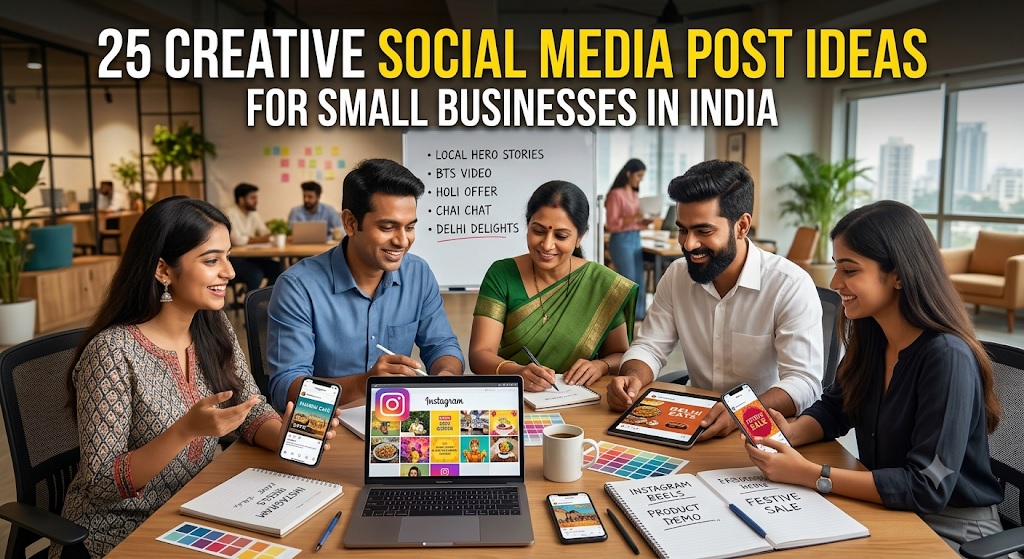
In this guide, we will explore 25 creative social media post ideas for small businesses in India, with practical examples that you can start using immediately.
Why Social Media Marketing Matters for Small Businesses in India
Your potential customers are already spending time on social media. They use Instagram to discover products, Facebook to find local services, YouTube to learn new things and WhatsApp to communicate with businesses.
This creates an opportunity for small businesses to connect with people without spending heavily on traditional advertising.
Here is what an active social media presence can help you achieve.
- Increase local visibility: Introduce your business to people in your city, neighbourhood or service area.
- Attract new customers: Help potential buyers discover your products and services.
- Build customer trust: Share genuine customer experiences, business stories and useful information.
- Generate enquiries: Encourage people to contact you through WhatsApp, phone calls or direct messages.
- Promote offers: Announce seasonal discounts, new arrivals, special packages and events.
- Build customer relationships: Stay connected with existing customers and encourage repeat purchases.
Remember, social media is not just about getting likes and followers. The real objective is to make more people aware of your business and give them a reason to choose you.
Before You Start: Understand What Makes a Good Social Media Post
You don’t need to post something extraordinary every day. You need content that catches attention, communicates a clear message and encourages people to take action.
Keep these basic principles in mind.
1. Know Your Target Customers
Think about the people most likely to buy from you.
For example:
- A playschool should create content for parents of young children.
- A restaurant should target food lovers and people living nearby.
- A coaching centre should focus on students and parents.
- A beauty salon should reach people interested in grooming and personal care.
- A boutique should appeal to people looking for clothing, fashion and styling ideas.
When you understand your audience, choosing relevant content becomes much easier.
2. Use Good Photographs and Videos
People notice visuals before they read the caption.
Use clear photographs of your products, shop, staff, services and customers. You can create attractive graphics and short videos using simple mobile editing and design tools.
Your content does not need to look expensive. It needs to look genuine, neat and professional.
3. Write Captions That Get Attention
Avoid long introductions and complicated language.
Start with something that makes people interested.
For example:
- Looking for a reliable home tutor in your area?
- Craving delicious street food this weekend?
- Need a fresh look for the festive season?
- Planning a memorable family holiday?
- Want to improve your child’s English skills?
Follow the opening line with useful information and a clear call to action.
4. Make It Easy for Customers to Contact You
Every promotional post should tell people what to do next.
Depending on your business, encourage them to:
- Send a WhatsApp message.
- Call to enquire.
- Visit your store.
- Book an appointment.
- Request a quotation.
- Place an order.
- Visit your business website.
Don’t assume that customers will search for your contact details themselves.
5. Be Consistent
Posting ten times in one day and disappearing for the next month is not a good strategy.
Start with three or four useful posts every week. Maintain a manageable schedule and focus on quality rather than posting just for the sake of it.
25 Creative Social Media Post Ideas for Small Businesses in India
Here are 25 practical ideas that businesses across different industries can use. You can adapt them for Instagram, Facebook, LinkedIn, YouTube Shorts and WhatsApp Business.
1. Introduce Your Business and Tell Your Story
Make people familiar with the business behind the products and services.
Many potential customers may have seen your business name but know very little about you.
Create an introduction post explaining who you are, what you offer and what makes your business different.
Share:
- When and why you started your business.
- What products or services you specialise in.
- Which areas or customers you serve.
- What makes your business worth choosing.
Example:
“Welcome to ABC Boutique! We bring you stylish ethnic wear, beautiful festive collections and everyday fashion at affordable prices. Visit us and discover something special for every occasion.”
This type of post gives your business a personality and helps people connect with you.
2. Showcase Your Best-Selling Products
Show customers what other people already love.
Choose your most popular products and give them individual attention.
Instead of uploading a photograph with just the product name and price, explain what makes it special.
For example:
- A bakery can showcase its most popular chocolate cake.
- A clothing store can feature its bestselling kurta collection.
- A restaurant can highlight its signature dish.
- A furniture shop can present its most popular sofa design.
Use attractive photographs, mention important features and include the price when appropriate.
Post idea: “Our customers’ favourite! Here’s why everyone loves our special chocolate truffle cake.”
3. Share Before-and-After Transformations
Show the difference your business can make.
Before-and-after posts are particularly effective for businesses where customers can see a visible result.
Ideas include:
- Beauty salons showing hair transformations.
- Interior designers displaying room makeovers.
- Car detailing businesses showing cleaned vehicles.
- Fitness centres sharing client progress with permission.
- Cleaning services showing restored spaces.
- Home renovation companies presenting completed projects.
Use genuine photographs and obtain customer permission before sharing personal images.
Post idea: “From an ordinary room to a beautiful living space! See what thoughtful design can do.”
4. Introduce Your Team
People like doing business with people they know and trust.
Introduce the people who make your business work.
Feature your employees, teachers, chefs, designers, technicians, trainers or customer support staff.
You can share their names, roles, experience and a little information about their work.
For example, a coaching centre can introduce its teachers, while a restaurant can introduce its head chef.
This helps customers understand the people behind your business and creates a more personal connection.
5. Share Customer Reviews and Testimonials
Let satisfied customers explain why your business is worth choosing.
Customer feedback can influence purchasing decisions, especially when people are comparing local businesses.
Turn genuine reviews into attractive social media posts.
You can share:
- A customer’s experience with your service.
- Feedback about a product.
- A positive restaurant review.
- A parent’s feedback about a coaching centre.
- A customer’s experience at your salon.
Use screenshots or designed testimonial graphics, with permission where required.
Post idea: “Don’t just take our word for it. Here’s what our customers have to say!”
Never create fake testimonials or misleading ratings. Authentic feedback builds lasting trust.
6. Create a Behind-the-Scenes Video
Give customers a look at what happens behind the scenes.
People are often interested in how products are made and how services are delivered.
Show them the actual work that goes into running your business.
Examples:
- A bakery preparing fresh cakes.
- A restaurant kitchen preparing popular dishes.
- A boutique selecting fabrics and stitching outfits.
- A printing shop working on an order.
- A florist arranging a bouquet.
- A furniture workshop creating a product.
Short, natural videos work well for this type of content.
You don’t need elaborate production. A smartphone and a few interesting clips are enough.
7. Announce New Arrivals and Launches
Give existing and potential customers a reason to check back.
Whenever you introduce something new, make it a social media event.
Announce:
- New clothing collections.
- New menu items.
- Newly launched products.
- Additional courses or classes.
- New beauty treatments.
- Recently introduced services.
Use a teaser post before the launch and a detailed announcement when the product or service becomes available.
Post idea: “Something new has arrived! Explore our latest festive collection, now available at our store.”
8. Share Useful Tips Related to Your Industry
Become a helpful source of information, not just another business trying to sell.
Educational posts are useful because people can learn something from them even when they are not ready to purchase.
Examples:
- A salon can share haircare tips.
- A restaurant can explain how to store food properly.
- A coaching centre can share examination preparation tips.
- A travel agency can offer packing advice.
- A fitness studio can share simple exercise guidance.
- An electronics store can explain how to maintain appliances.
Post idea: “5 Simple Ways to Keep Your Hair Healthy During the Summer.”
Useful content encourages people to follow your business and return for more information.
9. Create a Frequently Asked Questions Post
Answer customer questions before they even ask.
Think about the questions your customers regularly ask.
Create a post answering five to seven common questions.
For example, a coaching centre might answer:
- Which classes do you teach?
- Which subjects are available?
- Are online classes available?
- What are your batch timings?
- Do you provide trial classes?
A restaurant might answer questions about opening hours, delivery, parking and reservations.
You can also turn each question into a separate post or short video.
This saves time, improves customer communication and helps generate better enquiries.
10. Celebrate Indian Festivals and Special Occasions
Connect your business with occasions that matter to your customers.
India has a diverse calendar of festivals, celebrations and special occasions.
Use these opportunities to create relevant posts around:
- Diwali.
- Holi.
- Eid.
- Christmas.
- Navratri and Durga Puja.
- Raksha Bandhan.
- Pongal.
- Onam.
- Baisakhi.
- Independence Day.
- Republic Day.
- Teacher’s Day.
- Mother’s Day and Father’s Day.
Don’t restrict yourself to greeting graphics.
Create festival-related offers, gift suggestions, special menus, product collections and useful seasonal content.
For example, a bakery can promote Diwali gift hampers, while a boutique can showcase festive clothing.
Make sure your posts are respectful and relevant to your audience.
11. Run a Social Media Contest or Giveaway
Give people a reason to interact with your business.
A simple contest can encourage engagement and introduce your business to new people.
Ideas include:
- Guess the price of a product.
- Identify a dish from a close-up photograph.
- Answer a question related to your industry.
- Share a favourite product from your collection.
- Participate in a festive quiz.
You can offer a small prize, discount voucher, free consultation or complimentary service.
Keep the rules simple and transparent. Mention eligibility, deadlines and how winners will be selected.
Also, follow the promotional rules of the social media platform you use.
12. Show How Your Product or Service Works
Help customers understand exactly what they are buying.
Sometimes people are interested in a product but are unsure how it works or how it will benefit them.
Create demonstration videos that show your product or service in action.
Examples:
- A kitchen store demonstrating a useful appliance.
- A beauty salon explaining a treatment.
- A gym demonstrating correct exercise techniques.
- A software company showing how its product works.
- A furniture store demonstrating storage features.
- A travel agency explaining a holiday package.
A good demonstration answers customer doubts and makes purchasing decisions easier.
13. Share Price Lists and Special Offers
Make it easy for customers to understand your pricing.
Many people avoid contacting businesses when they cannot find basic price information.
Share clear pricing wherever possible.
You can create posts featuring:
- Restaurant combo offers.
- Salon service packages.
- Coaching class fees.
- Seasonal discounts.
- Product price ranges.
- Membership packages.
- Festival promotions.
Mention what is included, the offer’s validity and any important conditions.
Avoid misleading “starting at” prices that do not reflect what customers will actually pay.
14. Create a Local Area or Neighbourhood Post
Make your business visible to people who can actually visit or use your services.
Local businesses should regularly create content that connects with their neighbourhood.
For example:
- “Looking for the best cakes for a birthday celebration in Rohini?”
- “Need a reliable AC repair service in South Delhi?”
- “Searching for quality home tuition in Noida?”
- “Planning a family dinner in Karol Bagh?”
Mention your locality, city and service area naturally in the post.
You can also share photographs of your shop, nearby landmarks, local events and community activities.
This makes your content more relevant to nearby customers.
15. Share a Customer Success Story
Show the real results your business helps customers achieve.
Customer stories are different from ordinary testimonials. They explain a problem, the solution and the outcome.
Examples:
- A student improves academic performance after joining a coaching centre.
- A customer finds the right outfit for a special occasion.
- A business owner gets a customised website.
- A client completes a home renovation project.
- A customer enjoys a memorable travel experience.
With customer permission, explain the journey and highlight the value your business provided.
Avoid promising that every customer will achieve the same result.
16. Post a Product Comparison
Help customers make informed buying decisions.
People often compare products before making a purchase.
Create simple comparison posts explaining the differences between two or more products or services.
Examples:
- Different types of air conditioners.
- Cotton versus linen clothing.
- Regular versus premium salon packages.
- Different cake flavours and sizes.
- Online versus classroom coaching.
- Different travel packages.
Use simple language and explain which option is suitable for different needs.
This positions your business as a helpful advisor rather than just a seller.
17. Create a Myth-Busting Post
Correct common misunderstandings about your industry.
Almost every industry has myths that confuse customers.
Turn these into interesting educational posts.
Examples:
- “Myth: Expensive skincare products always work better.”
- “Myth: Children can learn English only by speaking it at school.”
- “Myth: All modular kitchens are expensive.”
- “Myth: You need a gym membership to start exercising.”
- “Myth: Freshly baked cakes cannot be customised.”
Explain the truth in a simple and informative way.
This type of content can attract attention while demonstrating your knowledge.
18. Share a Day-in-the-Life Post
Give people a glimpse of your everyday business activities.
Create a short video or photo series showing what a typical working day looks like.
A restaurant owner could show the morning preparation, fresh ingredients arriving and the kitchen getting ready for lunch.
A boutique owner could show fabric selection, customer appointments and new designs.
A tutor could share lesson preparation and classroom activities.
Keep it natural. You don’t need to show every activity or make your business look perfect.
Authentic content makes your brand more relatable.
19. Ask Customers a Question
Turn your social media page into a two-way conversation.
Instead of always telling people what to buy, ask them what they like, need or prefer.
Examples:
- Which flavour would you choose: chocolate or red velvet?
- What is your favourite Indian breakfast?
- Which colour should we introduce in our next collection?
- What subject does your child find most challenging?
- Where would you love to travel this holiday season?
Use Instagram Stories, Facebook posts and other interactive formats to collect responses.
You can use customer feedback to plan products, services and future content.
20. Share Seasonal Products and Services
Promote what customers need at different times of the year.
Indian businesses have many opportunities to create seasonal content.
Plan your posts around changing customer needs.
| Season or occasion | Content ideas |
|---|---|
| Summer | Cool drinks, summer clothing, AC servicing, holiday packages |
| Monsoon | Waterproof products, rainwear, pest control, indoor activities |
| Festive season | Gift hampers, ethnic wear, sweets, decorations |
| Wedding season | Bridal services, photography, catering, clothing |
| Winter | Warm clothing, heaters, winter menus, skincare |
| School reopening | Stationery, uniforms, school supplies, tuition classes |
Plan seasonal campaigns in advance instead of waiting until the occasion arrives.
21. Introduce a Special Employee Skill or Expertise
Show customers the knowledge and experience available within your business.
Your team may have skills that customers don’t know about.
Highlight them through short videos, photographs or informative posts.
Examples:
- A chef explaining a special cooking technique.
- A teacher sharing an examination preparation tip.
- A hairstylist explaining how to choose a suitable haircut.
- A mechanic explaining basic vehicle maintenance.
- A designer discussing the latest fashion trends.
These posts help establish credibility and show customers why your business has the right expertise.
22. Create a Limited-Time Offer
Give customers a reason to take action now.
A well-planned limited-time offer can encourage people who are already interested in your products or services to make a decision.
Ideas include:
- Weekend restaurant discounts.
- Festival shopping offers.
- Limited-period salon packages.
- Early-bird coaching registrations.
- Special birthday packages.
- Discounts on selected products.
Clearly mention the offer, expiry date and conditions.
Use genuine deadlines. Avoid repeatedly advertising fake countdowns or discounts that never end.
23. Share User-Generated Content
Let your customers become part of your brand story.
User-generated content is material created by customers who use or purchase your products and services.
With their permission, share:
- Customer photographs wearing your products.
- Pictures of birthday cakes ordered from your bakery.
- Customers enjoying meals at your restaurant.
- Students participating in your events.
- Photographs of completed home interiors.
- Customer videos featuring your products.
This gives your social media page a more authentic feel and encourages other customers to share their experiences.
Always credit the creator when appropriate and obtain permission before reposting.
24. Announce Business Milestones and Achievements
Give customers a reason to celebrate your journey.
People enjoy seeing businesses grow.
Share important milestones such as:
- Completing one year in business.
- Serving your 1,000th customer.
- Opening a new branch.
- Launching a new product range.
- Receiving an industry award.
- Expanding your service area.
- Completing a major project.
Thank your customers and employees for being part of your journey.
A milestone post can strengthen customer relationships and create positive brand recognition.
25. Create a Strong Call-to-Action Post
Turn attention into actual business enquiries.
Not every customer will contact you after seeing a product photograph or informative post.
Sometimes you need to clearly invite them to take the next step.
Create dedicated posts that tell customers exactly how to enquire, book or purchase.
For a restaurant:
“Planning a family dinner this weekend? Explore our menu, reserve your table and enjoy a delicious meal with your loved ones.”
For a coaching centre:
“Admissions are open! Contact us to know more about our courses, batch timings and upcoming sessions.”
For a boutique:
“Looking for the perfect outfit for your next celebration? Visit our store and explore our latest collection.”
For a service business:
“Need professional assistance? Contact our team today for service details and a quotation.”
Keep the contact process simple. The fewer steps customers need to take, the easier it becomes for them to enquire.
Social Media Content Ideas for Different Types of Small Businesses
The 25 ideas above work across many industries. However, every business has different customers, products and marketing requirements.
Here is a quick reference showing what different Indian businesses can post.
| Business type | Social media post ideas |
|---|---|
| Restaurants and cafes | Food photographs, chef videos, customer reviews, menu highlights and offers |
| Coaching centres | Teacher introductions, student achievements, study tips, course details and admission announcements |
| Playschools | Classroom activities, learning games, teacher introductions, celebrations and parent feedback |
| Beauty salons | Before-and-after results, beauty tips, service demonstrations and packages |
| Clothing boutiques | New collections, styling tips, festive looks, customer photographs and fashion videos |
| Bakeries | Cake designs, baking videos, bestsellers, customer celebrations and seasonal hampers |
| Fitness centres | Exercise demonstrations, trainer introductions, fitness tips and member stories |
| Diagnostic centres | Health awareness information, facility introductions, available services and appointment details |
| Travel agencies | Destination highlights, travel itineraries, holiday packages and travel tips |
| Retail shops | Product demonstrations, new arrivals, comparisons, discounts and customer favourites |
| Furniture stores | Room makeovers, furniture demonstrations, design ideas and product comparisons |
| Home service providers | Work demonstrations, customer reviews, service explanations and completed projects |
The key is to choose ideas that are relevant to your products, services and target customers. You don’t have to use every idea.
How to Create Social Media Posts Without Hiring a Designer
One of the biggest challenges for small business owners is creating attractive content regularly.
Hiring a professional designer for every post may not fit your budget. Fortunately, you can create decent social media content using simple tools.
1. Use Canva for Social Media Designs
Canva offers ready-made templates for Instagram posts, Facebook graphics, promotional banners, presentations and other marketing materials.
You can customise templates using your business name, logo, colours, photographs and promotional messages.
Choose a consistent design style so that people can recognise your business posts.
2. Use Your Smartphone for Photography
You don’t need an expensive camera.
Follow these basic photography tips:
- Clean your phone camera lens.
- Use natural light wherever possible.
- Keep the background neat.
- Avoid unnecessary objects in the frame.
- Take photographs from different angles.
- Focus on the product or service.
- Avoid excessive filters and editing.
For food, clothing, jewellery and other visual products, good photographs can make a significant difference.
3. Create Short Videos Using Mobile Editing Apps
Short videos are useful for demonstrating products, introducing staff and showing behind-the-scenes activities.
Keep videos focused on one topic.
For example, a 20-second video showing how a bakery decorates a cake may be more interesting than a long video explaining the entire baking process.
Add subtitles because many people watch videos without sound.
4. Use AI Tools for Content Ideas
AI tools can help you brainstorm post ideas, write captions, prepare promotional messages and plan content calendars.
For example, you can ask an AI tool:
“Give me 10 Instagram post ideas for a small bakery in Delhi targeting local customers.”
You can also ask it to create captions for a new product, suggest festival promotions or rewrite a promotional message.
However, always check the content before publishing. Add your actual business details, correct prices, genuine offers and relevant local information.
Instagram, Facebook, WhatsApp and LinkedIn: Where Should Your Business Post?
You don’t need to be equally active on every social media platform.
Choose platforms based on the type of business you run and where your customers spend their time.
Instagram is particularly useful for businesses that depend on photographs and videos.
Suitable businesses include:
- Restaurants and cafes.
- Fashion boutiques.
- Beauty salons.
- Bakeries.
- Fitness studios.
- Travel agencies.
- Home decor businesses.
Use Reels, Stories, photographs, carousels and customer-generated content.
Facebook can help local businesses reach neighbourhood audiences and participate in relevant community groups.
It is useful for:
- Local shops.
- Restaurants.
- Coaching centres.
- Playschools.
- Home service providers.
- Community-based businesses.
Share business updates, customer reviews, offers, events and useful information.
WhatsApp Business
WhatsApp is particularly valuable for direct communication and customer enquiries.
You can use it to:
- Create a business profile.
- Display products and services through a catalogue.
- Share new arrivals and offers through Status.
- Answer customer questions.
- Send order updates.
- Communicate with customers who have opted in to receive messages.
Make it easy for people to start a conversation with your business.
Avoid sending unwanted bulk promotional messages.
LinkedIn is especially useful for professional services, consultants, training institutes, B2B businesses and business owners.
You can share:
- Industry insights.
- Professional achievements.
- Business case studies.
- Customer success stories.
- Useful business tips.
- Company updates.
- Educational articles.
Focus on building professional credibility rather than posting only promotional offers.
How Often Should a Small Business Post on Social Media?
You don’t need to post every day to maintain an effective social media presence.
Start with a realistic schedule that you can follow consistently.
Here is a simple weekly content plan.
| Day | Content type | Example |
|---|---|---|
| Monday | Educational post | 5 useful tips related to your industry |
| Tuesday | Product or service | Showcase a bestseller |
| Wednesday | Customer engagement | Ask a question or run a poll |
| Thursday | Behind the scenes | Show your team at work |
| Friday | Promotional post | Announce a special offer |
| Saturday | Customer trust | Share a genuine review |
| Sunday | Business personality | Share a story, milestone or weekly highlight |
You can adjust this schedule according to your business.
If you are a solo business owner, three well-planned posts per week are a good starting point.
The important thing is to maintain a balance between promotional and informative content.
The 70-20-10 Social Media Content Rule
One simple way to avoid making your social media page look like an advertising board is to divide your content into three categories.
70% Helpful and Engaging Content
Share information that your audience will find useful or interesting.
Examples include tips, educational posts, FAQs, industry information, behind-the-scenes videos and interactive questions.
20% Community and Customer Content
Show your customers, team, business journey and local involvement.
Share testimonials, customer experiences, achievements and community activities.
10% Direct Promotional Content
Promote products, services, discounts, special offers and new launches.
This is a suggested content mix, not a strict formula. You can adjust it depending on your industry and business goals.
The main idea is simple: give people reasons to follow your business beyond your sales messages.
How to Write Social Media Captions That Attract Customers
A good photograph may catch attention, but the caption helps communicate your message.
Use this simple structure when writing social media captions.
1. Start With an Attention-Grabbing Opening
Your first line should make people interested in reading further.
Examples:
- Looking for affordable home tuition in Delhi?
- Make your weekends more delicious!
- Searching for the perfect festive outfit?
- Need reliable home cleaning services?
- Give your child a stronger start in Mathematics!
2. Explain the Benefit
Tell people how your product or service can help them.
Avoid simply listing features. Explain why those features matter.
For example, instead of writing “We offer online Mathematics classes”, write “Help your child understand difficult Maths concepts through personalised online tuition.”
3. Add Relevant Business Information
Include details that help customers make a decision.
Depending on your business, these may include:
- Product or service name.
- Price or price range.
- Location.
- Availability.
- Special features.
- Timings.
- Booking information.
4. End With a Clear Call to Action
Tell customers what they should do next.
Examples:
- WhatsApp us for details.
- Call today to book your appointment.
- Visit our store this weekend.
- Message us to explore the collection.
- Contact us for a free consultation.
5. Use Relevant Hashtags
Hashtags can help organise and categorise your content.
Use a small selection of relevant hashtags rather than adding dozens of unrelated ones.
For a local business, consider a combination of:
- Business category hashtags.
- Product or service hashtags.
- City and locality hashtags.
- Relevant industry hashtags.
For example, a bakery in Noida might use hashtags related to baking, cakes, birthday cakes and Noida.
Avoid stuffing captions with hashtags that have nothing to do with your business.
How to Get More Local Customers Through Social Media
Getting likes and followers is useful, but your main objective should be attracting customers who can actually buy from you.
Here are some practical ways to make your social media marketing more local.
Mention Your City and Locality
Use your location naturally in captions and content.
For example:
“Looking for a reliable beauty salon in Rohini, Delhi? Visit us for professional hair and beauty services.”
This makes it clear where your business operates.
Use Location Tags
Where supported, add your business location to posts and Stories.
This can help people discover content associated with a particular area.
Join Relevant Local Communities
Participate in neighbourhood groups and local online communities where business promotion is permitted.
Answer questions, share useful information and contribute meaningfully.
Avoid posting repetitive advertisements.
Collaborate With Other Local Businesses
Find businesses that serve a similar audience without directly competing with you.
Examples:
- A bakery can collaborate with a party planner.
- A boutique can work with a local jewellery store.
- A fitness studio can collaborate with a nutrition professional.
- A playschool can connect with children’s activity centres.
- A travel agency can collaborate with a local photography business.
You can create joint offers, short videos, contests or informative posts.
Keep Your Google Business Profile Updated
Your social media presence should work alongside your Google Business Profile.
Make sure your business name, address, phone number, opening hours, photographs and services are accurate.
Encourage genuine customers to leave reviews.
This helps people who discover your business through social media verify your details when they search for you on Google.
How to Turn Social Media Followers Into Paying Customers
A common mistake among small business owners is focusing entirely on increasing followers.
A page with 10,000 followers is not necessarily more profitable than a page with 500 followers.
What matters is whether your content attracts the right audience and generates enquiries.
Follow these steps to improve your chances of converting social media attention into business.
Make Your Business Profile Complete
Your social media bio should clearly explain:
- What your business offers.
- Where you are located.
- Who your products or services are for.
- How customers can contact you.
Use a recognisable business logo or profile photograph.
Display Your Products and Services Clearly
Customers should not have to search through dozens of posts to understand what you sell.
Create dedicated posts for your main products and services.
If possible, organise your Instagram Highlights around categories such as Products, Services, Reviews, Offers and Contact.
Respond to Enquiries Quickly
When someone sends a message, asks about a price or comments on your post, respond politely and promptly.
A delayed response may cause a potential customer to contact a competitor.
Make Your Contact Details Easy to Find
Provide clear contact options wherever possible.
Use your phone number, WhatsApp Business profile, website and business listing details consistently.
Build Trust Before Asking for a Sale
Share genuine reviews, customer experiences, completed projects and useful information.
Customers are more comfortable contacting a business when they can see evidence of its work and reliability.
Common Social Media Marketing Mistakes Small Businesses Should Avoid
Even businesses that post regularly may struggle to generate results because of a few common mistakes.
1. Posting Only Advertisements
If every post says “Buy Now”, “Order Today” or “Get 20% Off”, people may lose interest.
Mix promotional posts with educational and engaging content.
2. Ignoring Comments and Messages
Social media is a communication channel, not just a publishing platform.
Reply to questions and acknowledge customer feedback.
3. Using Poor-Quality Photographs
Dark, blurry and poorly framed photographs can make even good products look unattractive.
Take a little time to improve your visuals.
4. Copying Competitors
You can learn from other businesses, but don’t copy their content.
Share your own products, experiences, expertise and customer stories.
Your genuine business identity is your biggest advantage.
5. Ignoring Local Customers
A local business should not focus only on reaching people across the country.
Use location-specific content to attract people who can visit your store or use your services.
6. Buying Fake Followers and Engagement
Fake followers may increase numbers but rarely generate genuine enquiries or sales.
Focus on building an audience that is actually interested in your business.
7. Giving Up Too Soon
Social media marketing takes time.
Don’t judge your entire strategy based on a handful of posts.
Study what works, improve your content and maintain consistency.
How to Measure Whether Your Social Media Posts Are Working
You should regularly check whether your content is helping your business grow.
Don’t focus only on likes.
Track these important measurements.
| Metric | What it tells you |
|---|---|
| Reach | How many unique people saw your content |
| Impressions | How many times your content was displayed |
| Engagement | Likes, comments, shares and other interactions |
| Profile visits | How many people visited your business profile |
| Website clicks | How many people visited your website |
| WhatsApp enquiries | How many people contacted you through WhatsApp |
| Phone calls | How many people called your business |
| Leads | How many genuine potential customers contacted you |
| Sales | How much business your social media activity generated |
Check these numbers regularly.
For example, if a particular type of post generates more WhatsApp enquiries than ordinary product photographs, create more content around that topic.
You can also ask new customers how they discovered your business. This gives you a better understanding of which marketing activities are bringing results.
A Simple 30-Day Social Media Marketing Plan for Small Businesses
If you are unsure where to begin, use this simple 30-day plan.
It combines different content formats so that your page does not look repetitive.
| Week | Post 1 | Post 2 | Post 3 |
|---|---|---|---|
| Week 1 | Introduce your business | Showcase a bestseller | Share a useful industry tip |
| Week 2 | Introduce your team | Share a customer review | Create a product demonstration |
| Week 3 | Answer common questions | Share behind-the-scenes content | Announce an offer |
| Week 4 | Share a customer story | Run a poll or contest | Create a strong enquiry post |
You can also use Stories to share daily updates, new arrivals, customer feedback, business activities and reminders.
At the end of 30 days, review your results.
Identify the posts that generated the most engagement, profile visits and customer enquiries.
Use those insights to plan the following month’s content.
Frequently Asked Questions About Social Media Marketing for Small Businesses
1. What should a small business post on social media?
A small business should post a combination of product photographs, service demonstrations, customer reviews, educational tips, behind-the-scenes videos, business updates, special offers and local content.
The best posts are those that interest your target customers and encourage them to learn more about your business.
2. How many times should a small business post on Instagram?
Start with three or four quality posts per week. You can also share Stories regularly to keep your audience updated.
Consistency matters more than posting multiple times every day.
3. Which social media platform is best for small businesses in India?
Instagram and Facebook are useful for many consumer-facing local businesses. WhatsApp Business is valuable for direct communication and enquiries. LinkedIn is particularly useful for professional services and B2B companies.
Choose platforms based on your customers and business category.
4. How can I promote my small business on social media for free?
You can promote your business organically by sharing useful content, posting product photographs, creating short videos, interacting with customers, participating in relevant local communities and encouraging customers to share genuine experiences.
You can also collaborate with complementary local businesses.
5. What type of social media content attracts the most customers?
There is no single content format that works for every business.
However, product demonstrations, customer testimonials, before-and-after transformations, useful tips, local offers and short videos can be effective when they address real customer interests.
Test different formats to find what works for your audience.
6. How can I get more followers for my local business?
Share relevant content consistently, use appropriate local hashtags, interact with your audience, collaborate with other businesses and encourage satisfied customers to follow your page.
Focus on attracting genuine followers who may become customers.
7. Do small businesses need to spend money on social media advertising?
No. You can begin with organic social media marketing without paying for advertisements.
However, once you understand which posts attract the right audience, paid advertising can help expand your reach and generate more enquiries.
Start with a manageable budget and track the results.
8. Can I use the same post on Instagram and Facebook?
Yes. You can reuse relevant content across platforms, but adjust the caption, format and presentation when necessary.
For example, an Instagram Reel can also be shared on Facebook. A detailed business update may work better as a Facebook post or LinkedIn update.
9. How can a local business get customers from Instagram?
Use a complete business profile, publish attractive product and service content, mention your location, use relevant local hashtags, share customer reviews and make it easy for people to contact you.
Include clear calls to action in your posts.
10. What is the easiest way to plan social media content?
Create a monthly content calendar.
Select different categories such as educational posts, product showcases, customer stories, local content and promotional offers.
Plan three or four posts per week and prepare captions and photographs in advance.
Make Social Media Work for Your Small Business
Promoting your business on social media does not have to be complicated or expensive.
You don’t need to create viral videos, post every day or spend thousands of rupees on professional marketing.
Start with simple ideas. Introduce your business, showcase your products, share useful tips, highlight customer experiences and communicate regularly with your audience.
Most importantly, remember that social media marketing is about building relationships, not just collecting followers.
Give people useful information, show them what makes your business special and make it easy for them to contact you.
And don’t restrict your online promotion to social media alone.
Create a complete online presence for your business. Keep your Google Business Profile updated, maintain a professional website if possible, collect genuine customer reviews and ensure that your business information is available across relevant online platforms.
You can also use HotList.in to showcase your business, promote your products and services, improve online visibility and give potential customers another way to discover and contact you.
Your next customer could be scrolling through social media right now. Give them a reason to stop, notice your business and get in touch.
Related Posts
A Beginner’s Guide to Google Ads, Facebook & Instagram Ads
How to Promote Your Local Business on Quora, Reddit & Facebook Groups
25 YouTube Video Ideas for Local Businesses in India to Attract More Customers