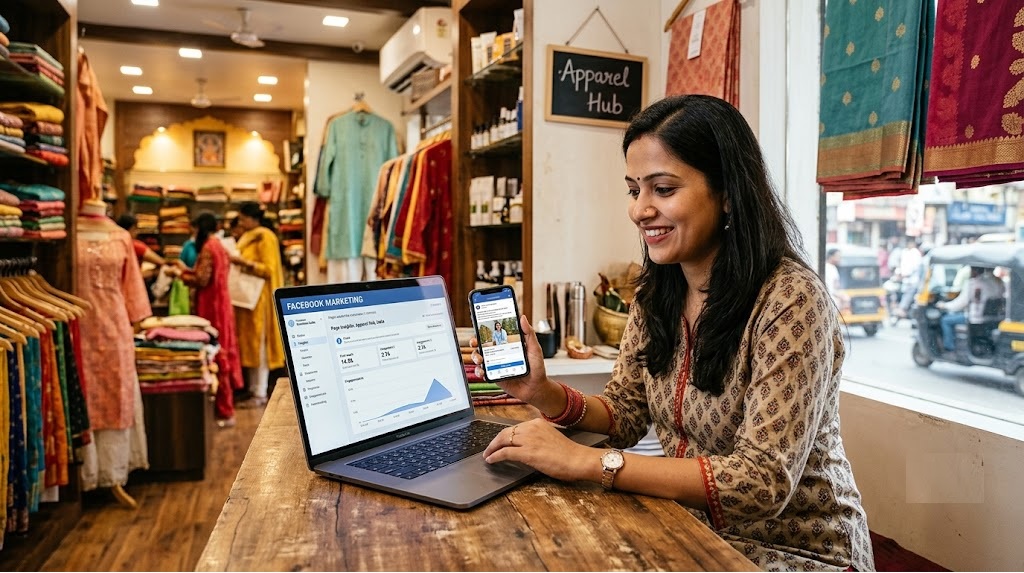
Facebook Marketing for Small Businesses in India

Facebook Marketing for Small Businesses in India

Running a small business in India is challenging. You may have excellent products, quality services and happy customers, but how do you make more people aware of your business?

Your potential customers are already spending time on Facebook. They browse local business pages, watch videos, look for recommendations, read customer reviews, discover new products and interact with businesses in their neighbourhood.

This creates a valuable opportunity for small business owners.

Facebook marketing allows local businesses to reach potential customers, showcase their products and services, build trust and generate enquiries without spending a fortune on advertising.

Whether you run a restaurant, coaching centre, beauty salon, retail shop, playschool, fitness centre, travel agency or home-based business, Facebook can help you attract more customers.

The best part? You can start with a free Facebook Business Page and grow your marketing efforts as your business develops.

This guide explains how to use Facebook marketing effectively, with practical strategies, content ideas, advertising tips and examples that Indian business owners can implement without needing a professional marketing team.

1. What Is Facebook Marketing?

Facebook marketing is the process of promoting your business, products or services through Facebook to connect with potential customers.

It involves creating and managing a Facebook Business Page, publishing useful content, sharing product photographs and videos, interacting with customers, joining relevant communities and running paid advertisements.

For example:

  • A restaurant in Delhi can share its menu, food photographs, special offers and customer feedback.
  • A coaching centre in Jaipur can publish information about courses, admission dates, faculty and student achievements.
  • A beauty salon in Mumbai can showcase its services, latest hairstyles, bridal makeup and special packages.
  • A playschool in Bengaluru can share classroom activities, learning programmes and information for parents.
  • A local clothing shop in Lucknow can display new arrivals, seasonal collections and festival offers.

The objective is simple: make your business visible to the right people and give them a reason to contact you.

Facebook Marketing vs Facebook Advertising

These two terms are often used interchangeably, but they are not the same.

Facebook marketing includes all your promotional activities on the platform, including free posts, videos, customer interactions, community participation and paid campaigns.

Facebook advertising involves paying Meta to display your advertisements to selected audiences.

You can use Facebook marketing without spending money on advertisements. However, paid advertising can help you reach more people and generate enquiries faster when campaigns are properly planned.

2. Why Should Small Businesses in India Use Facebook Marketing?

Facebook remains a useful marketing channel for businesses that want to reach local audiences, build customer relationships and promote their products or services.

Here are some important benefits.

2.1 Promote Your Business Without a Large Budget

Traditional advertising through newspapers, magazines, banners and local publications can become expensive.

Facebook offers a more affordable starting point.

You can create a Business Page, publish posts, share photographs, announce offers and communicate with potential customers without paying for every activity.

Even a small business with a limited marketing budget can establish an online presence.

2.2 Reach Customers in Your Local Area

One of the biggest advantages of Facebook is the ability to connect with people based on their location and interests.

A business does not necessarily need customers from across India. It may simply need more customers from nearby residential areas, neighbourhoods or commercial markets.

For example:

  • A dentist in Karol Bagh can target people looking for dental services in and around the area.
  • A tuition centre in Noida can reach parents living in nearby sectors.
  • A restaurant in Pune can promote its food and offers to people in surrounding localities.
  • A boutique in South Delhi can showcase its collections to potential customers nearby.

Local marketing helps businesses focus their efforts on people who are more likely to visit or purchase from them.

2.3 Showcase Your Products and Services

Customers often want to see what a business offers before making a purchase.

Facebook gives you an opportunity to showcase your products, services, facilities, staff, work samples and customer experiences.

A clothing store can display its latest collection. A restaurant can share food photographs. A salon can showcase its work. A coaching institute can introduce its teachers.

Good photographs and informative videos can help customers understand your offerings before contacting you.

2.4 Build Trust and Credibility

People are more comfortable contacting businesses when they can find useful information about them online.

An active Facebook Page with genuine photographs, regular updates, customer feedback and clear contact details creates a better impression than an incomplete or inactive page.

Responding to questions and addressing customer concerns also shows that your business is approachable and attentive.

2.5 Generate Direct Customer Enquiries

Facebook can help potential customers contact your business through Messenger, WhatsApp or other available contact options.

For example, someone interested in a coaching course can ask about fees and batches. A customer looking for a birthday cake can enquire about designs and prices.

These conversations can turn into genuine business opportunities.

2.6 Stay Connected With Existing Customers

Marketing is not only about finding new customers.

Facebook also helps you stay connected with people who have already purchased from you.

You can inform them about new products, upcoming events, seasonal offers, service updates and special promotions.

Regular communication can encourage repeat purchases and referrals.

3. How to Set Up a Facebook Business Page

Before you start promoting your business, create a professional Facebook Business Page.

A Business Page is different from a personal Facebook profile. It is designed for businesses, organisations, brands and public figures.

You can create one through Facebook and manage it using the available business management tools.

Follow these steps.

Step 1: Create Your Business Page

Log in to Facebook and look for the option to create a new Page.

Enter your business name and select the category that best describes your business.

Examples include:

  • Restaurant
  • Education
  • Beauty, cosmetic and personal care
  • Shopping and retail
  • Health and wellness
  • Travel agency
  • Professional services
  • Local service

Choose the most relevant category so that visitors can quickly understand what your business does.

Step 2: Add a Professional Profile Picture

Your profile picture should help people recognise your business.

For most businesses, the logo is the best choice.

Use a clear, high-quality image that remains recognisable even when displayed in a small circular format.

Avoid using complicated designs or photographs containing too much text.

Step 3: Add an Attractive Cover Photo

Your cover photo is one of the first things visitors notice.

Use it to communicate what your business offers.

Examples:

  • A restaurant can display its signature dishes.
  • A salon can showcase its beauty services.
  • A coaching centre can feature its classrooms and faculty.
  • A retail shop can display its latest products.

You can also include a short tagline, important service information or your location.

Make sure the design looks good on both desktop and mobile screens.

Step 4: Write a Clear Business Description

Your description should explain what your business does, where it operates and why customers should choose you.

Include relevant keywords naturally.

For example:

“Looking for quality home tuition in Noida? We provide experienced tutors for school students, covering all major subjects and educational boards. Contact us to learn more about our tuition programmes.”

A useful description should answer three questions:

  • What products or services do you offer?
  • Where is your business located?
  • How can customers contact you?

Step 5: Add Complete Business Information

An incomplete Facebook Page can make potential customers hesitate.

Add all relevant details:

  • Business name
  • Full business address
  • Phone number
  • WhatsApp contact
  • Website URL
  • Business hours
  • Email address
  • Products and services
  • Location or service areas

If customers visit your physical establishment, make sure your address and map information are accurate.

Step 6: Add a WhatsApp or Contact Button

Make it easy for customers to contact you.

Depending on the options available to your Page, add an appropriate action button such as WhatsApp, Call Now, Send Message or Contact Us.

A customer should not have to search through multiple posts to find your contact information.

Step 7: Publish Your First Few Posts

Do not leave your Page empty after creating it.

Before inviting customers to follow you, publish some useful introductory content.

Start with:

  1. An introduction to your business.
  2. Your main products or services.
  3. Photographs of your products, premises or work.
  4. Your location and contact information.
  5. A special offer or an introductory announcement.

This gives new visitors enough information to understand your business.

4. How to Promote Your Business on Facebook for Free

You do not need to run advertisements immediately.

There are several ways to promote your business organically and gradually build an audience.

4.1 Post Regularly on Your Facebook Page

Consistency matters.

An inactive Page does little to remind people that your business exists.

Create a simple posting schedule that you can maintain.

For a small business, start with three to five useful posts every week, depending on the amount of content you can create.

Your posts should not always be advertisements.

Share information that helps customers understand your products, services and expertise.

For example, a restaurant can share recipes, food preparation videos, menu updates and customer favourites.

A coaching centre can publish study tips, subject explanations, exam updates and information about new batches.

4.2 Use High-Quality Photographs

Photographs are among the easiest ways to showcase a local business.

You do not need an expensive camera or professional photography equipment.

A modern smartphone can produce good results if you pay attention to lighting, background and presentation.

Some practical ideas:

  • Photograph your actual products.
  • Show your workplace or business premises.
  • Display different product varieties.
  • Share before-and-after results where appropriate.
  • Introduce your team.
  • Show how your products are prepared or services are delivered.

Use genuine photographs rather than relying entirely on generic stock images.

Customers want to see the real business they may be purchasing from.

4.3 Create Facebook Reels

Short videos are an excellent way to introduce your business to people who may not already follow your Page.

Facebook Reels can help you demonstrate products, explain services and show what makes your business different.

Ideas for different businesses:

Business type Reel ideas
Restaurant Food preparation, popular dishes and kitchen highlights
Boutique New arrivals, styling tips and outfit combinations
Beauty salon Hair transformations and beauty tips
Coaching centre Teacher introductions and quick lessons
Fitness centre Exercise demonstrations and workout tips
Bakery Cake decoration and baking processes
Playschool Learning activities and classroom moments
Travel agency Destination highlights and travel tips

Keep videos focused on one topic.

Start with something interesting in the first few seconds. Add clear text where useful and finish with a simple action such as asking viewers to contact your business.

4.4 Share Customer Testimonials

Genuine customer feedback can influence purchasing decisions.

Ask satisfied customers whether they would be comfortable sharing their experience.

You can publish testimonials as text posts, photographs or short videos, with their permission.

For example:

“Thank you for choosing us for your special occasion. We are delighted that you enjoyed our service!”

Avoid inventing reviews or presenting paid endorsements as independent customer experiences.

Authenticity is more valuable than exaggerated promotional claims.

4.5 Share Festival and Seasonal Offers

Indian customers respond well to relevant seasonal promotions.

Use important festivals, holidays and local events as opportunities to introduce special products and offers.

Some examples include:

  • Diwali gift collections
  • Holi special offers
  • Raksha Bandhan gift packages
  • Wedding season collections
  • Summer vacation programmes
  • Back-to-school offers
  • Christmas bakery specials
  • New Year fitness memberships

Plan these promotions in advance instead of publishing them at the last minute.

4.6 Join Relevant Facebook Groups

Facebook Groups can help local businesses connect with people in specific neighbourhoods, cities and interest communities.

Look for groups related to:

  • Your city or locality
  • Local residents
  • Parents and families
  • Food and restaurants
  • Shopping and fashion
  • Education and tuition
  • Local recommendations
  • Community events

However, do not join groups simply to publish advertisements repeatedly.

Read the group rules first. Some groups do not allow commercial promotions.

Participate in discussions, answer relevant questions and share useful information.

When promotional posts are permitted, make them informative and relevant to the group.

4.7 Use Facebook Stories

Stories are useful for sharing quick updates that do not necessarily need to remain permanently on your Page.

You can use them for:

  • Daily offers
  • New product arrivals
  • Behind-the-scenes photographs
  • Business updates
  • Limited-time promotions
  • Customer feedback
  • Event announcements

Stories help keep your business visible to people who already follow your Page.

4.8 Invite Existing Customers to Follow Your Page

Your existing customers can become your first Facebook audience.

Invite friends, customers, employees, suppliers and business associates to follow your Page.

Add your Facebook Page link to your website, email signature, visiting cards, invoices and WhatsApp Business profile.

You can also display a QR code that takes customers directly to your Facebook Page.

The objective is to bring people who already know your business into your online community.

5. Facebook Content Ideas for Different Small Businesses in India

One of the biggest challenges for small business owners is deciding what to post.

If every post simply says “Buy Now” or “Contact Us”, people may lose interest.

A better strategy is to mix promotional posts with educational, informative, entertaining and trust-building content.

Here are practical content ideas for different business categories.

5.1 Restaurants, Cafés and Food Businesses

Food businesses have plenty of opportunities to create attractive Facebook content.

Post ideas:

  • Your most popular dishes.
  • Daily specials and new menu items.
  • Food preparation videos.
  • Customer favourites.
  • Kitchen and restaurant photographs.
  • Special family dining packages.
  • Festival menus and seasonal dishes.
  • Customer testimonials.
  • Restaurant location and parking information.

A simple video showing how your signature dish is prepared can be more engaging than a long advertisement.

5.2 Coaching Centres and Tuition Classes

Parents often look for educational information before selecting a coaching centre or tutor.

Useful Facebook content includes:

  • Faculty introductions.
  • Course details and admission announcements.
  • Subject-specific learning tips.
  • Exam preparation strategies.
  • Student achievements, with permission.
  • Classroom photographs.
  • Demo class announcements.
  • Information about online and offline classes.

Focus on demonstrating the quality of your teaching rather than repeatedly asking parents to enrol.

5.3 Beauty Parlours and Salons

Beauty and wellness businesses can use visual content to showcase their work.

Ideas include:

  • Latest hairstyles.
  • Makeup transformations.
  • Bridal makeup packages.
  • Skincare tips.
  • Seasonal beauty offers.
  • New treatments and services.
  • Salon interiors.
  • Customer experiences.

Always obtain permission before publishing identifiable customer photographs.

5.4 Retail Shops and Designer Boutiques

Retail businesses should use Facebook to introduce products and encourage customers to visit or enquire.

Share:

  • New arrivals.
  • Product photographs.
  • Price information.
  • Festival collections.
  • Styling suggestions.
  • Product demonstrations.
  • Special discounts.
  • Store location and opening hours.

Make it easy for customers to enquire about product availability and purchasing options.

5.5 Playschools and Daycare Centres

Parents want to understand the environment, teaching methods and safety arrangements before choosing a playschool.

Useful content includes:

  • Classroom activities.
  • Learning programmes.
  • School facilities.
  • Teacher introductions.
  • Admission announcements.
  • Parent testimonials.
  • Events and celebrations.
  • Information about age groups and timings.

Avoid publishing children’s photographs or personal information without appropriate parental consent.

5.6 Fitness Centres and Yoga Studios

Fitness businesses can attract attention by sharing useful information rather than only advertising memberships.

Try:

  • Simple exercise demonstrations.
  • Beginner workout routines.
  • Yoga tips.
  • Healthy lifestyle suggestions.
  • Trainer introductions.
  • Gym facility photographs.
  • Membership information.
  • Group activity videos.

Useful content helps establish your business as a source of fitness knowledge.

6. How to Run Facebook Ads for Small Businesses in India

Organic Facebook marketing is useful, but it may take time to build an audience.

If you want to reach more potential customers, paid Facebook advertising can help.

Facebook advertising is managed through Meta’s advertising tools.

You can create campaigns with different objectives, audiences, placements and budgets.

However, spending money without a clear marketing goal can lead to poor results.

Before creating an advertisement, decide exactly what you want customers to do.

6.1 Choose the Right Advertising Objective

Your advertising objective should match your business requirements.

Business goal Suitable advertising approach
Increase brand awareness Awareness campaigns
Get more enquiries Leads campaigns
Receive WhatsApp enquiries Click-to-WhatsApp advertising
Generate website visitors Traffic campaigns
Sell products online Sales campaigns
Promote videos Video-view focused campaigns

The available objectives and campaign options may change as Meta updates its advertising platform.

For most local businesses, enquiries, leads and sales are more meaningful goals than simply collecting likes.

6.2 Target the Right Location

Local targeting is particularly important for Indian small businesses.

There is little value in spending money reaching people in another city if your customers need to visit your physical establishment.

For example:

  • A salon in Rohini can focus on relevant nearby residential areas.
  • A restaurant in Connaught Place can promote itself to people who may visit that part of Delhi.
  • A tuition centre in Sector 62, Noida, can reach parents in nearby residential sectors.
  • A boutique in Jaipur can target relevant audiences within its delivery or service area.

Use location settings that match where your customers actually come from.

For service businesses that travel to customers, consider the areas you can realistically serve.

6.3 Select the Right Audience

Your audience should be based on the people most likely to purchase your products or services.

Consider:

  • Location
  • Age group, where relevant
  • Interests
  • Customer requirements
  • Shopping behaviour
  • Previous interactions with your business

For example, a playschool may focus on parents in its service area, while a wedding photographer may target people interested in wedding-related services.

Avoid selecting too many unrelated interests. A smaller, relevant audience can be more useful than a large audience with little interest in your offering.

6.4 Set a Realistic Advertising Budget

You do not need a huge budget to experiment with Facebook advertising.

Start with an amount your business can comfortably afford to test.

For example, you could allocate:

  • ₹150 per day for an initial small campaign.
  • ₹300 per day to test different advertisements.
  • ₹500 per day for a more substantial local campaign.

These are illustrative testing budgets, not guaranteed spending requirements or performance benchmarks.

Start small, monitor results and increase spending only when you identify an advertisement that generates worthwhile enquiries.

6.5 Create Advertisements That Encourage Action

A good Facebook advertisement should communicate three things:

  1. What are you offering?
  2. Why should customers consider your business?
  3. What should they do next?

For example, a local coaching centre could use:

Need Expert Tuition for Your Child in Noida?

Explore experienced teachers, personalised learning support and classes for different school subjects.

Contact us today to enquire about courses and admission details.

Use a relevant photograph, short video or product demonstration.

Include a clear call to action such as Send Message, WhatsApp or Learn More, depending on your campaign.

6.6 Test Different Advertisements

Do not assume that your first advertisement will perform best.

Experiment with different versions.

For example:

  • One advertisement featuring your products.
  • Another highlighting a special offer.
  • A third using a customer testimonial.
  • A fourth featuring a short video.

Compare the results and identify which version generates better-quality enquiries.

This process is called A/B testing.

7. How to Generate More WhatsApp Enquiries Through Facebook

For many Indian businesses, WhatsApp is one of the easiest ways to communicate with potential customers.

Customers are familiar with it and can quickly ask questions about prices, availability, services and appointments.

You can use Facebook to encourage visitors to start a WhatsApp conversation.

7.1 Connect Your WhatsApp Business Account

Where supported, connect your WhatsApp Business account to your Facebook Page.

This allows you to use WhatsApp as a contact option and create advertisements that direct interested customers into a conversation.

7.2 Use Clear WhatsApp Calls to Action

Your posts should tell people what they can enquire about.

Examples:

  • WhatsApp us for today’s menu.
  • Message us for course details and fees.
  • Contact us for product availability.
  • WhatsApp to book an appointment.
  • Message us for a personalised quotation.

Specific calls to action work better than vague statements such as “Contact us for more information.”

7.3 Respond to Enquiries Quickly

Getting an enquiry is only the beginning.

Customers may contact several businesses before making a decision.

Respond professionally and provide the information they need.

Prepare simple answers for frequently asked questions about pricing, timings, location, availability and services.

If you cannot respond immediately, use appropriate WhatsApp Business features such as greeting messages and away messages.

8. How to Create a Facebook Marketing Strategy for Your Business

Posting randomly is not a marketing strategy.

You need a simple plan that identifies your audience, marketing objectives, content and promotional activities.

Here is a practical framework.

Step 1: Identify Your Ideal Customers

Think about the people most likely to purchase from your business.

Ask yourself:

  • Who needs my products or services?
  • Where do these people live?
  • What problems are they trying to solve?
  • What information do they need before purchasing?
  • Why should they choose my business?

The more clearly you understand your customers, the easier it becomes to create relevant content.

Step 2: Set Clear Marketing Goals

Choose one or two primary objectives.

For example:

  • Increase local brand awareness.
  • Get 30 genuine enquiries per month.
  • Promote a new product collection.
  • Increase restaurant visits.
  • Generate admissions for upcoming courses.
  • Receive more appointment bookings.

Specific goals make it easier to evaluate your marketing efforts.

Step 3: Create a Monthly Content Calendar

Planning your posts in advance saves time and improves consistency.

You can use a simple spreadsheet or calendar to organise your content.

A useful starting point is to publish three to five posts every week.

Step 4: Use Different Content Formats

Do not depend entirely on text posts.

Experiment with:

  • Photographs
  • Reels
  • Short videos
  • Educational graphics
  • Product demonstrations
  • Customer testimonials
  • Festival announcements
  • Question-and-answer posts

Different formats help you communicate with different types of audiences.

Step 5: Engage With Your Audience

Respond to comments, answer questions and acknowledge customer feedback.

If someone asks about a product, provide useful information rather than sending a generic response.

Regular interaction helps create stronger customer relationships.

Step 6: Review Your Results

At the end of every month, examine your Facebook performance.

Identify the posts that received the most meaningful engagement and the campaigns that generated genuine enquiries.

Use these insights to improve your next month’s strategy.

9. A Simple 30-Day Facebook Marketing Plan for Indian Small Businesses

If you are new to Facebook marketing, the following 30-day plan can help you get started without feeling overwhelmed.

Period Marketing activities Objective
Days 1–3 Create your Page, add business details and contact information Establish your presence
Days 4–7 Publish introductory posts, products and services Introduce your business
Days 8–10 Share photographs, videos and customer information Build interest
Days 11–14 Join relevant local groups and participate in discussions Connect with communities
Days 15–18 Publish useful tips, demonstrations and customer feedback Build credibility
Days 19–21 Share a special offer or seasonal promotion Encourage enquiries
Days 22–25 Experiment with Reels and short videos Expand visibility
Days 26–28 Test a small local advertising campaign if your budget permits Reach potential customers
Days 29–30 Review performance and plan the next month Improve results

The purpose of this plan is to establish consistent marketing habits.

You do not need to complete every activity perfectly. Start with what you can manage and improve gradually.

10. Facebook Marketing Mistakes Small Businesses Should Avoid

Many businesses create a Facebook Page but fail to use it effectively.

Avoid these common mistakes.

10.1 Posting Only Advertisements

If every post asks people to buy something, customers may stop paying attention.

Balance promotional content with useful information, tips, demonstrations and customer stories.

10.2 Ignoring Comments and Messages

A potential customer who receives no response may simply contact a competitor.

Check your messages regularly and respond to enquiries professionally.

10.3 Using Poor-Quality Photographs

Dark, blurry or poorly presented photographs can make even excellent products look unattractive.

Use clear photographs with good lighting and uncluttered backgrounds.

10.4 Targeting Everyone

A business that targets everyone often wastes time and advertising money.

Focus on customers who are genuinely interested in your offerings and are within your service area.

10.5 Buying Fake Followers and Likes

Fake followers may increase numbers, but they do not necessarily bring customers.

Focus on building a genuine audience that has an actual interest in your business.

10.6 Running Advertisements Without Tracking Results

Do not judge an advertisement only by the number of likes or views.

Track enquiries, calls, WhatsApp conversations, appointments and actual sales.

10.7 Ignoring Other Online Marketing Channels

Facebook should not be your only online marketing platform.

Your potential customers may also discover businesses through Google Search, Google Maps, business directories, Instagram and other online platforms.

A strong marketing strategy should make your business visible in more than one place.

11. How to Measure the Success of Your Facebook Marketing

Facebook provides insights and performance data that can help you understand how people interact with your Page and advertisements.

Depending on the available reporting features, you can monitor several important measurements.

Reach

Reach tells you how many individual people saw your content.

It helps you understand how far your posts and advertisements are spreading.

Engagement

Engagement includes interactions such as reactions, comments, shares and other available post interactions.

High engagement can indicate that people find your content interesting.

Link Clicks

Link clicks help you understand whether people are interested enough to visit your website or another destination.

Messages and Enquiries

Track the number of people who contact you through Messenger, WhatsApp or other channels.

More importantly, identify how many of these enquiries are relevant to your business.

Leads and Conversions

A lead is a potential customer who has shown interest in your product or service.

A conversion occurs when someone completes a desired action, such as making a purchase, booking an appointment or enrolling in a course.

Cost Per Lead

If you run advertisements, calculate how much you spend to generate each enquiry.

For example:

If you spend ₹3,000 and receive 30 enquiries, your average cost per enquiry is ₹100.

However, do not stop at this calculation. Also examine how many enquiries become paying customers.

A campaign generating fewer but more serious enquiries may be more valuable than one producing numerous irrelevant messages.

12. Facebook Marketing Tips for Different Indian Business Locations

Local marketing requires a slightly different approach depending on where your business operates.

A business in a large metropolitan city may face different challenges from one in a smaller town.

Here are some practical suggestions.

Businesses in Delhi NCR

Focus on neighbourhoods, residential sectors and nearby commercial areas.

A coaching centre in Noida, a salon in Rohini or a restaurant in Karol Bagh should communicate its location clearly.

Mention nearby landmarks where useful so that customers can identify the business easily.

Businesses in Mumbai and Pune

Use location-specific posts to reach people in your immediate service area.

Restaurants, boutiques, fitness centres and professional service providers can highlight convenience, accessibility and relevant local offers.

Businesses in Bengaluru and Hyderabad

Businesses catering to students, working professionals and families can create content around their specific requirements.

For example, fitness centres can promote convenient workout timings, while restaurants can highlight takeaway, delivery and dining options.

Businesses in Jaipur, Lucknow, Indore and Other Cities

Local language content can help businesses connect with customers who prefer communicating in Hindi or their regional language.

You can create bilingual posts using English and Hindi or another relevant local language.

The important thing is to communicate in a way that your customers understand comfortably.

13. Facebook Marketing and Other Online Promotion Strategies: Why You Need Both

Facebook can help your business reach people who spend time on social media. However, not every potential customer discovers businesses through Facebook.

Some people search Google for a nearby restaurant, coaching centre, doctor, salon or shop.

Others look for recommendations in business directories or visit websites to compare services.

This is why combining Facebook marketing with other online promotion methods can improve your overall visibility.

13.1 Create and Optimise Your Google Business Profile

A Google Business Profile helps eligible local businesses appear in Google Search and Google Maps.

Make sure your profile contains:

  • Correct business name.
  • Accurate address and location.
  • Phone number and website.
  • Business hours.
  • Relevant categories.
  • Products and services.
  • Genuine photographs.
  • Customer reviews and responses.

Keep your information updated.

A well-maintained Google Business Profile can help people discover your business when searching for relevant local services.

13.2 Get Your Business Listed on HotList.in

Facebook helps you promote your business through social media, but a dedicated business listing can give potential customers another place to discover your products and services.

HotList.in is a business listings and local lead generation platform designed to help Indian businesses improve their online visibility and receive direct customer enquiries.

You can use HotList.in to showcase your business information and make it easier for potential customers to discover what you offer.

A HotList business listing can help you:

  • Publish your business details online.
  • Display your Google Business Profile link.
  • Direct visitors to your website.
  • Enable WhatsApp enquiries through eligible paid listings.
  • Promote your business through HotList.in and its social networks through paid listing benefits.

If you want to promote your local business beyond Facebook, a business listing can provide an additional online discovery and enquiry channel.

Visit HotList.in to explore business listing opportunities.

13.3 Use WhatsApp Business for Customer Communication

WhatsApp Business can help you manage customer conversations and respond to enquiries.

Use its available features to:

  • Create a business profile.
  • Display products and services through a catalogue.
  • Set greeting and away messages.
  • Organise conversations using labels.
  • Share product information.
  • Respond to customer questions.

Combine WhatsApp Business with Facebook and your business listing to create a convenient communication process.

13.4 Build a Simple Business Website

A website gives your business a dedicated online presence.

It allows you to provide detailed information about your products, services, pricing, location, contact details and frequently asked questions.

You can also use your website to publish useful articles that attract customers through Google Search.

Add your website link to your Facebook Page and other online business profiles.

14. Frequently Asked Questions About Facebook Marketing for Small Businesses

Is Facebook marketing free for small businesses in India?

Yes. Creating a Facebook Business Page and publishing regular organic posts are free.

However, Facebook advertising requires a budget. You may also incur costs if you hire professionals to create content or manage campaigns.

How can I promote my small business on Facebook without spending money?

Start by creating a complete Business Page. Publish useful posts, share product photographs and videos, participate in relevant Facebook Groups, invite existing customers to follow your Page and respond to enquiries.

Consistency and relevant content are important for organic promotion.

How many times should a small business post on Facebook?

Three to five quality posts per week can be a practical starting point.

However, the ideal frequency depends on your business, audience and ability to create useful content.

Focus on consistency rather than publishing several low-quality posts every day.

Are Facebook Ads worth it for small businesses?

They can be worthwhile when you have a clear objective, relevant audience and properly planned campaign.

Start with a manageable budget, test different advertisements and measure the enquiries and sales generated.

Do not spend money simply to increase likes and followers.

How can I get more local customers through Facebook?

Use location-specific content, mention your business area, participate in relevant local groups and create advertisements targeted towards people in your service area.

Make sure your contact details and location are easy to find.

Can I promote my business on Facebook without a website?

Yes. You can create a Facebook Business Page and use available contact options such as WhatsApp and Messenger to receive enquiries.

However, having a website can provide additional credibility and allow you to share more detailed information about your business.

Is Facebook better than Instagram for small businesses?

Both platforms can be useful, but their suitability depends on your products, services and target customers.

Facebook is useful for local communities, business information, Groups and customer interactions.

Instagram is particularly useful for visual content, product discovery, Reels and lifestyle-related businesses.

Many businesses can benefit from using both.

Can Facebook help a local shop increase sales?

Yes. A local shop can showcase products, announce new arrivals, share special offers and communicate directly with potential customers.

You can also use local advertising to reach people who are more likely to visit your shop or purchase your products.

How long does it take to see results from Facebook marketing?

There is no fixed timeline.

You may receive enquiries soon after publishing an offer or running an advertisement. However, building a recognisable brand, developing customer trust and generating consistent sales generally requires ongoing effort.

Monitor your results and improve your strategy over time.

15. Make Facebook Marketing Work for Your Small Business

You do not need a large marketing budget or an expert team to start promoting your business on Facebook.

You need a clear understanding of your customers, an informative Business Page, useful content and regular communication.

Start with the basics. Show people what your business offers. Share genuine photographs, answer questions, highlight customer experiences and make it easy for interested people to contact you.

As your online presence grows, combine Facebook marketing with Google Business Profile optimisation, WhatsApp Business, a website and trusted business listing platforms such as HotList.in.

Remember, the objective is not simply to get more likes, followers or views.

The real objective is to help more potential customers discover your business, trust your offerings and contact you when they need your products or services.

Start promoting your business today, stay consistent and turn your online visibility into meaningful business opportunities.

Related Posts

12 Proven Business Marketing Strategies to Get More Customers Online

How to Get Your Business Featured in Google AI Overviews

How to Use Instagram to Promote Your Small Business in India
How to Promote Your Local Business on LinkedIn

How to Build a Business Website That Attracts Local Customers and Generates More Enquiries

How to Build a Business Website That Attracts Local Customers and Generates More Enquiries

A potential customer searches Google for a restaurant near them, a reliable plumber, a coaching centre for their child, a beauty salon, or a diagnostic centre. They find a few businesses, visit their websites, compare what each one offers and decide whom to contact.

Now imagine your business appearing in those search results. A well-designed website explains what you offer, builds trust, answers customer questions and makes it easy for people to contact you.

That is the real purpose of a business website.

You do not need an expensive website, complicated technology or advanced marketing knowledge to get started. You need a website that tells people what your business does, shows why they should choose you and gives them a simple way to make an enquiry.

For Indian small business owners, local service providers, retailers, restaurants, coaching institutes, clinics and other establishments, a website can become an important source of new customers.

This ultimate guide explains how to build a business website from scratch, attract local customers through Google, turn visitors into genuine enquiries and promote your business online without wasting money.

1. Understand What a Business Website Should Actually Do

Before choosing a domain name, buying hosting or hiring a web designer, understand what you expect your website to achieve.

A business website is not simply an online brochure. It should work as a digital representative of your business, available to potential customers whenever they want information.

A good business website should help you:

  • Make your business visible to people searching for your products or services.
  • Explain what you offer and where you operate.
  • Build confidence through genuine reviews, photographs and business information.
  • Answer common customer questions.
  • Encourage visitors to call, WhatsApp or submit an enquiry.
  • Bring customers from Google Search, Google Maps and social media.
  • Generate enquiries even outside your regular business hours.

For example, a coaching institute in Noida may want parents to enquire about admission, courses, fees and demo classes. A restaurant in Delhi may want customers to view its menu, find its location and call for reservations. A home repair service in Pune may want customers to request a quotation through WhatsApp.

Although these businesses have different requirements, their websites should have one common goal: make it easy for potential customers to take the next step.

Start with your target customer

Think about the people most likely to purchase from you.

Ask yourself:

  • Who are my customers?
  • What products or services are they searching for?
  • Which locations do I want to target?
  • What questions do customers usually ask before purchasing?
  • What would make someone choose my business over a competitor?

Your answers will help determine your website structure, content, design and marketing strategy.

2. Choose a Domain Name That Customers Can Remember

Your domain name is your website’s online address. For example, if your business is called ABC Dental Clinic, you might choose a domain that includes your business name.

A good domain name should be:

  • Short and easy to remember.
  • Simple to spell and pronounce.
  • Closely connected to your business name or brand.
  • Professional and suitable for long-term use.

Should you choose .com or .in?

Both extensions can work well for Indian businesses.

.com: A widely recognised domain extension suitable for businesses targeting customers in India and internationally.

.in: A good option for businesses that primarily serve Indian customers and want a domain associated with India.

You can also consider other relevant extensions depending on availability and your business requirements.

Avoid unnecessarily long domain names, confusing spellings, excessive hyphens and numbers.

Practical tip: Choose a domain name that you can continue using as your business grows. Changing your domain later can create additional work involving SEO, redirects, email accounts and customer communication.

3. Select Reliable Web Hosting

Once you have your domain name, you need web hosting.

Web hosting is the service that stores your website files and makes your website accessible on the internet.

Your hosting provider can affect website speed, reliability, security and overall performance.

What should Indian business owners look for?

When comparing hosting providers, consider:

  • Good loading speed: Your website should open quickly, particularly on mobile networks.
  • Reliable uptime: Customers should be able to access your website whenever they need it.
  • SSL certificate: Your website should use HTTPS to protect connections between visitors and your website.
  • Regular backups: Backups help you recover your website if something goes wrong.
  • Security features: Look for malware scanning, firewall protection and secure server infrastructure.
  • Customer support: Choose a provider that offers support when technical problems arise.
  • Room to grow: Your hosting should support additional pages, content and visitors as your business expands.

Do not select hosting only because it is the cheapest option. A website that frequently stops working or loads slowly can cost you potential customers.

4. Choose the Right Website Platform

You do not necessarily need to hire a developer to create a professional business website.

Several website-building platforms allow business owners to create and manage websites without extensive technical knowledge.

WordPress

WordPress is one of the most flexible options for small and medium-sized businesses.

It allows you to:

  • Create business websites, blogs and service pages.
  • Add contact forms and WhatsApp buttons.
  • Improve SEO using suitable plugins.
  • Publish articles and helpful guides.
  • Create location-specific landing pages.
  • Expand your website as your business grows.

WordPress is particularly useful if you want control over your website content and marketing activities.

However, it requires regular updates, backups, security checks and basic maintenance.

Website builders

Website builders offer ready-made designs and simpler editing tools.

They can be useful if you want to create a basic website quickly without managing hosting and technical settings separately.

Before choosing one, check its SEO features, contact form options, mobile performance, pricing and ability to export or move your website.

Custom-developed websites

A custom website may be suitable for businesses with specialised requirements, such as online booking systems, customer dashboards, complex product catalogues or customised payment workflows.

For most local businesses, however, a simple, well-planned website is a better starting point than an expensive custom development project.

5. Plan the Essential Pages of Your Business Website

One of the biggest mistakes business owners make is creating a website with only a homepage and a contact number.

Customers need more information before they decide to contact or purchase from you.

A properly structured website should answer their questions without making them search through multiple pages.

Here are the essential pages you should consider.

Homepage

Your homepage is often the first impression visitors get of your business.

It should immediately communicate:

  • Your business name.
  • What products or services you provide.
  • Which locations you serve.
  • Why customers should choose you.
  • How visitors can contact you.

Your main message should be visible without requiring visitors to scroll excessively.

For example:

ABC Dental Clinic – Trusted Dental Care in South Delhi

Offering general dentistry, dental implants, teeth whitening and family dental care. Contact our clinic to book an appointment.

Include a prominent Call Now or WhatsApp button.

Do not fill your homepage with long introductions, unnecessary animations or too many promotional messages.

About Us Page

Customers want to know who they are dealing with.

Your About Us page should explain:

  • When your business started.
  • What experience you have.
  • What products or services you specialise in.
  • Your approach to customer service.
  • Your business values and qualifications, where relevant.

Use genuine information. Avoid exaggerated claims such as being the best or number one unless you can substantiate them.

Products or Services Page

This is one of the most important sections of your website.

Clearly explain what customers can purchase or enquire about.

For every major service, include:

  • Service name.
  • What the service includes.
  • Who needs it.
  • Important features or benefits.
  • Service availability.
  • Pricing or quotation information, where appropriate.
  • How customers can enquire.

For example, a coaching centre should not simply write “We provide tuition classes.”

It should explain the classes, subjects, boards, teaching methods, batches and available learning options.

Similarly, a beauty salon should provide details about its services rather than displaying only a list of service names.

Location or Contact Page

Your contact page should make it easy for customers to find and reach your business.

Include:

  • Complete business address.
  • Locality, city, state and PIN code.
  • Contact telephone number.
  • WhatsApp number.
  • Business email address.
  • Google Maps location.
  • Business hours.
  • Enquiry form.

If you operate from a physical location, ensure that the address matches your Google Business Profile.

Testimonials and Reviews Page

Customer feedback helps new visitors understand what existing customers think about your business.

Include genuine testimonials and, where appropriate, links to your Google reviews.

Do not create fake reviews or publish misleading customer claims.

Frequently Asked Questions Page

A well-written FAQ section can answer common customer questions and reduce unnecessary enquiries.

For example:

Coaching Institute

  • Which classes do you teach?
  • Which education boards do you cover?
  • Are online classes available?
  • Do you offer demo classes?
  • What are your fees?

Restaurant

  • What are your opening hours?
  • Do you offer home delivery?
  • Is advance booking available?
  • Where is your restaurant located?

Answer questions clearly and directly.

6. Design Your Website to Attract and Convert Local Customers

An attractive website is useful, but a beautiful design alone does not generate enquiries.

Your website should make it easy for customers to understand your offering and contact you.

Keep the design simple and professional

Use a clean layout, readable fonts, consistent colours and properly organised sections.

Avoid:

  • Too many colours and font styles.
  • Excessive animations.
  • Unnecessary pop-ups.
  • Large blocks of text.
  • Confusing navigation.
  • Auto-playing videos and music.
  • Buttons that are difficult to find.

Your website should look professional without distracting visitors from your products or services.

Make mobile-friendly design a priority

A large number of customers search for local businesses using smartphones.

Someone looking for a nearby restaurant, tutor, electrician, salon or medical store may discover your business while travelling or during a short break.

Your website must work properly on mobile devices.

Check that:

  • Text is readable without zooming.
  • Buttons are easy to tap.
  • Images fit the screen.
  • Contact details are visible.
  • Enquiry forms are easy to complete.
  • Menus open and close properly.
  • Pages load quickly.

Test your website on different screen sizes before publishing it.

Use genuine business photographs

Real photographs help customers understand what your business looks like and what they can expect.

Depending on your business, include:

  • Shop or office photographs.
  • Interior and exterior photographs.
  • Product photographs.
  • Team photographs.
  • Service-related photographs.
  • Work samples or completed projects.

For example, a restaurant should display actual food and restaurant photographs. A coaching centre can show its classrooms and learning environment. A boutique can display its designs and products.

Use clear, properly sized images and descriptive file names. Compress images before uploading them to avoid slowing down your website.

7. Make It Extremely Easy for Visitors to Contact You

This is where many business websites fail.

A visitor may like your products or services but leave because they cannot quickly find your contact details.

If you want more enquiries, remove unnecessary steps between discovering your business and contacting you.

Add a prominent WhatsApp button

WhatsApp is one of the most convenient communication channels for Indian customers.

A WhatsApp button allows visitors to enquire without copying your phone number or opening another application manually.

Place it where customers can easily find it:

  • Homepage.
  • Service pages.
  • Product pages.
  • Contact page.
  • Mobile screen.

You can also use a pre-filled message such as:

“Hello, I found your business website and would like to know more about your services.”

This makes it easier for customers to start a conversation.

Add a click-to-call button

Mobile visitors should be able to call your business with a single tap.

Use a clearly visible Call Now button, particularly if your business depends on telephone enquiries.

Create short enquiry forms

Not every customer wants to call or send a WhatsApp message.

An enquiry form gives visitors another way to contact you.

Ask only for information you actually need.

A simple form can include:

  • Name.
  • Phone number.
  • Email address (optional, where appropriate).
  • Product or service required.
  • Message.

Avoid asking visitors to complete long forms before they can make a basic enquiry.

Add a clear Call to Action

A Call to Action (CTA) tells visitors what to do next.

Examples include:

  • Enquire Now.
  • Get a Free Consultation.
  • Request a Quote.
  • Book an Appointment.
  • Call Now.
  • WhatsApp Us.
  • Visit Our Store.

Use relevant CTAs throughout your website instead of placing one contact button only at the bottom.

8. Optimise Your Website for Local SEO

Local SEO is the process of improving your online visibility when people search for products and services in a particular geographical area.

For example, a customer might search:

  • Best dentist in Rohini.
  • Restaurants in Karol Bagh.
  • Maths tuition classes in Noida.
  • AC repair service in Gurgaon.
  • Beauty parlour near me.
  • Diagnostic centre in South Delhi.

Your goal should be to make your website relevant to the locations and services you actually offer.

Find the right local keywords

Keywords are the words and phrases people enter into search engines.

Start by identifying your main products, services and target locations.

For example, a coaching institute in Delhi might target:

  • Coaching institute in Delhi.
  • Maths tuition in Rohini.
  • Science tuition classes in Delhi.
  • CBSE coaching classes in Pitampura.
  • Online tuition classes for Class 10.

A restaurant in Mumbai might target:

  • Restaurant in Andheri.
  • Family restaurant in Andheri West.
  • North Indian food in Andheri.
  • Best vegetarian restaurant near Andheri.

Choose phrases that match what your business genuinely offers.

Do not add every possible keyword to every page. Each page should focus on a clear topic and customer requirement.

Optimise your page titles and meta descriptions

Your page title and meta description help search engines and users understand what a page is about.

For example:

SEO Title: Dental Clinic in Rohini, Delhi | ABC Dental Clinic

Meta Description: Looking for dental care in Rohini, Delhi? Explore dental treatments, experienced professionals and appointment options at ABC Dental Clinic.

Create unique titles and descriptions for important pages.

Include your main service and location naturally. Avoid repeating keywords unnecessarily.

Use location-specific service pages

If your business serves multiple areas, create separate pages for important locations where you genuinely provide services.

For example, a home cleaning business in Delhi NCR may create pages for:

  • Home Cleaning Services in Noida.
  • Home Cleaning Services in Greater Noida.
  • Home Cleaning Services in Ghaziabad.
  • Home Cleaning Services in Indirapuram.

Each page should contain useful, location-specific information.

Explain the services available in that area, how customers can book and any relevant service details.

Do not create dozens of nearly identical pages by simply changing the city name. Such pages provide little value to visitors.

Optimise headings and page content

Use headings to organise your content.

For example:

H1: AC Repair Services in Dwarka, Delhi

H2: Our AC Repair Services

H3: Split AC Repair

H3: Window AC Repair

H2: Why Choose Our AC Repair Service?

H2: Areas We Serve

H2: Frequently Asked Questions

This structure helps visitors navigate your content and makes the subject of each section clear.

Optimise images for SEO

Use descriptive image file names instead of random numbers.

For example:

  • ac-repair-service-dwarka.jpg
  • dental-clinic-rohini.jpg
  • restaurant-karol-bagh.jpg

Add meaningful alt text describing the image.

Image optimisation also involves compressing files and using suitable image dimensions.

Add internal links

Internal links connect different pages of your own website.

For example, a restaurant homepage can link to its menu, catering services, contact page and location page.

A coaching institute’s article about Class 10 preparation can link to its Class 10 tuition service page.

These links help visitors discover relevant information and help search engines understand your website structure.

9. Create a Google Business Profile and Connect It to Your Website

For a local business in India, a Google Business Profile is an important part of online promotion.

It helps eligible businesses appear in Google Search and Google Maps when people look for nearby products and services.

Your website and Google Business Profile should support each other.

Set up or improve your Google Business Profile

Make sure your profile contains:

  • Correct business name.
  • Accurate business category.
  • Complete business address, if applicable.
  • Phone number.
  • Website link.
  • Business hours.
  • Products and services.
  • Genuine photographs.
  • Relevant business information.

Choose the most appropriate primary category and add relevant secondary categories where suitable.

Keep your business information accurate and up to date.

Encourage genuine customer reviews

Reviews help potential customers evaluate your business before contacting you.

After completing a purchase or providing a service, politely ask satisfied customers to share their honest experience.

Make the process easy by sharing your Google review link.

Respond to reviews professionally, including negative feedback.

Never purchase fake reviews, offer incentives in exchange for positive reviews or post reviews on behalf of customers.

Connect your website and Google Business Profile

Add your website URL to your Google Business Profile.

Similarly, display your business address, phone number and Google Maps location on your website.

Keep important business details consistent across both platforms.

This gives customers multiple ways to discover and contact you.

10. Write Website Content That Answers Customer Questions

Your website content should be written for people, not just search engines.

A common mistake is filling pages with generic marketing statements such as:

“We provide the best quality services at affordable prices.”

This tells customers very little.

Instead, explain what you actually do, how you help customers and what they should expect.

Focus on customer problems

Consider what a potential customer wants to know.

A person searching for a pest control service may have questions about:

  • Which pests you treat.
  • Whether you provide home and commercial services.
  • How long treatment takes.
  • Whether follow-up visits are available.
  • How to book an inspection.

A parent searching for a tutor may want to know:

  • Which classes and subjects are covered.
  • Which education boards are supported.
  • Whether online and home tuition are available.
  • What the tutor’s qualifications are.
  • How to arrange a demo class.

Address these questions on your website.

Create separate pages for important services

If you provide multiple services, avoid putting everything on a single page.

For example, a digital marketing agency can create individual pages for:

  • SEO Services.
  • Social Media Marketing.
  • Website Development.
  • Google Business Profile Management.
  • Content Marketing.

Each page can explain the service in detail, describe its benefits, answer common questions and include a relevant enquiry button.

This also creates more opportunities to rank for specific search terms.

Publish helpful blog articles

A business blog can attract visitors who are researching a problem before making a purchase.

For example:

A Dental Clinic Can Publish:

  • How Often Should You Visit a Dentist?
  • Common Causes of Tooth Sensitivity.
  • What to Know Before Getting Dental Implants.

A Coaching Institute Can Publish:

  • How to Prepare for Class 10 Board Exams.
  • Tips to Improve Mathematics Performance.
  • How to Choose the Right Tuition Classes.

A Home Interior Business Can Publish:

  • How Much Does Home Interior Design Cost in India?
  • Small Bedroom Interior Design Ideas.
  • How to Choose the Right Modular Kitchen.

Write useful articles that answer real customer questions. Link relevant articles to your service pages so readers can easily enquire when they need professional help.

11. Build Trust Before Asking Customers to Make an Enquiry

People are more likely to contact businesses they trust.

Your website should provide enough genuine information for visitors to feel comfortable taking the next step.

Display your business credentials

Depending on your industry, include:

  • Relevant registrations and licences.
  • Professional qualifications.
  • Years of experience, where accurate.
  • Industry certifications.
  • Awards and recognitions.
  • Genuine customer testimonials.
  • Business photographs.

For example, a diagnostic centre should display relevant credentials and information about its services. A financial consultant should explain professional qualifications and relevant regulatory registrations.

Only display credentials that are valid and applicable to your business.

Be transparent about pricing

Customers often leave websites because they cannot find basic pricing information.

You do not always need to publish exact prices, especially if your services require individual quotations.

However, where possible, provide:

  • Starting prices.
  • Service packages.
  • Approximate price ranges.
  • Factors affecting the final cost.
  • How customers can request a quotation.

Transparency helps attract more relevant enquiries and avoids unnecessary conversations.

Keep your business information current

Check your website regularly to ensure that:

  • Phone numbers are working.
  • WhatsApp links open correctly.
  • Business hours are accurate.
  • Services are still available.
  • Prices are updated.
  • Address details are correct.
  • Forms are functioning.

An outdated website can damage customer confidence.

12. Improve Website Speed and Technical SEO

A slow website can frustrate visitors and reduce the chances of getting enquiries.

People do not want to wait several seconds for a page to open, especially when browsing on mobile networks.

Improve page loading speed

Follow these practical steps:

  • Compress large images.
  • Avoid unnecessary plugins.
  • Use lightweight website themes.
  • Enable browser caching.
  • Use suitable hosting.
  • Minimise unnecessary scripts.
  • Consider a content delivery network (CDN).
  • Remove unused website features.

You can use Google PageSpeed Insights to identify performance issues and understand what needs improvement.

Use HTTPS

Your website should use HTTPS rather than HTTP.

An SSL certificate helps protect information exchanged between your website and visitors.

It is particularly important if customers submit personal information through enquiry forms.

Create an XML sitemap

An XML sitemap helps search engines discover important pages on your website.

SEO plugins and website tools can generate and update sitemaps automatically.

Submit your sitemap through Google Search Console.

Set up Google Search Console

Google Search Console is a free tool that helps you understand how your website performs in Google Search.

You can use it to:

  • Monitor search impressions and clicks.
  • Identify search queries bringing visitors.
  • Check indexing status.
  • Discover certain technical issues.
  • Monitor page performance.
  • Submit your sitemap.

Check it regularly to identify opportunities for improving your website’s search visibility.

Add structured data

Structured data helps search engines understand information about your business and website.

Depending on your business, relevant schema types may include:

  • LocalBusiness.
  • Organization.
  • Product.
  • Service.
  • Article.
  • BreadcrumbList.

Use accurate information and appropriate schema types. Do not add ratings, prices, addresses or other details that are not supported by your actual business information.

13. Use Your Website to Generate More WhatsApp and Phone Enquiries

Getting visitors to your website is only the first step. You also need to convert those visitors into potential customers.

This is called conversion optimisation.

Here are practical ways to improve enquiry generation.

Place contact buttons in strategic locations

Do not make visitors scroll to the bottom of every page to find your phone number.

Include contact buttons:

  • Near the main homepage headline.
  • After important service descriptions.
  • Below pricing information.
  • After customer testimonials.
  • At the end of blog articles.
  • On your contact page.

Offer something useful

Give customers a reason to contact you.

Depending on your business, this could be:

  • Free initial consultation.
  • Free quotation.
  • Product demonstration.
  • Trial class.
  • Appointment booking.
  • Service inspection.
  • Menu or product catalogue.

Only advertise offers that you genuinely provide.

Use dedicated landing pages

A landing page is designed around a specific product, service or marketing campaign.

For example, a coaching institute running an advertisement for Class 10 Maths tuition should direct visitors to a page specifically about that course.

The page should include:

  • Course details.
  • Classes and subjects.
  • Teaching information.
  • Important benefits.
  • Fees or pricing information, where possible.
  • Testimonials, where available.
  • Enquiry form.
  • WhatsApp and call buttons.

A dedicated landing page is usually more relevant than sending every visitor to your homepage.

Track where your enquiries come from

You should know which marketing activities are generating actual business enquiries.

Track:

  • Phone calls.
  • WhatsApp messages.
  • Website enquiry forms.
  • Appointment requests.
  • Product enquiries.
  • Quotation requests.

You can use Google Analytics 4, Google Tag Manager and suitable form or call-tracking tools to understand visitor behaviour and conversions.

Use UTM parameters for campaign links where appropriate.

This helps you identify whether customers are coming from Google Search, social media, advertisements, business listings or other marketing channels.

14. Promote Your Business Website to Attract Local Customers

Publishing your website does not automatically bring visitors.

You need to promote it consistently across platforms where your potential customers spend time.

The good news is that many effective promotional activities do not require a large marketing budget.

1. Optimise Your Google Business Profile

Keep your Google Business Profile updated with correct information, photographs, services, business hours and genuine customer reviews.

Share relevant updates and make sure your website link is included.

2. List Your Business on Online Business Directories

Online business directories help customers discover businesses by category and location.

Create accurate business listings on relevant platforms.

Include:

  • Business name.
  • Category.
  • Address.
  • Phone number.
  • Website URL.
  • Products and services.
  • Business description.
  • Photographs.

Prioritise genuine, relevant directories rather than submitting your business to hundreds of low-quality websites.

Platforms such as HotList.in can help businesses build an additional online presence through business listings.

A HotList business listing can showcase your business details and connect potential customers with your Google Business Profile, website and WhatsApp, depending on the listing plan.

3. Promote Your Website on WhatsApp

WhatsApp is widely used by Indian customers and offers an easy way to share your website.

You can:

  • Add your website to your WhatsApp Business profile.
  • Share service pages with interested customers.
  • Include your website in business messages.
  • Share product catalogues.
  • Add your website to relevant status updates.
  • Encourage existing customers to share your business information.

Avoid sending unsolicited promotional messages to people who have not agreed to receive them.

4. Use Facebook and Instagram

Social media platforms can help you reach people in your target locations.

Share:

  • Product photographs.
  • Service information.
  • Customer testimonials.
  • Special offers.
  • Business updates.
  • Helpful tips.
  • Short videos.
  • Links to relevant website pages.

For example, a bakery can share photographs of its cakes and link to its ordering page. A coaching institute can share study tips and direct parents to its course pages.

Include a clear next step in your posts.

5. Publish Helpful Content on LinkedIn

LinkedIn can be useful for businesses targeting professionals, companies and other business owners.

Share informative posts about your industry, customer problems, services and business achievements.

If you provide B2B services, publish practical content that demonstrates your knowledge and directs interested readers to relevant website pages.

6. Create Short Videos

Short videos can help customers understand your products and services.

You can create videos showing:

  • How your products are made.
  • How your services work.
  • Your business premises.
  • Before-and-after work examples, where appropriate.
  • Frequently asked questions.
  • Customer experiences, with permission.
  • Special products and offers.

Publish them on YouTube Shorts, Instagram Reels and Facebook.

Include your website address in your profile and relevant video descriptions.

7. Use Local Online Communities

Local Facebook groups, community platforms and neighbourhood networks can help you reach people in your service area.

Participate genuinely by answering questions and sharing useful information.

Follow group rules and avoid repeatedly posting advertisements.

8. Use Email Marketing

If you have collected email addresses with appropriate consent, you can use email to stay connected with customers.

Send useful updates about:

  • New products.
  • Upcoming services.
  • Special offers.
  • Seasonal promotions.
  • Helpful articles.
  • Business announcements.

Include relevant website links so interested customers can learn more.

9. Run Local Google Ads

If you have a marketing budget, Google Ads can help your business appear when people search for relevant products and services.

You can target selected locations, search terms and customer requirements.

For example, a plumber in Gurgaon can target searches related to plumbing services in the areas they actually serve.

Start with a limited budget, monitor enquiry quality and improve your campaigns based on results.

Do not spend money simply to generate website visits. Focus on enquiries that can turn into paying customers.

15. Create a Local SEO Strategy for Every Important Service Area

If your business serves multiple neighbourhoods or cities, local SEO can help you reach more customers.

However, your strategy should be based on actual service availability.

For example, a home tuition agency serving Delhi NCR may target:

  • Home Tutors in Rohini.
  • Home Tutors in Pitampura.
  • Home Tutors in Dwarka.
  • Home Tutors in Noida.
  • Home Tutors in Gurgaon.

A business serving these locations can create relevant pages explaining its services in each area.

Use local information in your content

Your location pages should contain useful details, such as:

  • Services available in that area.
  • Types of customers served.
  • Service availability.
  • Nearby landmarks, where relevant.
  • Local contact or booking information.
  • Common questions from customers in that area.

Avoid mentioning neighbourhood names merely to insert keywords.

Target realistic locations

A small business does not need to target an entire state or country if it primarily serves a few nearby neighbourhoods.

Start with the areas where you can provide reliable services.

Expand your geographical reach as your business capacity grows.

Understand the difference between local SEO and general SEO

General SEO focuses on improving visibility for relevant searches across a broader geographical area.

Local SEO focuses on attracting customers searching for businesses and services in specific locations.

For a neighbourhood restaurant, salon, repair service or local clinic, local SEO should be a major part of the marketing strategy.

16. Common Business Website Mistakes That Cost You Customers

Even businesses with attractive websites sometimes struggle to generate enquiries because of avoidable mistakes.

Here are some problems to watch out for.

Mistake 1: Creating a website without a clear purpose

A website should have specific business goals.

Decide whether you want phone calls, WhatsApp messages, bookings, quotations or online purchases.

Build your pages around those goals.

Mistake 2: Hiding contact details

Your contact number, WhatsApp button and enquiry options should be easy to find.

Do not make potential customers search for basic information.

Mistake 3: Using generic content

Statements such as “We offer the best services” do not explain why someone should choose you.

Describe your actual products, services, experience and customer benefits.

Mistake 4: Ignoring mobile users

A website that looks good on a desktop but does not work properly on a smartphone can lose valuable enquiries.

Always test mobile usability.

Mistake 5: Publishing outdated information

Incorrect phone numbers, old prices, discontinued services and outdated business hours create confusion.

Review your website regularly.

Mistake 6: Ignoring local SEO

A website without location-related content may miss opportunities to reach nearby customers.

Include relevant service and location information naturally.

Mistake 7: Expecting immediate Google rankings

SEO takes time and depends on competition, website quality, relevance, authority and many other factors.

Do not expect a new website to rank at the top of Google immediately.

Focus on consistent improvements.

Mistake 8: Buying low-quality backlinks

Avoid services promising hundreds or thousands of backlinks at extremely low prices.

Poor-quality link-building practices can harm your website’s long-term search performance.

Focus on useful content, relevant business listings, genuine mentions and legitimate partnerships.

Mistake 9: Spending money on visitors instead of enquiries

A large number of visitors does not necessarily mean more customers.

Measure calls, WhatsApp conversations, bookings and qualified enquiries.

Mistake 10: Never updating the website

Your website should grow with your business.

Add new services, publish helpful articles, update photographs and improve pages based on customer questions and search performance.

17. How Much Does It Cost to Build a Business Website in India?

The cost of creating a website depends on its size, design, features, platform and development requirements.

There is no single price that applies to every business.

Here are the main expenses to consider.

Website expense What it covers
Domain name Your website address
Web hosting Server space and website availability
Website design Layout, colours and visual presentation
Development Website setup and functionality
Content writing Homepage, service pages and articles
SEO Search optimisation and technical improvements
Maintenance Updates, backups and security
Marketing Advertising and promotional activities

Basic business website

A small business may start with a simple website containing a homepage, About Us page, service pages and contact page.

This is suitable for local shops, individual professionals, small service providers and consultants.

Professional business website

A growing business may need additional features such as:

  • Multiple service pages.
  • Location-specific pages.
  • Blog section.
  • Customer enquiry forms.
  • WhatsApp integration.
  • Booking functionality.
  • Advanced SEO setup.
  • Analytics and conversion tracking.

E-commerce website

Businesses selling products online may require:

  • Product catalogues.
  • Shopping cart.
  • Payment gateway.
  • Order management.
  • Shipping integration.
  • Customer accounts.
  • Inventory management.

These features increase development and maintenance requirements.

How can small businesses reduce website costs?

If you have a limited budget:

  1. Start with a professional, mobile-friendly template.
  2. Use WordPress or a suitable website builder.
  3. Create only the essential pages initially.
  4. Write basic business information yourself.
  5. Use genuine photographs of your business.
  6. Add free tools such as Google Analytics and Google Search Console.
  7. Expand the website as your business grows.

Do not compromise on security, reliable hosting or essential customer contact features simply to save a small amount of money.

18. A Practical 30-Day Plan to Launch and Promote Your Business Website

If you are starting from scratch, the following plan can help you organise the work.

You do not need to complete everything in one day.

Week 1: Plan and Set Up

Day 1–2: Understand your business goals

  • Identify your target customers.
  • Decide which products or services to promote.
  • Select your target locations.
  • Decide how customers should contact you.

Day 3–4: Arrange the domain and hosting

  • Choose a suitable domain name.
  • Purchase reliable hosting.
  • Set up your SSL certificate.
  • Install your website platform.

Day 5–7: Plan your website structure

  • Decide which pages you need.
  • Prepare your business information.
  • Collect photographs.
  • Organise your products and services.

Week 2: Build Your Website

Day 8–10: Create essential pages

  • Homepage.
  • About Us.
  • Products and Services.
  • Contact Us.

Day 11–12: Add enquiry options

  • WhatsApp button.
  • Click-to-call button.
  • Enquiry form.
  • Google Maps location.

Day 13–14: Improve the design

  • Check mobile responsiveness.
  • Improve readability.
  • Compress photographs.
  • Test navigation and contact buttons.

Week 3: Set Up SEO and Local Visibility

Day 15–16: Optimise website content

  • Write relevant page titles.
  • Add meta descriptions.
  • Organise headings.
  • Include relevant service and location keywords.

Day 17–18: Set up Google tools

  • Create or improve your Google Business Profile.
  • Connect Google Search Console.
  • Set up Google Analytics.
  • Submit your XML sitemap.

Day 19–21: Build your online presence

  • Create accurate business directory listings.
  • Add your website to social media profiles.
  • Update your WhatsApp Business profile.
  • Encourage genuine customer reviews.

Week 4: Start Marketing and Measuring Results

Day 22–24: Publish useful content

  • Write your first helpful blog article.
  • Create service-related social media posts.
  • Publish photographs and short videos.
  • Share relevant website pages.

Day 25–27: Promote your website

  • Share links through WhatsApp.
  • Publish on Facebook and Instagram.
  • Reach relevant local communities.
  • Consider a small, targeted advertising campaign.

Day 28–30: Review performance

  • Check website traffic.
  • Monitor Google Search Console.
  • Test enquiry forms.
  • Review calls and WhatsApp messages.
  • Identify pages that need improvement.

At the end of 30 days, your website should have a solid foundation for ongoing marketing.

Remember that launching a website is the beginning, not the end, of your online promotion journey.

19. How to Measure Whether Your Website Is Generating Business

Do not judge your website’s success only by how attractive it looks or how many visitors it receives.

The important question is whether it helps your business attract potential customers.

Track the following metrics.

Website traffic

Use Google Analytics 4 to understand:

  • Number of visitors.
  • Traffic sources.
  • Most visited pages.
  • Mobile and desktop visitors.
  • Visitor engagement.

Google Search performance

Use Google Search Console to monitor:

  • Search impressions.
  • Search clicks.
  • Click-through rate.
  • Average search position.
  • Queries bringing visitors to your website.

These figures can help you identify pages and keywords that need improvement.

Enquiry performance

This is one of the most important measurements for a local business.

Record:

  • Number of phone enquiries.
  • Number of WhatsApp enquiries.
  • Number of completed forms.
  • Number of bookings.
  • Number of quotations requested.
  • Number of enquiries converted into customers.

Calculate your enquiry conversion rate

Your website conversion rate tells you what percentage of visitors complete a desired action.

You can calculate it using:

Conversion Rate = (Number of Conversions ÷ Total Website Visitors) × 100

For example, if your website receives 1,000 visitors and 30 people submit enquiries:

Conversion rate = (30 ÷ 1,000) × 100 = 3%

This gives you a starting point for measuring improvement.

Also track enquiry quality. Thirty relevant enquiries may be more valuable than 100 enquiries from people who are not interested in your services.

20. How HotList.in Can Help Your Business Build an Online Presence

Building a business website is an important step, but it should not be your only online marketing activity.

Your potential customers may discover businesses through Google Search, Google Maps, social media and online business directories.

This is why maintaining an additional presence on relevant business listing platforms can be useful.

HotList.in is a business listing and local lead generation platform that helps Indian businesses improve their online visibility and connect with potential customers.

Businesses can use HotList to showcase their business information and provide customers with convenient ways to explore their services and get in touch.

Why should you consider listing your business on HotList.in?

  • Improve online visibility: Create an additional online presence for your business through a dedicated listing page.
  • Connect your Google Business Profile: Help potential customers access your existing Google Business listing.
  • Drive website traffic: Include your website link with a paid listing.
  • Receive direct WhatsApp enquiries: Give interested customers a convenient way to contact your business through the WhatsApp button available with a paid listing.
  • Promote your business: Get additional promotional and marketing support through HotList.in and its social networks with the paid listing.

For a business owner looking to improve visibility and make it easier for potential customers to get in touch, the paid listing offers additional promotional opportunities.

Get your business listed on HotList.in and give potential customers another way to discover your business.

Your website, Google Business Profile, social media accounts and business listings should work together to build a stronger online presence.

21. Frequently Asked Questions About Building a Business Website in India

1. Does every small business need a website?

A website is useful for most businesses that want to attract customers online. It gives you a dedicated platform to display your products, services, business information and contact details.

Even if most of your customers come through referrals, a website can help new customers verify your business and learn more about what you offer.

2. Can I build a business website without coding?

Yes. Platforms such as WordPress and website builders allow you to create professional websites without writing code.

You can use ready-made themes, page builders and plugins to add features such as enquiry forms, WhatsApp buttons and service pages.

3. How much does a business website cost in India?

The cost depends on the domain, hosting, design, number of pages, functionality and development work.

A basic website generally costs less than a professional website with advanced SEO, booking systems or e-commerce functionality.

Request quotations from multiple providers and compare what is included before making a decision.

4. How many pages should a small business website have?

There is no fixed number.

A basic website can start with five essential sections or pages: Home, About Us, Products or Services, Contact Us and FAQs.

You can add separate service pages, location pages, testimonials and blog articles as your business grows.

5. How can I attract local customers to my website?

Focus on local SEO, Google Business Profile optimisation, relevant business listings, useful website content and social media promotion.

Include your service areas, contact information and clear enquiry options.

6. How long does it take for a new website to rank on Google?

There is no guaranteed timeframe.

A new website may take several weeks or months to gain meaningful search visibility. The time depends on competition, content quality, technical SEO, website authority and the relevance of your pages.

Consistent improvements are more useful than expecting instant rankings.

7. Is a Google Business Profile enough without a website?

A Google Business Profile can help customers discover and contact your business without visiting a separate website.

However, a website gives you more control over how you present your services, explain your products, publish information and generate enquiries.

Using both can create a stronger online presence.

8. Should I add WhatsApp to my business website?

Yes, if WhatsApp is a suitable communication channel for your customers.

A WhatsApp button makes it easy for mobile visitors to enquire directly. Make sure the linked number is active and monitored regularly.

9. Do I need a blog on my business website?

A blog is not compulsory, but it can help attract people searching for information related to your products and services.

Publish helpful articles that answer customer questions and link them to relevant service pages.

10. How can I get more enquiries from my business website?

Make your website easy to use, explain your services clearly, display genuine customer feedback, provide transparent information and add prominent WhatsApp, call and enquiry form options.

Also monitor which pages generate enquiries and improve them regularly.

11. Can I promote my business website for free?

Yes. You can promote your website through your Google Business Profile, social media accounts, WhatsApp Business, relevant online directories, email and helpful blog content.

Free promotion requires time and consistency, but it can help small businesses build visibility without spending heavily on advertising.

12. Is SEO necessary for a small business website?

SEO helps your website become more visible in search results when people look for relevant products and services.

For local businesses, local SEO is particularly important because it helps connect your business with people searching in your service areas.

Build a Website That Brings Customers, Not Just Visitors

A business website should do more than display your company name, logo and telephone number.

It should help potential customers discover your business, understand your offerings, trust your services and contact you without difficulty.

You do not need to build everything at once.

Start with a professional homepage, clear service pages, genuine business information and easy enquiry options. Connect your website to Google Business Profile, improve your local SEO, publish helpful content and promote your business across relevant online platforms.

Most importantly, keep measuring your results.

Find out which pages attract visitors, which channels generate enquiries and which improvements bring better customers.

For Indian business owners, the opportunity is significant. People are already searching online for local products and services. A well-planned website, supported by consistent online promotion, can help your business become easier to find and easier to contact.

Start building your online presence today. Make it easier for local customers to discover your business, explore your services and send you an enquiry.

Related Posts

How to Identify Your Target Audience & Reach More Customers

How to Promote Your Local Business on Social Media and Get More Customers

How to Optimize Your Google Business Listing to Attract More Local Customers

15 Best Free Advertising Sites in India to Promote Your Small Business Online

How to Use ChatGPT for Local Business Marketing

How to Use ChatGPT for Local Business Marketing

Running a local business is not easy. You have products to sell, customers to serve, staff to manage and payments to track. Finding time to promote your business online can become another challenge.

You know that your business needs visibility on Google, social media and other online platforms. You may also know that regular posts, attractive offers, useful content and customer engagement can help bring in more enquiries. But what if you don’t have a marketing team, a big advertising budget or the time to do everything yourself?

This is where ChatGPT can help.

ChatGPT is an AI tool that can help you plan your marketing, write promotional content, create social media posts, prepare WhatsApp messages, improve your business descriptions and come up with fresh ideas to attract customers.

The best part? You don’t need to be a marketing expert or have technical knowledge to use it.

Whether you own a restaurant, retail shop, coaching centre, salon, clinic, playschool, fitness studio, bakery or any other local business, this guide will show you how to use ChatGPT for local business marketing, step by step.

Let’s start with the basics.

What Is ChatGPT and How Can It Help Your Local Business?

ChatGPT is an AI-powered assistant that understands questions and instructions and generates written responses. You can communicate with it just as you would with a person.

For example, you can ask:

  • Write an attractive promotional post for my clothing shop.
  • Suggest 10 ways to attract more customers to my restaurant.
  • Create a WhatsApp message announcing a special festival offer.
  • Write an SEO-friendly description for my coaching centre.
  • Give me 20 Instagram post ideas for my beauty salon.

ChatGPT will generate suggestions and content based on the information you provide.

Think of it as having a marketing assistant who can help you with ideas, writing and planning whenever you need it.

Why Should Small Business Owners Use ChatGPT?

Traditional marketing often requires time, money and professional assistance. Small business owners may not have the resources to hire a dedicated digital marketing team.

ChatGPT makes several marketing activities easier and more accessible.

Here is what it can help you do:

  1. Save time: Create promotional content in minutes instead of spending hours writing it yourself.
  2. Reduce marketing costs: Prepare marketing material without hiring a professional writer for every task.
  3. Generate fresh ideas: Discover new ways to promote products, services and special offers.
  4. Reach more customers: Create content for Google, Facebook, Instagram and WhatsApp.
  5. Improve communication: Write clearer business descriptions, customer messages and responses.
  6. Plan marketing activities: Organise your promotional campaigns and create a regular posting schedule.

ChatGPT does not replace good products, customer service or a proper marketing strategy. It helps you do the marketing work more efficiently.

How to Start Using ChatGPT for Your Business

Getting started is simple. You don’t need to understand artificial intelligence, learn coding or install complicated software.

Step 1: Open ChatGPT

Visit ChatGPT and create an account if you don’t already have one. You can start with the free version.

You can use ChatGPT on your computer or smartphone.

Step 2: Tell ChatGPT About Your Business

This is one of the most important steps.

ChatGPT can give you much better marketing suggestions when it understands what your business does, who your customers are and where you operate.

For example, instead of simply asking it to write a promotional post, give it some background information.

Try this prompt:

” I own a family restaurant in Karol Bagh, Delhi. We serve North Indian food, snacks and beverages. Our main customers are families, office workers and local residents. I want to attract more customers from nearby areas. Suggest practical and affordable ways to promote my restaurant online.”

You can replace the details with information about your own business.

Step 3: Give Clear Instructions

The quality of ChatGPT’s response depends greatly on the instructions you provide.

A vague instruction produces a general response. A detailed instruction gives ChatGPT a better understanding of what you need.

For example:

Instead of asking:

“Write a Facebook post for my shop.”

Try asking:

“Write an engaging Facebook post for my ladies’ clothing boutique in Rohini, Delhi. We sell ethnic wear, designer suits and festive collections. Our target customers are women aged 20–50. Keep the language simple, highlight our latest collection and encourage customers to visit our shop or contact us on WhatsApp.”

You will get a much more relevant result.

Step 4: Review and Improve the Content

Never publish everything ChatGPT generates without checking it.

Read the content carefully. Make sure the business name, address, phone number, prices, offers and product details are correct.

Ask ChatGPT to make changes whenever necessary.

For example:

  • Make this post shorter and more attractive.
  • Use simpler language.
  • Make it sound more natural.
  • Add a stronger call to action.
  • Write it in Hindi.
  • Make it suitable for Instagram.

You can keep refining the same content until you are happy with the result.

15 Practical Ways to Use ChatGPT for Local Business Marketing

Now that you understand the basics, let’s look at how you can use ChatGPT to promote your business online.

These examples are designed around the everyday marketing needs of Indian small businesses.

1. Create Attractive Social Media Posts

Social media is one of the easiest ways to showcase your business and stay connected with customers.

However, posting regularly can be difficult when you don’t know what to write.

ChatGPT can help you create engaging content for Facebook, Instagram and LinkedIn.

You can use it to promote:

  • New products and services.
  • Special discounts and seasonal offers.
  • Customer testimonials.
  • Business achievements.
  • New arrivals and collections.
  • Upcoming events and celebrations.

Try this prompt:

“Act as a social media marketing expert. I own a bakery in Jaipur. We specialise in cakes, pastries, cookies and customised birthday cakes. Create 10 engaging Instagram post ideas to attract local customers. Use simple, interesting language and include a call to action in every post.”

You can also ask ChatGPT to create different versions of the same post for different social media platforms.

Marketing tip: Don’t make every post an advertisement. Share useful information, product highlights, behind-the-scenes activities and customer experiences to keep your audience interested.

2. Write Promotional Messages for WhatsApp Marketing

WhatsApp is an important communication and marketing channel for Indian businesses.

Many local businesses use it to share product updates, announce offers, answer customer questions and receive enquiries.

But promotional messages need to be interesting enough to encourage people to respond.

ChatGPT can help you write short, attractive WhatsApp messages.

Try this prompt:

“Write a short and engaging WhatsApp promotional message for my beauty salon in Noida. We are offering a special festive beauty package that includes a facial, hair spa and manicure. Make the message friendly and attractive. Encourage customers to book an appointment. Keep it under 70 words.”

You can also ask ChatGPT to create:

  • Welcome messages for new customers.
  • Messages announcing new products.
  • Festival greetings with promotional offers.
  • Appointment reminders.
  • Follow-up messages after a service.
  • Messages requesting customer feedback.

Marketing tip: Send promotional messages only to people who have agreed to receive them. Avoid sending repeated unsolicited messages.

3. Improve Your Google Business Profile Description

When people search for a local business, Google can display business information through Google Search and Maps.

Your Google Business Profile helps potential customers understand what you offer, where you are located and how they can contact you.

A clear and informative business description can make a good first impression.

ChatGPT can help you write a professional description that explains your products, services and location.

Try this prompt:

“Write an SEO-friendly Google Business Profile description for my dental clinic in Lajpat Nagar, Delhi. We offer dental consultations, teeth cleaning, root canal treatment, dental implants and cosmetic dentistry. Use natural language, mention the location and explain our services clearly. Keep it within Google’s business description character limit.”

You can also ask ChatGPT to suggest:

  • Relevant business categories to investigate.
  • Descriptions of individual services.
  • Answers to common customer questions.
  • Ideas for Google Business Profile posts.
  • Responses to genuine customer reviews.

Marketing tip: Always verify Google’s current content policies and character limits before publishing. Never add unnecessary keywords or make claims about your business that you cannot support.

4. Find the Right Keywords for Local SEO

Local SEO helps your business appear when people search online for products and services in a particular area.

For example, someone looking for a coaching centre might search for:

  • Best coaching centre in Dwarka.
  • Maths tuition classes in Rohini.
  • English tutor in South Delhi.
  • Online science classes in Noida.

These are local search keywords.

ChatGPT can help you identify keyword ideas based on your business category, services and location.

Try this prompt:

“I own a men’s clothing store in Laxmi Nagar, Delhi. Suggest 30 relevant local SEO keywords that potential customers might use when searching for men’s clothing, formal shirts, trousers, ethnic wear and casual clothing in and around Laxmi Nagar. Group the keywords by search intent.”

You can use these suggestions when creating:

  • Website pages.
  • Business descriptions.
  • Service pages.
  • Blog articles.
  • Frequently asked questions.
  • Social media content.

Important: ChatGPT generates keyword ideas, not verified search-volume data. Use keyword research tools to check actual search demand and competition.

5. Write SEO-Friendly Website Content

If your business has a website, it is important to provide useful information about your products and services.

A website should help customers understand what you offer, why they should choose your business and how they can contact you.

ChatGPT can help you write:

  • Homepage content.
  • About Us pages.
  • Product descriptions.
  • Service descriptions.
  • Frequently asked questions.
  • Landing pages for different locations.
  • Contact page content.

Try this prompt:

“Write SEO-friendly homepage content for my digital marketing agency in Gurgaon. We provide SEO, website development, social media marketing and Google Business Profile management. Our target customers are small and medium-sized businesses in Gurgaon and Delhi NCR. Use simple language, explain our services and encourage visitors to contact us.”

Marketing tip: Make every page useful and original. Avoid creating dozens of nearly identical location pages just to target different keywords. Google values helpful content that serves visitors rather than pages created mainly to manipulate search rankings.

6. Create Engaging Offers and Promotional Campaigns

Special offers can encourage people to try your products or services.

However, coming up with fresh promotional ideas every month can be challenging.

ChatGPT can help you plan campaigns around:

  • Diwali and other festivals.
  • New Year promotions.
  • Independence Day offers.
  • Wedding and festive seasons.
  • Summer and winter sales.
  • Business anniversaries.
  • New product launches.

Try this prompt:

“I own a furniture showroom in Jaipur. Suggest 10 creative promotional campaign ideas for Diwali. Our products include sofas, beds, dining tables and wardrobes. We want to attract local families and encourage showroom visits. Suggest affordable campaigns suitable for a small business.”

Once you select an idea, ask ChatGPT to prepare the complete campaign, including social media captions, WhatsApp messages, promotional headlines and customer calls to action.

Marketing tip: Make sure every advertised discount and offer is genuine. Clearly mention applicable conditions and validity dates.

7. Write Better Product and Service Descriptions

A customer visiting your website or online business listing should quickly understand what you sell and what makes it useful.

Poorly written descriptions can make even good products and services look uninteresting.

ChatGPT can help you create clear, persuasive and informative descriptions.

Try this prompt:

“Write an attractive product description for a handmade wooden dining table sold by my furniture shop in Jaipur. Mention its design, material, appearance and suitability for family dining. Use simple language and make the description appealing to potential buyers.”

For service-based businesses, you can ask ChatGPT to explain:

  • What the service includes.
  • Who can benefit from it.
  • How the service works.
  • What customers should expect.
  • How customers can enquire or book.

Use actual product specifications and service details so that the descriptions remain accurate.

8. Respond to Google Reviews Professionally

Customer reviews influence how people perceive your business.

A thoughtful response shows that you value customer feedback and take customer experiences seriously.

ChatGPT can help you draft professional responses to positive, neutral and negative reviews.

Try this prompt:

“Write a polite and friendly response to this positive Google review for my restaurant. Thank the customer for visiting and appreciating our food and service. Keep the response natural and personal. Review: [Paste customer review].”

For a negative review, try:

“Help me write a calm and professional response to this negative customer review. Acknowledge the customer’s concern, apologise for their unpleasant experience where appropriate and invite them to contact us so we can understand and address the issue. Do not argue or blame the customer.”

Marketing tip: Personalise every response. Don’t use identical replies for all customers. Never ask ChatGPT to invent customer experiences or post fake reviews.

9. Create a Monthly Social Media Content Calendar

One of the biggest challenges for small business owners is deciding what to post every day.

A content calendar makes this easier by giving you a ready-made plan.

ChatGPT can create a weekly or monthly schedule based on your business category.

Try this prompt:

“Create a 30-day social media content calendar for my fitness studio in Pune. We offer personal training, weight training, yoga and group fitness classes. Include a mix of educational posts, service promotions, fitness tips, customer engagement ideas and special offers. Suggest a post topic, caption idea and call to action for each day.”

You can also ask it to organise the content into categories:

  • Educational posts.
  • Promotional posts.
  • Product and service highlights.
  • Customer testimonials.
  • Frequently asked questions.
  • Festival and seasonal content.

This gives you a structured approach instead of posting randomly whenever you find time.

10. Create Blog Topics That Attract Local Customers

Blogging can help your website attract people who are searching for information related to your products and services.

For example:

A dental clinic can publish articles about oral hygiene and dental care.

A coaching centre can write about exam preparation and study techniques.

A bakery can publish articles about birthday cake designs, wedding cakes and customised desserts.

A travel agency can write about holiday destinations and travel planning.

ChatGPT can help you discover relevant topics and prepare article outlines.

Try this prompt:

“I own a playschool in Gurgaon. Suggest 20 SEO-friendly blog topics that parents might search for when looking for information about preschool education, early childhood development, school readiness and choosing a playschool. Focus on topics that can attract parents from Gurgaon.”

You can then ask ChatGPT to prepare an outline and draft the article.

Marketing tip: Don’t publish AI-generated articles without reviewing them. Add your actual experience, professional knowledge, local information and practical advice to make the content genuinely useful.

11. Create Instagram Reels and Short Video Scripts

Short videos are a useful way to showcase your products, services and business activities.

But many business owners struggle to decide what to say or show in a video.

ChatGPT can help you create short scripts for Instagram Reels, YouTube Shorts and Facebook videos.

Try this prompt:

“I own a clothing boutique in Delhi specialising in women’s ethnic wear. Write five short Instagram Reel scripts of 20–30 seconds each to promote our latest festive collection. Each script should start with an interesting hook, highlight a product or benefit and end with an invitation to visit our store.”

You can create videos around:

  • New product arrivals.
  • How a product is made.
  • Before-and-after transformations.
  • Frequently asked customer questions.
  • Behind-the-scenes activities.
  • Special offers.
  • Customer testimonials, with permission.

You can also ask ChatGPT to suggest video titles, captions and hashtags.

12. Write Emails That Bring Customers Back

Email marketing is useful for maintaining relationships with existing customers and informing them about new products, services and offers.

ChatGPT can help you write simple, professional emails for different situations.

Try this prompt:

“Write a friendly email for customers of my home furnishing store in Chandigarh. Announce our new collection of curtains, bedsheets and cushion covers. Highlight the latest designs and encourage customers to visit our showroom. Include an attractive subject line and a clear call to action.”

You can also use ChatGPT to prepare:

  • Welcome emails.
  • New product announcements.
  • Festival offers.
  • Customer appreciation messages.
  • Follow-up emails.
  • Special event invitations.

Send marketing emails only to people who have agreed to receive them and provide an appropriate unsubscribe option.

13. Create Better Customer FAQs

Customers often ask the same questions before purchasing a product or booking a service.

For example:

  • What are your business hours?
  • Where is your shop located?
  • Do you offer home delivery?
  • What payment methods do you accept?
  • Do you provide online classes?
  • How can I book an appointment?

ChatGPT can help you organise these questions and prepare clear answers.

Try this prompt:

“I own a beauty salon in Indirapuram, Ghaziabad. Suggest 20 frequently asked questions that potential customers may have about our services, appointments, pricing, timings, hygiene and location. Also draft short, friendly answers using the information I provide.”

You can use these FAQs on your website, Google Business Profile where appropriate, social media and WhatsApp Business.

Make sure all answers reflect your actual business policies.

14. Generate Marketing Ideas for Your Specific Location

Local businesses need to reach customers in their surrounding areas.

A restaurant in Karol Bagh may want to attract office workers and nearby residents. A playschool in Dwarka may want to reach parents living in nearby residential societies.

ChatGPT can help you brainstorm location-focused marketing activities.

Try this prompt:

“I own a pharmacy in Rajouri Garden, Delhi. Suggest 15 practical and affordable marketing ideas to increase awareness among people living in nearby residential areas. Focus on online promotion, local search visibility, community engagement and customer communication. Avoid expensive advertising campaigns.”

You can also ask ChatGPT to suggest:

  • Local events where your business can participate.
  • Community engagement ideas.
  • Partnerships with complementary businesses.
  • Neighbourhood-specific promotional campaigns.
  • Content ideas targeting nearby customers.

Remember that AI cannot independently tell you which local strategy will work best. Test different ideas and track the enquiries they generate.

15. Plan a Complete Digital Marketing Strategy

You can use ChatGPT for more than individual posts and promotional messages.

It can help you create an organised digital marketing plan for your entire business.

Try this prompt:

“Act as a digital marketing consultant for small Indian businesses. I own a coaching centre in Bhopal offering tuition for Classes 6–12. My monthly marketing budget is ₹3,000. I want to increase student enquiries and attract more admissions from nearby areas. Create a practical 30-day digital marketing plan using Google Business Profile, social media, WhatsApp, local SEO and online business listings. Include weekly activities, estimated costs and ways to measure results.”

Ask ChatGPT to break the strategy into manageable weekly tasks.

This is particularly useful if you are managing your business marketing yourself.

Ready-to-Use ChatGPT Marketing Prompts for Different Indian Businesses

Different businesses need different marketing approaches. A restaurant needs to promote its menu and dining experience, while a coaching centre needs to build trust among parents and students.

Here are some additional prompts you can copy and use.

For Restaurants and Cafés

“Suggest 15 creative and affordable online marketing ideas for my restaurant in [Location]. We serve [Cuisine/Products]. Our target customers are [Customer Type]. Focus on attracting nearby customers, increasing restaurant visits and generating more enquiries through social media, Google and WhatsApp.”

For Retail Shops

“Create a 30-day online marketing plan for my retail shop in [Location]. We sell [Products]. Suggest promotional campaigns, social media posts, WhatsApp messages and local SEO ideas to attract customers from nearby areas.”

For Coaching Centres and Tuition Classes

“Create a digital marketing strategy for my coaching centre in [Location]. We offer classes for [Classes/Subjects]. Our target audience is students and parents. Suggest ways to promote our courses online, generate admission enquiries and build trust.”

For Beauty Salons

“Create 20 attractive social media post ideas for my beauty salon in [Location]. We offer [Services]. Focus on beauty tips, service highlights, seasonal offers, customer engagement and appointment bookings.”

For Playschools

“Suggest 15 online marketing ideas for my playschool in [Location]. Our target audience is parents of children aged 2–5 years. Focus on building parental trust, showcasing our facilities and activities, and generating admission enquiries.”

For Medical and Diagnostic Centres

“Create an informative and professional online marketing plan for my diagnostic centre in [Location]. We offer [Services]. Suggest ways to improve our online visibility, explain our services and make it easier for patients to find our centre. Ensure all content is accurate and avoids unsupported medical claims.”

For Hotels and Travel Agencies

“Create a digital marketing plan for my hotel/travel agency in [Location]. We offer [Services]. Suggest content ideas, seasonal promotions, social media campaigns and ways to attract travellers searching online.”

How to Use ChatGPT in Hindi and Other Indian Languages

One major advantage of ChatGPT is that you are not restricted to English.

If your customers are more comfortable communicating in Hindi or another Indian language, you can ask ChatGPT to create marketing content accordingly.

For example, a shop owner in Delhi can ask:

“Write an attractive WhatsApp promotional message in simple Hindi for my grocery store in Delhi. Announce our special Diwali offers and encourage nearby residents to visit the shop.”

You can also request content in:

  • Hindi.
  • Hinglish.
  • Bengali.
  • Tamil.
  • Telugu.
  • Marathi.
  • Gujarati.
  • Kannada.
  • Malayalam.
  • Punjabi.

You can even ask ChatGPT to translate an English promotional message into a conversational local language.

Always review translations, especially when they contain product names, prices, cultural references or important business information.

How to Get Better Results from ChatGPT: 10 Important Tips

ChatGPT can save you time, but the way you use it makes a difference.

Follow these tips to get more useful marketing content.

1. Provide Complete Business Information

Mention your business category, location, products, services and target customers. The more relevant information you provide, the more useful the suggestions become.

2. Tell It Who Your Customers Are

Marketing for college students is different from marketing for parents, working professionals or senior citizens.

Describe the people you want to reach.

3. Specify the Platform

Tell ChatGPT whether you need content for Instagram, Facebook, LinkedIn, WhatsApp, Google Business Profile or your website.

Each platform serves a different purpose.

4. Ask for Multiple Versions

Don’t settle for the first response. Ask for five headlines, three promotional messages or different versions of a social media caption.

Compare them and choose the most suitable one.

5. Use Simple Language

Ask ChatGPT to write in simple, conversational language that your customers can understand easily.

Avoid complicated words and unnecessary marketing jargon.

6. Include a Clear Call to Action

Every promotional message should tell customers what to do next.

Examples include:

  • Call us today.
  • Visit our showroom.
  • Book your appointment.
  • Explore our latest collection.
  • Contact us on WhatsApp.
  • Enquire about our courses.

7. Keep Your Content Genuine

Don’t make exaggerated claims or promise results you cannot guarantee. Authentic communication builds stronger customer relationships.

8. Add Your Own Experience

ChatGPT can generate ideas, but you understand your customers better than an AI tool.

Include real customer questions, product knowledge, local experiences and information that makes your business different.

9. Check Every Detail

Verify contact information, prices, offers, business hours, addresses and service details before publishing.

AI can sometimes generate incorrect information.

10. Track What Works

Check which posts generate enquiries, which campaigns bring customers and which marketing activities are worth repeating.

Use actual results to improve your future marketing.

Best AI Marketing Tools to Use Alongside ChatGPT

ChatGPT is a useful starting point, but you can combine it with other tools to manage different parts of your marketing.

Here are some useful options.

Tool How It Can Help Your Business
ChatGPT Marketing ideas, writing, planning and customer communication
Canva Promotional graphics, posters, flyers and social media designs
Google Business Profile Local business visibility on Google Search and Maps
WhatsApp Business Customer communication, product catalogues and enquiries
Google Analytics Understanding website traffic and visitor behaviour
Google Search Console Monitoring website search performance
CapCut Editing short promotional videos
Meta Business Suite Managing Facebook and Instagram content

You don’t need to use every tool.

Start with ChatGPT, Canva, Google Business Profile and WhatsApp Business. These can cover several important marketing activities for a small local business.

Check the latest pricing, features and availability before choosing paid plans.

What ChatGPT Cannot Do for Your Business

While ChatGPT is useful, it is important to understand its limitations.

Using AI does not automatically mean your business will rank higher on Google, receive more enquiries or generate more sales.

Here are some things you should keep in mind.

ChatGPT Cannot Guarantee Google Rankings

ChatGPT can suggest SEO keywords, write website content and help you understand local SEO. However, it cannot guarantee that your website or business profile will rank at the top of Google Search or Maps.

Search rankings depend on several factors, including relevance, distance, prominence, competition and the quality of your online presence.

ChatGPT Cannot Replace Real Customer Reviews

Customer reviews must come from genuine customer experiences.

Never use AI to create fake reviews or pretend that customers have purchased your products or used your services.

ChatGPT Cannot Verify Every Business Detail

AI-generated information may be outdated, incomplete or incorrect.

Always verify important information before publishing it.

ChatGPT Cannot Replace Good Customer Service

Attractive marketing may bring customers to your business, but their experience determines whether they return and recommend you to others.

Your products, service quality, pricing and customer relationships still matter.

ChatGPT Cannot Do All Your Marketing Automatically

ChatGPT can help prepare content and plans, but you still need to publish your posts, communicate with customers, manage enquiries and track results.

Use it as a marketing assistant, not a substitute for running your business.

Beyond ChatGPT: Why Your Business Needs a Strong Online Presence

Creating great social media posts and promotional messages is only one part of online marketing.

You also need to make sure potential customers can discover your business when they search online.

Think about how people find local businesses today.

Someone looking for a restaurant may search Google Maps. A parent looking for a tutor may search for tuition classes in their neighbourhood. Someone looking for a beauty salon may check online listings, reviews and social media pages before making a decision.

This means your business needs more than occasional social media posts.

1. Create a Professional Online Business Presence

Make sure your business has accurate and updated information available online.

At a minimum, focus on:

  • A valid Google Business Profile.
  • A website or dedicated business page, where possible.
  • Active social media profiles.
  • Correct business address and contact details.
  • Clear descriptions of your products and services.
  • Genuine customer reviews.

Your online information should be consistent so that customers can easily identify and contact your business.

2. Get Your Business Listed on Online Business Directories

Online business directories provide another way for potential customers to discover local businesses.

A well-maintained listing can showcase your business name, location, products, services, contact information and website.

This is particularly useful for small businesses that want to improve their online visibility without spending heavily on advertising.

For example, HotList.in is a business listings and local lead generation platform that helps Indian businesses showcase their products and services online.

You can create a business listing on HotList.in and provide potential customers with information about your business, along with your Google Business Profile link.

Paid listings also offer additional visibility and promotional features, including website links and WhatsApp contact options.

3. Make It Easy for Customers to Contact You

Your marketing should make it simple for interested customers to take the next step.

Include clear contact options wherever possible.

These can include:

  • Phone number.
  • WhatsApp button.
  • Website link.
  • Google Maps location.
  • Enquiry form.
  • Social media contact details.

The fewer obstacles customers face when contacting you, the easier it becomes to convert interest into enquiries.

4. Promote Your Business Across Multiple Platforms

Don’t depend entirely on one platform.

Use a combination of Google Business Profile, your website, social media, WhatsApp and relevant business directories.

For example, you can use ChatGPT to create a promotional campaign for your restaurant, publish the content on Instagram and Facebook, share an offer through WhatsApp and maintain an updated business listing on HotList.in.

Each platform provides another opportunity to connect with potential customers.

A Simple 30-Day ChatGPT Marketing Plan for Your Local Business

If you are new to AI marketing, don’t try to do everything at once.

Start with this simple 30-day plan. You can follow it whether you own a shop, restaurant, salon, coaching centre or any other local business.

Week 1: Set Up Your Online Presence

Goal: Make your business easier to find online.

  • Review your Google Business Profile and update all important information.
  • Check your website and social media profiles.
  • Create or update your HotList.in business listing.
  • Ask ChatGPT to improve your business description.
  • Prepare a list of your main products and services.

Week 2: Start Creating Promotional Content

Goal: Make your business more visible.

  • Ask ChatGPT for 15 social media post ideas.
  • Create promotional graphics using Canva.
  • Publish three or four useful social media posts.
  • Prepare two WhatsApp promotional messages.
  • Create one short video showcasing your products or services.

Week 3: Focus on Local Customers

Goal: Attract enquiries from nearby areas.

  • Ask ChatGPT to suggest local SEO keywords.
  • Prepare location-focused social media content.
  • Write answers to frequently asked customer questions.
  • Share genuine customer testimonials with permission.
  • Publish an informative post about your products or services.

Week 4: Review and Improve

Goal: Understand what is working.

  • Check social media engagement.
  • Review website traffic and search performance.
  • Track phone calls, WhatsApp messages and enquiries.
  • Identify which posts generated the most interest.
  • Ask ChatGPT to suggest improvements based on your results.

At the end of 30 days, you will have a much clearer idea of how to manage your online marketing.

Continue with the activities that generate genuine customer interest.

Frequently Asked Questions About Using ChatGPT for Local Business Marketing

1. Is ChatGPT free for small business owners?

Yes. ChatGPT offers a free version that small business owners can use for many everyday marketing activities, including writing social media posts, generating promotional ideas, preparing WhatsApp messages and creating marketing plans. Paid plans offer additional features and higher usage limits.

2. Can I use ChatGPT to promote my local business?

Absolutely. You can use ChatGPT to create promotional content, write business descriptions, suggest local SEO keywords, prepare social media calendars, draft customer messages and develop marketing strategies.

3. Can ChatGPT help my business rank higher on Google?

ChatGPT can help you prepare SEO-friendly content, identify keyword ideas, improve business descriptions and create useful website articles. However, it cannot guarantee higher Google rankings. Your overall SEO strategy, business information, website quality and local competition also matter.

4. How can I use ChatGPT for WhatsApp marketing?

You can ask ChatGPT to write promotional messages, announce special offers, create festival greetings, prepare welcome messages and draft customer follow-ups. Always personalise the messages and send marketing communications only to customers who have agreed to receive them.

5. Can ChatGPT create Instagram and Facebook posts?

Yes. ChatGPT can generate post ideas, captions, headlines, hashtags, promotional messages and content calendars for Instagram and Facebook. You can also use Canva to turn these ideas into attractive graphics.

6. Can ChatGPT help a small business with no marketing team?

Yes. ChatGPT is particularly useful for business owners who manage their own marketing. It can help with content creation, planning, customer communication and brainstorming without requiring professional marketing knowledge.

7. Can ChatGPT write content in Hindi for Indian customers?

Yes. You can ask ChatGPT to write marketing messages, social media posts, advertisements and business descriptions in Hindi, Hinglish and several other Indian languages. Always review the final content to ensure it sounds natural.

8. How often should I use ChatGPT for business marketing?

You can use it whenever you need marketing assistance. A practical approach is to prepare your social media content once a week, plan campaigns monthly and use ChatGPT whenever you need new ideas or customer communication material.

9. Can ChatGPT help me get more customers without spending money on advertisements?

ChatGPT can help you create organic marketing content, improve your business descriptions, plan local SEO activities and communicate with customers. These activities can support customer acquisition without paid advertising, although results depend on your execution, competition and online visibility.

10. Should I use ChatGPT instead of hiring a digital marketing agency?

It depends on your business needs. ChatGPT can handle many basic marketing tasks and help you save money. However, businesses that need advanced SEO, paid advertising, website development or professional campaign management may still benefit from experienced marketing professionals.

Make AI Your Marketing Assistant and Grow Your Business

You don’t need a large marketing budget or a dedicated marketing team to start promoting your business online.

With ChatGPT, you can create social media posts, write promotional messages, plan campaigns, improve your business descriptions and discover new ways to reach potential customers.

Start with one simple task. Ask ChatGPT to write a promotional post for your business. Then try creating a WhatsApp message, improving your Google Business Profile description or planning your next month’s social media content.

As you become more comfortable, you can use it for almost every part of your marketing routine.

But remember, creating content is only half the job. Your business also needs to be visible where customers are searching for products and services.

Combine AI-powered marketing with a strong Google Business Profile, an informative website, active social media pages and relevant online business listings.

Give your business more opportunities to be discovered. Create your free business listing on HotList.in and start building your online presence today.

Related Posts

How to Use AI to Get More Customers for Your Business

10 Best Free AI Marketing Tools for Small Businesses in India

How to Use AI to Promote Your Local Business on Google

How to Use AI for Social Media Marketing

10 Best Free AI Marketing Tools for Small Businesses in India

10 Best Free AI Marketing Tools for Small Businesses in India

Running a small business in India is not easy. You have products to sell, customers to serve, staff to manage and bills to pay. On top of that, you need to promote your business online to attract new customers.

You know you should post on social media, improve your Google visibility, update your website and respond to customer enquiries. But who has the time to do everything?

Hiring a digital marketing agency can be expensive. Creating promotional graphics, writing content and planning campaigns yourself can take hours every week.

This is where artificial intelligence, or AI, can help.

The best free AI marketing tools for small businesses can help you create promotional content, design attractive posts, improve your online visibility and connect with potential customers without hiring a large marketing team.

Whether you run a clothing shop, restaurant, coaching centre, salon, bakery, clinic, fitness studio or any other local business, you can start using AI to make your marketing easier.

In this guide, we will explore 10 useful free AI marketing tools, explain how to use them and share practical examples that Indian business owners can apply immediately.

What Is AI Marketing and How Can It Help Your Small Business?

AI marketing means using artificial intelligence to make marketing activities faster, easier and more effective.

Think of AI as a helpful assistant. You tell it what your business does and what you want to achieve. It helps you develop ideas, write content, create designs, research topics and organise your marketing work.

For example, imagine you own a salon in Delhi and want to attract more customers before the festive season.

Instead of spending an entire afternoon planning your promotion, you could use AI to:

  • Generate ideas for festive offers.
  • Write promotional messages for WhatsApp.
  • Create captions for Instagram and Facebook.
  • Develop ideas for short promotional videos.
  • Prepare answers to common customer questions.
  • Plan a month of social media content.

You still decide which offers to run, what your business promises and how you serve your customers. AI simply helps you complete many marketing tasks more quickly.

Why Should Indian Small Business Owners Use AI Marketing Tools?

AI tools are particularly useful for small businesses that have limited time, money and marketing expertise.

Here are some of the biggest advantages.

Save time: Create first drafts of social media posts, advertisements, product descriptions and promotional messages in minutes.

Reduce marketing costs: Handle many basic content and design tasks yourself instead of paying someone for every small assignment.

Promote your business consistently: Plan posts and campaigns in advance instead of scrambling for ideas every day.

Reach local customers: Create content relevant to your city, neighbourhood, products and services.

Communicate in familiar languages: Develop marketing messages in English, Hindi or other supported Indian languages.

Make better marketing decisions: Use available search and website data to understand what potential customers are looking for.

AI cannot guarantee more sales or higher Google rankings. However, when you combine it with useful content, good customer service and consistent promotion, it can make your marketing efforts more effective.

10 Best Free AI Marketing Tools for Small Businesses in India

You do not need to subscribe to ten different services or learn complicated software.

Start with tools that solve your most immediate problems. The following options cover content creation, graphic design, social media, search visibility, video marketing, email campaigns and customer management.

A quick note about free plans: Some tools are completely free for their core functions, while others offer free plans with usage limits. AI features may have separate restrictions, and these limits can change. Check the current plan before relying on a particular feature.

1. ChatGPT — Best for Everyday Business Marketing

ChatGPT is one of the most useful AI assistants for small business owners because you can use it for a wide range of marketing tasks without needing technical knowledge.

Instead of struggling to find the right words for a promotion, you can describe your business and ask ChatGPT to prepare a draft.

You can also ask it to simplify complicated ideas, generate campaign suggestions and adapt messages for different audiences.

What Can You Do with ChatGPT?

Use ChatGPT to:

  • Write Facebook and Instagram posts.
  • Create WhatsApp promotional messages.
  • Develop ideas for seasonal offers.
  • Write product and service descriptions.
  • Generate blog article ideas.
  • Draft responses to customer reviews.
  • Create frequently asked questions for your website.
  • Prepare a weekly or monthly marketing plan.

Practical Example: A Clothing Shop in Jaipur

Suppose you own a clothing boutique in Jaipur and want to promote your festive collection.

You could enter this prompt:

“Act as a digital marketing expert for a women’s clothing boutique in Jaipur. We sell ethnic wear, kurtis and festive outfits. Suggest five affordable promotional ideas to attract local customers during the festive season. For each idea, provide an Instagram caption and a short WhatsApp message in simple English. Make the content appealing to Indian customers and include a clear call to action.”

ChatGPT can generate a starting point that you can customise with your actual products, prices and offers.

You can continue the conversation to refine the content until it matches your brand.

Another Useful Way to Use ChatGPT

Ask it to create a seven-day content calendar for your business.

You will receive a structured plan with ideas for each day, making it easier to maintain a regular presence on social media.

Best for: Business owners who need help with writing, planning, promotional ideas and customer communication.

Cost: A free version is available, with usage and feature limits.

2. Google Gemini — Best for Marketing Ideas and Content Research

Google Gemini is an AI assistant that can help you brainstorm marketing campaigns, develop content and organise business information.

It is useful when you need fresh ideas or want to understand a topic before creating promotional content.

What Can You Do with Google Gemini?

You can use Gemini to:

  • Generate promotional campaign ideas.
  • Draft product descriptions.
  • Create social media content.
  • Brainstorm blog topics.
  • Prepare customer FAQs.
  • Develop content for local events and festivals.
  • Rewrite marketing messages in simpler language.
  • Create content variations for different customer groups.

Practical Example: A Coaching Centre in Lucknow

Imagine you operate a coaching centre offering tuition for Classes 6 to 12.

You want to attract parents who are searching for additional academic support for their children.

Ask Gemini:

“I run a coaching centre in Lucknow offering tuition for Classes 6 to 12. Suggest ten useful social media post ideas that would appeal to parents looking for academic support. Include study tips, examination preparation, common learning challenges and information about our classes. Keep the ideas helpful rather than overly promotional.”

You can use the suggestions to plan posts that demonstrate your expertise and help parents understand your services.

How to Get Better Results

Give the tool specific information about your business.

Mention your location, target customers, services, preferred language and marketing objective. The more useful context you provide, the more relevant the suggestions can become.

Always verify factual claims, particularly when publishing educational, financial, health-related or technical information.

Best for: Brainstorming, content research, promotional planning and generating alternative marketing ideas.

Cost: A free version is available, with limits that depend on the feature.

3. Canva — Best for Creating Promotional Graphics

You do not need to be a graphic designer to create attractive promotional material.

Canva provides ready-made templates for social media posts, flyers, posters, presentations and other marketing materials. Its AI-powered features can assist with certain writing, design and content tasks.

The free plan is a useful starting point for businesses that want to create their own promotional graphics.

What Can You Create with Canva?

Use Canva to design:

  • Instagram and Facebook posts.
  • Festival offer posters.
  • Product promotion graphics.
  • Restaurant menus.
  • Coaching centre admission announcements.
  • Service price lists.
  • Business introduction presentations.
  • Promotional flyers for WhatsApp sharing.
  • Thumbnails for short videos.

Some AI features and premium design elements may require a paid plan.

Practical Example: A Bakery in Mumbai

Suppose you own a bakery and want to promote a special Diwali gift box.

You can choose a suitable promotional template in Canva and customise it with your product photograph, offer details, business name and contact information.

You can also use available AI design assistance to explore layout or content ideas.

Your finished graphic should clearly communicate:

  • What you are selling.
  • Why customers might want it.
  • The price or offer, if applicable.
  • How customers can place an order.
  • Your location or delivery area.

A beautiful graphic is not enough if customers cannot understand what you are offering or how to buy it.

A Simple Design Tip

Use the same colours, logo and font style across your promotional graphics. This helps customers recognise your business when they see your posts repeatedly.

Best for: Local retailers, restaurants, salons, boutiques, bakeries and service providers who need affordable marketing designs.

Cost: A free plan is available; some templates, assets and AI features require payment.

4. Grammarly — Best for Improving Marketing Copy

Your marketing message does not need complicated English to be effective. It needs to be clear, correct and easy to understand.

Grammarly helps you check spelling, grammar and writing clarity. Its AI-powered writing assistance can also help with certain rewriting tasks, depending on the plan.

This is particularly useful if you write your own website content, emails, product descriptions or customer messages.

What Can You Improve with Grammarly?

Use it to review:

  • Website content.
  • Business descriptions.
  • Email campaigns.
  • Product listings.
  • Promotional announcements.
  • Customer service messages.
  • Business proposals.
  • Social media captions.

Practical Example: A Digital Marketing Agency in Delhi

Suppose you have written this promotional message:

“We provide best digital marketing service for grow your business and increase customers.”

The message communicates your intention, but the wording needs improvement.

A clearer version would be:

“We provide digital marketing services to help your business reach more customers online.”

Grammarly can help identify writing issues and suggest improvements. You should still review the final wording to ensure it communicates your intended message.

Why Clear Writing Matters

Customers are more likely to understand your offer when your message is direct.

Avoid unnecessary jargon, exaggerated promises and long sentences. Explain what you do, who you help and how customers can contact you.

Best for: Business owners who write their own website content, advertisements, emails and promotional messages.

Cost: A free version is available; advanced features may require payment.

5. Buffer — Best for Organising Social Media Posts

One of the biggest challenges in social media marketing is consistency.

You might post several times during one week and then remain inactive for the next two weeks because business gets busy.

Buffer helps you plan and schedule social media posts for supported platforms. Its AI assistance can help with content ideas and drafting, subject to the available plan and limits.

What Can You Do with Buffer?

You can use it to:

  • Organise social media content.
  • Schedule posts in advance.
  • Maintain a publishing calendar.
  • Manage content across supported social channels.
  • Draft or refine post ideas with available AI assistance.
  • Reduce the need to publish every post manually.

Practical Example: A Restaurant in Pune

Imagine you run a family restaurant and want to stay active on social media throughout the week.

You could plan the following content:

Day Post idea
Monday Introduce a popular dish
Tuesday Share a customer-approved food photograph
Wednesday Highlight a lunch offer
Thursday Introduce a menu item
Friday Promote weekend dining
Saturday Share a behind-the-scenes moment
Sunday Remind customers about reservations or takeaway

Prepare your posts in advance and schedule them where supported.

Before publishing, verify the schedule, images, prices and offer details.

Does Scheduling Guarantee More Customers?

No. Scheduling helps you publish consistently, but the content still needs to interest your audience.

Share useful information, genuine product photographs, clear offers and updates that encourage customers to visit, enquire or place an order.

Best for: Small businesses that want to maintain an organised social media presence without publishing everything manually.

Cost: A free plan is available with limits on supported channels and scheduling.

6. Google Trends — Best for Discovering Popular Topics

How do you know what potential customers are interested in?

Google Trends helps you explore how search interest in particular topics changes over time and across locations.

It is not a conventional AI writing tool. However, it complements AI marketing by helping you research topics before creating content.

What Can You Use Google Trends For?

You can explore:

  • Seasonal interest in products.
  • Popular topics related to your industry.
  • Changes in search interest over time.
  • Differences in interest across regions.
  • Related search topics that may inspire content ideas.

Practical Example: A Gift Shop in Ahmedabad

Suppose you sell gifts, decorative items and personalised products.

You want to plan your marketing calendar around festivals and important occasions.

You can explore search interest for relevant terms and compare how interest changes over time.

Then ask ChatGPT to turn your research into a promotional plan.

For example:

“Based on these seasonal marketing opportunities, create a four-week content plan for my gift shop in Ahmedabad. Suggest social media posts, product highlights and WhatsApp promotions. Do not invent customer demand or guarantee sales.”

This combination allows you to use search trends for research and AI for content planning.

An Important Limitation

Google Trends shows relative search interest, not the exact number of customers looking for your products. A rising trend does not automatically mean that people in your neighbourhood are ready to buy.

Use it to generate ideas, then check whether those ideas fit your actual customers and business goals.

Best for: Businesses that depend on seasonal sales, changing customer interests and timely promotional campaigns.

Cost: Free.

7. Google Search Console — Best for Understanding Your Website’s Google Performance

If you have a website, you need to know whether people can find it through Google Search.

Google Search Console helps you understand how your website appears in Google Search. It provides information about search queries, impressions, clicks, indexing and certain website issues.

It is not itself a general-purpose AI marketing tool, but it is an important free resource for making smarter SEO decisions.

What Can You Learn from Search Console?

You can discover:

  • Which search queries bring people to your website.
  • Which pages receive impressions and clicks.
  • How often your pages appear in search results.
  • Which pages may need better titles or descriptions.
  • Whether Google has encountered certain indexing problems.

Practical Example: A Dental Clinic in Bengaluru

Suppose you run a dental clinic website.

Search Console might show that one of your pages receives impressions for searches related to teeth cleaning, but very few people click through.

You can use that information to review the page title and description.

Then ask ChatGPT:

“My dental clinic website has a page about professional teeth cleaning. People see it in Google Search, but relatively few click on it. Suggest five clear, trustworthy SEO title and meta description combinations for this page. Do not make medical claims or promise specific results.”

Review the suggestions and select the one that accurately describes your service.

Why This Is Useful

AI can help you generate ideas, but Search Console gives you information about how your actual website performs in Google Search.

Combining the two is more useful than publishing content based only on guesses.

Best for: Businesses with websites that want to improve search visibility and understand organic traffic.

Cost: Free.

8. Google Analytics — Best for Measuring Website Traffic

Getting visitors to your website is only part of online marketing.

You also need to understand what those visitors do after arriving.

Google Analytics helps you measure website activity, including traffic sources, page views, engagement and conversions when the relevant tracking is configured.

Some reporting and insight features may use automation or machine learning, but availability depends on the feature and account.

What Can You Measure?

Depending on your setup, you can analyse:

  • How many people visit your website.
  • Which channels bring visitors.
  • Which pages attract attention.
  • Whether visitors engage with your content.
  • Whether visitors complete tracked actions.
  • How marketing campaigns contribute to website activity.

Practical Example: A Coaching Centre in Bhopal

Suppose you promote your coaching centre through social media, a website and business directory listings.

You want to understand which channels bring visitors to your website.

With properly configured analytics, you can compare traffic sources and identify pages that attract attention.

You can then ask an AI assistant to help interpret an exported report:

“Analyse this website traffic report. Identify the pages and traffic sources with the strongest engagement. Suggest five practical marketing improvements for my coaching centre. Do not assume that visits automatically represent enquiries or admissions.”

Remove personal or confidential customer information before sharing any report with an AI tool.

Track Enquiries, Not Just Visitors

For a local business, a website visit is not always the final goal.

Where possible, track meaningful actions such as contact form submissions, appointment requests or completed enquiries.

This helps you understand whether your marketing is attracting potential customers rather than simply generating traffic.

Best for: Businesses that want to measure website performance and improve their marketing decisions.

Cost: The standard Google Analytics service is free.

9. HubSpot CRM — Best for Managing Customer Enquiries

Imagine a customer contacts your business through your website. Another sends a WhatsApp message. A third enquires through social media.

If you do not organise these enquiries, you might forget to reply or fail to follow up.

A customer relationship management system, or CRM, helps you keep track of prospective customers and the conversations or sales opportunities associated with them.

HubSpot offers CRM tools that can help small businesses organise contacts and manage their sales process. Some AI capabilities are subject to account and plan restrictions.

What Can You Do with a CRM?

You can use a CRM to:

  • Organise customer contacts.
  • Record incoming enquiries.
  • Track the status of potential sales.
  • Set reminders for follow-ups.
  • Keep notes about customer requirements.
  • Manage leads through different stages of your sales process.

Practical Example: An Interior Design Business in Hyderabad

Suppose your interior design business receives enquiries from people planning to renovate their homes.

You could organise your leads into stages:

Stage What it means
New enquiry A potential customer has contacted you
Contacted You have responded to the enquiry
Consultation planned A meeting or discussion is scheduled
Proposal sent You have shared an estimate or proposal
Won The customer has confirmed the project
Lost The opportunity did not proceed

This gives you a clearer picture of your sales pipeline.

You can use AI to draft polite follow-up messages, but check each message before sending it.

Is a CRM Necessary for Every Small Business?

Not necessarily.

If you receive only a handful of enquiries, a simple spreadsheet may be enough. A CRM becomes more useful when you handle many leads or need a reliable follow-up process.

Best for: Service providers, coaching centres, agencies, consultants and businesses with longer sales cycles.

Cost: HubSpot offers a free CRM option. Check which features are included in the current plan.

10. Mailchimp — Best for Email Marketing

Social media platforms can help you reach potential customers, but you do not control how often your followers see your posts.

Email marketing gives you another way to communicate with people who have willingly subscribed to receive your updates.

Mailchimp provides tools for creating email campaigns, managing subscriber lists and reviewing campaign performance. AI-assisted features vary by plan.

What Can You Use Email Marketing For?

Depending on your business, you can send:

  • New product announcements.
  • Seasonal offers.
  • Business updates.
  • Helpful tips related to your services.
  • Event invitations.
  • Appointment reminders, where supported.
  • Newsletters for existing customers.

Practical Example: A Fitness Studio in Chennai

Suppose you run a fitness studio and have customers who have opted in to receive your emails.

You want to announce a new batch of group classes.

You could ask ChatGPT to draft the email and then use Mailchimp to prepare the campaign.

A useful prompt would be:

“Write a friendly email announcing new group fitness classes at my fitness studio in Chennai. Include placeholders for the start date, class timings, fees and booking details. Keep the message short and encourage interested readers to enquire.”

Fill in the correct details, proofread the message and send it to the appropriate subscribers.

Follow Good Email Marketing Practices

Only email people who have given appropriate permission to receive your marketing messages. Include a clear way to unsubscribe and respect opt-out requests.

Do not purchase email lists or send unsolicited bulk promotions.

Best for: Businesses that want to build relationships with existing customers and interested subscribers.

Cost: Mailchimp has offered free and paid plans, but eligibility, subscriber limits and available features can change. Check its current terms before signing up.

Which Free AI Marketing Tools Should You Choose?

You do not need all ten tools to get started.

The right combination depends on what your business needs most.

Your business need Tool to start with
Writing promotional content ChatGPT
Generating marketing ideas Google Gemini
Creating posters and social media graphics Canva
Checking grammar and writing clarity Grammarly
Planning and scheduling social media Buffer
Researching seasonal topics Google Trends
Improving website SEO Google Search Console
Measuring website traffic Google Analytics
Organising customer enquiries HubSpot CRM
Sending email campaigns Mailchimp

Choose two or three tools that address your biggest problems. Learn to use them well before adding more.

A small collection of tools used consistently is usually more useful than ten accounts you rarely open.

How to Use AI to Promote Your Local Business Online: A Step-by-Step Plan

Knowing about AI tools is one thing. Using them to promote your business is another.

Here is a practical marketing plan you can start implementing without hiring a marketing team.

Step 1: Make Sure Your Business Can Be Found Online

Before spending time creating promotional content, check whether customers can find your business.

Start with the basics.

Set Up Your Google Business Profile

If your business is eligible, claim or create your Google Business Profile and verify it.

Make sure the business name, address or service area, phone number, opening hours, category and services are accurate.

Add genuine photographs and keep important details updated.

A well-maintained profile helps Google understand your business and gives potential customers useful information.

Create or Improve Your Website

A website gives you space to explain your services, display products, answer questions and provide contact information.

If you already have a website, review it for outdated information, broken links and unclear calls to action.

If you do not have one, start by identifying the essential information customers need before contacting you.

List Your Business on Relevant Directories

Business directories provide additional opportunities for customers to discover your business online.

HotList.in helps businesses build an online presence through business listings and provides a way for potential customers to discover listed businesses.

For businesses using HotList.in, a listing can complement their Google Business Profile, website and social media activities.

The aim is to make your business easier to discover across relevant online channels.

Step 2: Use AI to Create a Month of Marketing Content

You do not need to invent a new promotional idea every day.

Ask an AI assistant to prepare a 30-day content calendar for your business.

Use this prompt:

“Act as a practical digital marketing assistant for my business.

Business name: [Your business name]

Business type: [Shop, restaurant, salon, coaching centre or other]

Location: [Your city and neighbourhood]

Products or services: [Describe what you offer]

Target customers: [Describe your ideal customers]

Marketing goal: [More enquiries, store visits, bookings or sales]

Create a 30-day marketing calendar for Facebook, Instagram and WhatsApp. Suggest useful content topics, promotional ideas, customer questions and seasonal opportunities. Keep the ideas affordable and realistic for a small Indian business. Do not invent offers, prices, reviews or business claims.”

Review the results and select the ideas that genuinely fit your business.

You can then ask the AI tool to write each post separately.

Step 3: Create Attractive Promotional Designs

Use Canva to turn your strongest content ideas into graphics.

For example, a restaurant might create:

  • A graphic highlighting a popular dish.
  • A weekend dining offer.
  • A photograph-led post featuring a new menu item.
  • A festive announcement.
  • A post explaining takeaway or delivery options.

Use genuine product photographs whenever possible. Make prices, offer conditions and contact details easy to read.

Do not let decorative elements distract from the message.

Step 4: Promote Your Business on the Right Channels

You do not need to be active on every social media platform.

Choose the channels that suit your customers and your business.

For restaurants and cafés: Focus on attractive food photographs, menu highlights, local discovery and timely offers.

For salons and beauty businesses: Showcase genuine work with appropriate customer permission, explain services and share booking information.

For coaching centres and tutors: Publish useful educational content, explain courses and answer common parent questions.

For retail shops and boutiques: Highlight new arrivals, product benefits, prices and seasonal collections.

For clinics and healthcare providers: Prioritise accurate, responsible educational content, service information and appointment details.

For professional service providers: Share practical advice, explain your services and make it easy for prospective customers to enquire.

Use AI to adapt your content for each platform rather than posting identical messages everywhere.

Step 5: Turn Interest into Customer Enquiries

Marketing is not just about views, likes and followers.

Your content should give interested people a clear next step.

Depending on your business, invite them to:

  • Call your business.
  • Send a WhatsApp enquiry.
  • Visit your shop.
  • Request a quotation.
  • Book an appointment.
  • Explore your products or services on your website.

For example, instead of ending a salon post with “Thank you for reading,” use a relevant call to action such as “Contact us to enquire about available appointment times.”

Make sure the contact details you publish are correct and that someone is available to respond.

Step 6: Measure What Is Working

Review your marketing results regularly.

Look beyond the number of posts you published.

Useful measurements include:

  • Website visits.
  • Calls and genuine enquiries.
  • Appointment requests.
  • Messages received.
  • Store visits that customers attribute to your marketing.
  • Orders and sales.
  • Customer acquisition costs, where you can calculate them reliably.

If a particular type of post attracts relevant enquiries, investigate what made it effective and create more useful content around that subject.

If a campaign receives many views but no meaningful enquiries, review the audience, offer, message and next step.

Use the results to improve your next campaign.

10 Ready-to-Use AI Marketing Prompts for Indian Business Owners

One of the easiest ways to get started with AI is to use specific instructions, often called prompts.

You do not need to learn technical language. Explain what you want, provide relevant details and describe the kind of result you expect.

Here are ten prompts you can copy and customise.

Prompt 1: Generate Ideas to Attract Local Customers

“Act as a marketing consultant for a small business in India. My business is [business type] in [location]. My target customers are [customer type]. Suggest 15 practical, affordable ways to attract more local customers online. Prioritise ideas I can implement myself without hiring an agency.”

Prompt 2: Write an Instagram Promotional Post

“Write an engaging Instagram post for my [business type] in [location]. We offer [products or services]. Our target customers are [audience]. Highlight the main customer benefit, use simple language and end with a clear call to action. Do not invent prices, discounts or claims.”

Prompt 3: Create a WhatsApp Promotion

“Write three short WhatsApp promotional messages for my [business type]. We want to promote [product, service or genuine offer] to customers in [location]. Make the messages friendly, clear and persuasive without sounding pushy. Include a suitable call to action.”

Prompt 4: Improve My Business Description

“Rewrite this business description to make it clearer and more appealing to potential customers. My business is located in [location] and offers [services or products]. Naturally include relevant local search terms without keyword stuffing. Keep the description accurate and easy to understand.”

Prompt 5: Plan Festival Marketing

“Create a practical festive marketing plan for my [business type] in India. Suggest promotional content for the four weeks leading up to [festival]. Include social media ideas, WhatsApp messages and affordable promotional activities. Do not invent discounts or assume that every idea will increase sales.”

Prompt 6: Create a Weekly Content Calendar

“Prepare a seven-day social media content calendar for my [business type] in [location]. Include educational posts, product or service highlights, customer FAQs and promotional ideas. For each day, suggest a topic, a short caption and a call to action.”

Prompt 7: Generate Blog Ideas

“Suggest 15 useful blog article topics for my [business type] serving customers in [location]. Focus on questions potential customers ask before buying, common problems my services solve and practical advice. Make the topics specific, useful and suitable for search engine optimisation.”

Prompt 8: Improve Customer Enquiry Responses

“Write five polite responses to common enquiries received by my [business type]. Customers may ask about pricing, availability, location, services and booking. Keep the answers professional and friendly. Use placeholders wherever actual business information is required.”

Prompt 9: Develop a Local SEO Content Plan

“My business is a [business type] in [location]. Our main services are [list services]. Suggest relevant local SEO topics, website page ideas and customer FAQs. Avoid unnatural repetition of location keywords and explain which topics should have separate pages.”

Prompt 10: Review My Marketing Strategy

“I run a [business type] in [location]. My current online marketing activities are [list activities]. My main goal is [more enquiries, bookings, store visits or sales]. Suggest five practical improvements I can make over the next 30 days. Prioritise affordable actions and tell me how to measure the results.”

How to Get Better Results from These Prompts

Do not simply copy a prompt and accept the first answer.

Add details about your actual business, including your services, location, target audience, strengths and marketing goals.

Review the output carefully. Replace generic suggestions with details that distinguish your business from competitors.

Most importantly, make sure every published claim is true.

Common AI Marketing Mistakes Small Business Owners Should Avoid

AI makes marketing easier, but using it carelessly can waste time or damage customer trust.

Publishing Generic Content Without Editing It

AI-generated content can sound repetitive or impersonal if you publish it without reviewing it.

Add your experience, genuine product details, local knowledge and examples from your business.

Your customers should feel that the content was created for them rather than copied from a generic template.

Using Fake Reviews or Misleading Claims

Never use AI to invent customer testimonials, qualifications, product benefits or business achievements.

If you want to showcase customer feedback, use genuine reviews and follow the relevant platform’s rules.

Trust is more valuable than a short-term promotional advantage.

Expecting AI to Guarantee Google Rankings

AI can help you research keywords, draft content and improve website pages. It cannot guarantee that your business will rank first on Google or Google Maps.

Search visibility depends on several factors, including relevance, competition, location and the quality of your online presence.

Focus on providing accurate business information and useful content for your customers.

Trying Too Many Tools at Once

Signing up for every AI tool can become another distraction.

Start with one writing assistant and one design tool. Add scheduling, analytics or customer management software when you have a clear need.

The goal is to improve your marketing, not to spend your day learning software.

Ignoring Customer Enquiries

AI can help you prepare responses, but it cannot replace good customer service.

If your promotions generate enquiries, respond promptly, answer questions accurately and make the buying process straightforward.

A well-written marketing campaign loses much of its value if interested customers never receive a response.

Sharing Confidential Customer Information

Do not upload customer contact details, private conversations, financial records or other confidential information to an AI tool without checking whether its data handling is appropriate for your use.

Use anonymised examples whenever possible and follow applicable privacy requirements.

A Simple 30-Day AI Marketing Plan for Your Small Business

If you are new to AI marketing, follow this straightforward plan.

You do not need to complete every task perfectly. Consistency matters more than doing everything at once.

Week What to do Expected outcome
Week 1 Review your Google Business Profile, website and business listings. Use AI to improve your business description. A clearer online presence
Week 2 Create social media content and promotional graphics using ChatGPT and Canva. A collection of ready-to-publish content
Week 3 Publish useful posts, share relevant offers and make it easy for customers to contact you. More opportunities for customer engagement
Week 4 Review enquiries, website traffic and content performance. Identify what to improve. A more informed marketing plan for the next month

What Should You Aim to Achieve?

Your first month’s goal should be to establish a repeatable marketing routine.

By the end of 30 days, aim to have:

  • Accurate and up-to-date business information online.
  • A collection of useful promotional content.
  • A consistent social media publishing routine.
  • Clear ways for customers to contact you.
  • A basic method for tracking enquiries and results.

You may begin seeing improvements earlier, but results depend on your industry, location, competition, audience and the quality of your marketing.

Use your first month to learn what works for your business.

How HotList.in Can Complement Your AI Marketing Strategy

AI helps you create marketing content, but creating content is only one part of online promotion.

Potential customers also need opportunities to discover your business.

This is where a business listing can complement your marketing activities.

HotList.in is a business listing and local lead generation platform that helps businesses establish an online presence and gives potential customers another place to discover their products and services.

Why Consider a HotList Business Listing?

A relevant business listing can help you present important business information in one place.

Depending on your listing plan, HotList.in can help you:

  • Publish your business details online.
  • Provide a link to your Google Business Profile.
  • Direct potential customers to your website.
  • Offer a WhatsApp contact option where included in your plan.
  • Gain additional exposure through HotList.in and its promotional activities.

Your listing can work alongside your Google Business Profile, website, social media pages and other marketing channels.

For example, a restaurant can use AI to write social media captions, Canva to design menu promotions and Google tools to understand website performance. A HotList business listing can complement these efforts by giving potential customers another place to find its business information.

Similarly, a coaching centre can use AI to prepare educational posts while maintaining its business details on relevant online platforms.

The important point is that AI content creation and online business visibility serve different purposes. Combining them can help you build a more complete marketing strategy.

Start with the Basics

Make sure your business information is accurate and your Google Business Profile is valid.

Then explore whether a HotList listing fits your online promotion strategy.

Choose the plan that suits your needs and review the current listing requirements before submitting your business.

Frequently Asked Questions About Free AI Marketing Tools

1. What Are the Best Free AI Marketing Tools for Small Businesses in India?

Useful options include ChatGPT for content creation, Google Gemini for marketing ideas, Canva for promotional graphics, Grammarly for writing improvements, Buffer for social media scheduling, Google Trends for research, Google Search Console for SEO, Google Analytics for website measurement, HubSpot CRM for lead management and Mailchimp for email marketing.

The best combination depends on your business needs and the free features currently available.

2. Can I Promote My Small Business Online Without Spending Money?

Yes, you can start with free tools and organic marketing activities.

Create useful content, maintain your Google Business Profile, publish consistently on suitable social media platforms and make sure customers can contact you easily.

You can also explore free business listings and other relevant online directories.

Although these activities do not require a large advertising budget, they still require time and effort. Paid advertising may be useful later if it fits your goals and budget.

3. Can AI Help My Business Get More Customers?

AI can help you develop promotional ideas, create content, research keywords and improve your marketing workflow.

However, it cannot guarantee new customers or sales. Results depend on factors such as your offer, audience, location, competition, customer experience and the quality of your marketing.

Use AI to support a clear business strategy rather than expecting the tool to do everything automatically.

4. Is ChatGPT Enough for Small Business Marketing?

ChatGPT can handle many writing and planning tasks, including social media captions, promotional messages, blog ideas and customer response drafts.

However, you may still need other tools for graphic design, social media scheduling, website analytics and customer management.

Start with ChatGPT and add other tools only when they solve a specific problem.

5. Can AI Help My Business Rank Higher on Google?

AI can assist with keyword research, content planning, business descriptions and website optimisation.

However, using AI does not automatically improve search rankings. Your content must be helpful, accurate and relevant, and your website and business information should be maintained properly.

For local businesses, an accurate Google Business Profile and a strong overall online presence remain important.

6. How Much Does AI Marketing Cost?

You can begin with free versions of several AI tools without paying for subscriptions.

Some features have usage limits, while others require paid plans. You may eventually decide to pay for tools that save enough time or provide enough value to justify the expense.

You do not need an expensive AI marketing setup to begin promoting your business online.

7. Is AI Marketing Suitable for Traditional Local Businesses?

Absolutely. AI can help restaurants, grocery shops, boutiques, salons, coaching centres, clinics, bakeries, fitness studios and many other local businesses.

You do not need advanced technical knowledge. Start with simple tasks such as writing a promotional message, creating a poster or planning a week’s social media content.

Choose tasks that directly support your business goals.

Start Using AI to Promote Your Business Today

You do not need a big marketing budget or a dedicated marketing team to begin improving your online presence.

With free AI marketing tools, you can create promotional content, design graphics, plan campaigns, research customer interests and organise your marketing activities more efficiently.

Start small. Choose two or three tools that address your immediate needs. Use them consistently, check your results and improve your approach as you learn more about your customers.

Remember that AI is only one part of successful online marketing. Your business still needs accurate information, useful content, a good customer experience and reliable ways for people to contact you.

Combine these essentials with an effective online presence, including relevant business listings, and you can build a stronger foundation for attracting local customers.

Ready to improve your business’s online visibility? Explore HotList.in and discover how a business listing can complement your digital marketing efforts.

Related Posts

How to Use AI to Get More Customers for Your Business

How to Use AI to Promote Your Local Business on Google

How to Use ChatGPT for Local Business Marketing

How to Use AI for Social Media Marketing

How to Use AI to Get More Customers for Your Business

How to Use AI to Get More Customers for Your Business

Want more customers for your business but don’t have a big marketing budget? You don’t need to hire an expensive agency or spend hours learning digital marketing. Artificial intelligence (AI) can help you promote your business online, reach potential customers and generate more enquiries without making marketing complicated.

Whether you run a shop, restaurant, coaching centre, salon, clinic, gym, bakery, boutique or home-based business, AI can help you attract people who are interested in what you offer.

You can use it to write social media posts, create promotional offers, improve your online business profile, plan marketing campaigns, respond to customer questions and discover better ways to reach people in your area.

The best part? You can start with free or low-cost tools and learn as you go.

In this guide, you’ll discover how to use AI to get more customers for your business in India, with practical examples, ready-to-use prompts and simple marketing strategies you can start applying today.

What Is AI Marketing and How Does It Help Small Businesses?

AI marketing means using artificial intelligence tools to plan, create and improve your marketing activities.

Think of AI as a marketing assistant. You tell it about your business, your customers and your goals. It helps you come up with ideas, write promotional content, organise your work and explore different ways to attract customers.

For example, imagine you own a bakery in Delhi.

You want more people from nearby areas to order birthday cakes. You could use AI to:

  • Write an attractive birthday cake promotion.
  • Create Instagram captions and Facebook posts.
  • Draft WhatsApp messages for potential customers.
  • Suggest special offers for birthdays and anniversaries.
  • Write a business description highlighting your cakes and delivery area.
  • Plan a week of promotional content.

Instead of spending hours thinking about what to write, you can get a first draft in minutes, improve it and publish it.

AI doesn’t replace your knowledge of your business. It helps you use that knowledge more effectively.

Can AI Really Help You Get More Customers?

Yes, AI can support customer acquisition by helping you market your business more consistently and effectively. However, using AI does not automatically bring customers or guarantee higher sales.

Results depend on several factors:

  • Whether your products or services meet customer needs.
  • How well you understand your target audience.
  • The quality and usefulness of your marketing.
  • Whether potential customers can find your business online.
  • How quickly and professionally you respond to enquiries.
  • The experience customers have when they buy from you.

The goal is not to use AI simply because it is popular. The goal is to use it to solve everyday marketing problems and make it easier for customers to choose your business.

Step 1: Understand Who Your Ideal Customers Are

Before you start creating advertisements, social media posts or promotional offers, understand whom you want to reach.

A common mistake is trying to sell to everyone. When your message is too general, it becomes harder for potential customers to see why your business is right for them.

For a local business, your ideal customers may be people living nearby, working in the area or searching online for a particular product or service.

For example:

  • A coaching centre may target parents looking for tuition for Classes 6–12.
  • A restaurant may target families, office workers and people looking for takeaway meals.
  • A salon may target people seeking regular grooming, skincare or occasion makeup.
  • A diagnostic centre may serve residents looking for convenient access to its available tests.
  • A clothing boutique may target customers interested in particular styles, occasions or budgets.

AI can help you organise these customer groups and understand what matters to them.

How to Use AI to Identify Your Target Customers

Open an AI assistant such as ChatGPT and describe your business in detail. Include your location, products or services, typical prices and the type of customers you want to attract.

Use this prompt:

AI Prompt: Identify Your Ideal Customers

” I run a [type of business] in [area, city]. My main products or services are [list them]. My typical customers are [describe them, if known]. Help me identify my most promising customer groups, what they are looking for, the problems they want solved and the reasons they might choose my business. Suggest five practical ways to reach these customers online. Keep the advice simple and suitable for a small Indian business with a limited marketing budget.”

AI can help you develop a starting plan. Compare its suggestions with what you know about your actual customers, the questions people ask and the feedback you receive.

Your action point: Choose two or three customer groups to focus on first. You can expand later when you know which groups respond best.

Step 2: Use AI to Improve Your Online Business Presence

When people hear about your business, they may search for it online before visiting or contacting you.

If they cannot find accurate information, understand what you offer or figure out how to contact you, you may lose a potential customer.

Your online presence should make four things clear:

  • What your business offers.
  • Where you operate or whom you serve.
  • Why customers should consider choosing you.
  • How people can contact you or make an enquiry.

AI can help you communicate these details clearly across the platforms where your business appears.

Improve Your Google Business Profile

For a local business, a well-maintained Google Business Profile can help customers discover you through Google Search and Maps.

Make sure your profile contains accurate business information, including your business name, address or service area, phone number, opening hours, categories and available services.

Use AI to improve the wording of your business description, organise service information and prepare helpful answers to common customer questions.

AI Prompt: Improve Your Business Description

” I run a [business type] in [locality, city]. We offer [main products or services] and serve customers from [areas]. Our key strengths are [genuine benefits]. Write a clear, natural and customer-friendly business description that explains what we offer, whom we serve and why customers may choose us. Use relevant local search terms naturally. Avoid exaggerated claims, keyword stuffing and invented information.”

Review the result carefully before using it. Keep every detail accurate and make sure the description follows Google’s current guidelines.

AI can help with the content, but it cannot guarantee that your business will rank higher on Google Maps. Local rankings depend on factors including relevance, distance and prominence.

Get Your Business Listed Online

Your website and Google Business Profile are important, but they are not the only ways customers can discover your business.

Relevant business directories provide additional opportunities for people to find your products or services while searching online.

For example, HotList.in helps businesses build an online presence through business listings. Depending on the listing plan, a business can provide information that helps potential customers discover it and reach out.

When choosing a directory, prioritise relevant categories, accurate business details and useful customer contact options. Avoid submitting your business indiscriminately to low-quality directories.

AI can help you prepare a consistent business description for different platforms. Make sure the information matches your actual business details everywhere.

Your action point: Check your existing online profiles and listings. Correct outdated information, improve unclear descriptions and identify relevant places where your business could be listed.

Step 3: Use AI to Create Social Media Posts That Attract Customers

You probably already know that social media can help promote a business. The challenge is deciding what to post regularly.

Publishing the same sales message every day can become repetitive. Posting without a clear purpose may also fail to generate enquiries.

AI can help you create a variety of posts that inform customers, demonstrate your expertise, answer questions and encourage people to take action.

You do not need to publish on every social media platform. Start with the platforms your potential customers actually use and that you can manage consistently.

Five Types of Social Media Content Every Local Business Can Create

1. Product and Service Posts

Show customers what you sell or what services you provide.

A restaurant could feature a popular dish. A boutique could showcase a new collection. A coaching centre could explain the subjects and classes it teaches.

AI can help turn a basic product description into an interesting, customer-focused post.

2. Helpful Tips and Advice

Share information that helps people solve a problem.

A fitness centre could publish beginner workout tips. A salon could explain how to care for hair. A computer training institute could share useful digital skills advice.

Helpful content gives potential customers a reason to follow your business before they are ready to buy.

3. Offers and Promotions

Use AI to brainstorm offers that make sense for your business and profit margins.

Examples include seasonal promotions, introductory packages, festival offers and discounts on selected products.

Always check the financial impact before launching an offer. A promotion that attracts customers but leaves you with little or no profit may not be worthwhile.

4. Customer Questions and Answers

Think about the questions customers ask before purchasing.

A boutique might explain alteration options. A coaching centre could describe its class timings and teaching approach. A restaurant could explain takeaway arrangements.

AI can turn these questions into a series of useful posts.

5. Customer Experiences and Business Stories

With permission, share genuine customer feedback, completed projects or stories about your business.

AI can help improve the wording, but it should never invent testimonials, customer experiences or reviews.

Authentic experiences are more valuable than exaggerated claims.

Create a Week of Social Media Content in Minutes

Instead of deciding what to post every morning, ask AI to prepare a weekly plan.

AI Prompt: Create a Social Media Content Calendar

” I own a [business type] in [city or locality]. My main customers are [customer group], and I want to attract more enquiries through social media. Create a seven-day content calendar for my business. Include a different topic for each day, a suggested post format, an engaging opening line, a short caption and a clear call to action. Mix educational content, product or service highlights, customer questions and promotional posts. Use simple English suitable for Indian customers. Do not repeat ideas.”

You can then ask AI to expand individual ideas into complete posts.

Before publishing, add your own product photographs, prices, actual offers and business details wherever relevant. Check that each post gives customers a useful reason to engage with you.

Your action point: Prepare seven posts in advance and schedule them where possible. Focus on useful content and genuine offers instead of posting simply to stay active.

Step 4: Use AI to Write WhatsApp Marketing Messages

For many Indian businesses, WhatsApp is an important way to communicate with customers.

People may use it to ask about prices, check availability, request product details, arrange appointments or place orders.

AI can help you write clear messages that explain your offer and make the next step easy.

Create Messages That Encourage Enquiries

Suppose you run a beauty salon and want to promote a festive makeup package.

A vague message such as “Best salon services available. Contact us now” does not explain what makes the offer useful.

A better message would clearly state what the package includes, whom it is suitable for, whether appointments are required and how customers can enquire.

AI can help you produce different versions for new customers, existing customers and people who have asked about a service.

AI Prompt: Write a WhatsApp Promotion

” I run a [business type] in [location]. I want to promote [specific product, service or offer]. The offer includes [accurate details], costs [price if applicable] and is available until [date, if applicable]. Write three short WhatsApp marketing messages in natural, friendly English for Indian customers. Each message should explain the benefit, include a clear call to action and avoid pressure tactics or exaggerated claims. Do not invent discounts, deadlines or benefits.”

Choose the message that sounds most natural for your business and edit it before sending.

How to Use WhatsApp More Effectively

  • Respond promptly to genuine enquiries.
  • Provide accurate prices and service details.
  • Share relevant product or service information when requested.
  • Use labels or another simple system to organise enquiries and follow-ups.
  • Ask customers for permission before sending ongoing promotional messages.
  • Respect opt-outs and avoid unsolicited bulk messaging.

Use the WhatsApp Business tools available to you to organise customer conversations and present your business information clearly.

Remember that sending more messages does not necessarily mean generating more sales. Relevant communication and good customer service matter more than message volume.

Step 5: Use AI to Plan Better Marketing Offers

Discounts are not the only way to attract customers. Sometimes a better package, a useful extra service or a more convenient buying option can make your business more appealing.

AI can help you brainstorm ideas, but you should evaluate each one against your costs, capacity and customer needs.

For example:

  • A restaurant might create a weekday lunch combination.
  • A tuition centre might offer a clearly defined introductory assessment.
  • A salon might bundle selected services.
  • A retailer might create a complementary product package.
  • A gym might develop a beginner-friendly membership option.

These are ideas to evaluate, not offers you must adopt. Choose promotions that suit your customers and remain financially viable.

Generate Promotion Ideas for Your Business

AI Prompt: Create Customer-Attracting Offers

” I own a [business type] in [location]. My main products or services are [list], and my typical prices are [prices]. My approximate costs are [cost information, if known]. Suggest ten practical promotional ideas to attract new customers and encourage repeat purchases. Include low-cost options that do not rely entirely on discounts. For each idea, explain the likely customer appeal, what I need to do and what costs or risks I should consider. Do not assume that every promotion will be profitable.”

Review the ideas and calculate the costs before committing to a campaign.

Your action point: Test one promotion at a time. Record how many people enquire, how many purchase and how much profit the campaign generates.

Step 6: Use AI to Improve Your Website and Local SEO

If your business has a website, it can help potential customers learn about your products, compare services and contact you.

However, simply having a website does not guarantee that customers will find it through search engines.

Your pages should answer the questions people are actually asking and clearly explain what your business offers.

AI can assist with planning and improving this content.

Find the Search Terms Your Customers May Use

People often search for a service together with a location or a specific need.

Examples include:

  • Best bakery in [locality].
  • Maths tuition for Class 10 in [city].
  • Bridal makeup artist in [area].
  • AC repair service near [locality].
  • Diagnostic centre in [city].
  • Affordable gym membership in [area].

These are examples of search patterns, not verified keyword-volume data.

Ask AI to brainstorm relevant search phrases based on your services, locations and customer questions. Then validate promising terms using actual search results and available keyword research tools.

Do not assume every suggested keyword has meaningful search demand.

Create Useful Website Content

AI can help you plan service pages, frequently asked questions, buying guides and articles that answer common customer concerns.

For example, a coaching centre might publish an article explaining how parents can choose tuition for Class 10. A bakery might create a guide to selecting a cake for different occasions.

The content should provide useful information rather than repeating the business name and location in every paragraph.

AI Prompt: Find Local SEO Content Ideas

” I run a [business type] in [city], serving customers in [specific areas]. My main services are [list]. Suggest 20 useful website article ideas and customer FAQs that could help people searching for these services. Include relevant local search-intent variations, but do not invent search volumes or claim that a keyword is easy to rank for. Prioritise topics that answer genuine customer questions and could lead to relevant enquiries.”

Select the most useful ideas and develop them into genuinely helpful content.

Optimise Your Website Pages

You can use AI to draft or improve:

  • Page titles and meta descriptions.
  • Product and service descriptions.
  • Frequently asked questions.
  • Clear headings and page introductions.
  • Calls to action.
  • Contact-page information.

Always review AI-generated content for accuracy, originality and usefulness. Publishing large quantities of generic, repetitive AI content is not a reliable SEO strategy.

Google’s focus is on helpful, reliable, people-first content, regardless of whether AI was used to create it.

Your action point: Improve your most important service page first. Make it clear what you offer, where you serve customers, why your service is useful and how people can contact you.

Step 7: Use AI to Create Better Promotional Videos

Short videos can help customers see your products, understand your services and get a feel for your business.

You do not need expensive equipment to begin. A smartphone, good lighting and a clear message can be enough for many local businesses.

AI can help you plan the video, write the script, develop a headline and suggest a sequence of shots.

For example:

  • A restaurant can show how a popular dish is prepared.
  • A boutique can present a new collection.
  • A salon can explain a hair-care service.
  • A coaching centre can introduce its teaching approach.
  • A furniture shop can demonstrate product features.

Create a Simple Video Script Using AI

AI Prompt: Write a Short Promotional Video

” I own a [business type] in [location]. I want to create a 30-second video promoting [product or service] to [target customers]. Write a simple video script with an attention-grabbing opening, three useful points, suggested shots I can record using my phone and a clear call to action. Use natural language and avoid exaggerated claims. The video should feel authentic and suitable for social media.”

Record real footage of your business wherever possible. Show actual products, staff, facilities or services rather than relying entirely on generic AI-generated visuals.

Add accurate captions and check the finished video before publishing. If you use AI-generated images or footage, make sure they do not mislead customers about what your business actually offers.

Step 8: Use AI to Improve Customer Service and Convert Enquiries into Sales

Attracting enquiries is only half the job. You also need to help potential customers make informed decisions.

If people ask about your prices, services, timings or availability and receive no response, they may contact another business.

AI can help you prepare responses to common questions, organise enquiry-handling procedures and draft professional follow-up messages.

Prepare Answers to Frequently Asked Questions

Start by listing the questions your customers ask most often.

These might include:

  • What services do you provide?
  • What are your prices?
  • Where are you located?
  • What are your opening hours?
  • Do I need an appointment?
  • How can I place an order?
  • Which payment methods do you accept?

Ask AI to draft short, clear answers based on the correct information.

You can use the approved responses as templates for your website, WhatsApp Business account or other customer communication channels.

Always check the answers before using them. Do not let AI invent prices, availability, policies or service details.

Write Better Follow-Up Messages

Some customers enquire but do not make a purchase immediately. A helpful follow-up may answer a question or make it easier for them to proceed.

For example, if someone asks about a coaching programme, you could follow up with the available subjects, timings and enrolment process.

AI Prompt: Create a Customer Follow-Up Message

” A potential customer contacted my [business type] about [product or service] but has not made a decision. Write a polite, short follow-up message that offers useful information and invites them to ask questions. Use a friendly tone, avoid pressure and do not assume they have agreed to buy. Here are the accurate details: [insert details].”

Send follow-ups thoughtfully and respect the customer’s preferences. Avoid repeated messages that make people feel pressured.

Use AI Without Losing the Human Touch

AI can help you prepare responses, but personal attention remains important.

Customers may have specific needs, concerns or circumstances that a standard response cannot address. Review each message and respond personally when the situation requires it.

For medical, financial, legal and other sensitive services, be especially careful about privacy, accuracy and professional responsibilities.

Step 9: Use AI to Understand What Is Working

One of the most useful ways to use AI is to review your marketing results and decide what to improve.

You do not need a complicated analytics system to begin. Start by recording a few basic numbers.

Track the following each week:

  • Number of new enquiries.
  • Where enquiries came from.
  • Number of enquiries that became customers.
  • Sales generated.
  • Marketing expenses.
  • Repeat purchases, where relevant.

You can maintain these details in a simple spreadsheet.

Ask AI to Analyse Your Marketing Results

Suppose you receive enquiries through WhatsApp, Google, social media and a business directory.

Recording the source of each enquiry can help you identify which channels are bringing potential customers to your business.

AI Prompt: Review My Marketing Performance

” I run a [business type] in [location]. Here are my marketing results for the last month: [insert your figures]. Analyse the results and identify which channels generated the most enquiries, which produced the most customers and what additional information is needed to judge profitability. Suggest three practical improvements for next month. Do not assume that a channel is profitable based only on the number of enquiries.”

Only provide information you are comfortable sharing. Remove customer names, phone numbers and other personal information before uploading records to an AI tool.

Focus on Sales, Not Just Likes

A social media post may receive hundreds of likes but generate few enquiries. Another post may receive less engagement but bring in several paying customers.

The more important question is whether your marketing is helping you achieve your business goals.

For each campaign, ask:

  • Did it reach the right audience?
  • Did it generate relevant enquiries?
  • How many enquiries resulted in sales?
  • Was the revenue sufficient to justify the cost?
  • What should I change next time?

Use the answers to improve your decisions rather than relying on engagement numbers alone.

Step 10: Use AI to Create a Simple, Affordable Marketing Plan

You do not need to implement every strategy at once.

If you run a small business, start with a manageable routine that fits your time and budget.

Here is a practical four-week plan.

Week 1: Build a Strong Online Foundation

Goal: Make your business easier to discover and contact.

  • Review your Google Business Profile and correct outdated information.
  • Check your website and existing business directory listings.
  • Improve your business description and service information with AI.
  • Make sure customers can easily find your phone number and enquiry options.
  • Identify the customer groups you want to reach.

Week 2: Start Publishing Useful Content

Goal: Give potential customers reasons to notice your business.

  • Prepare a seven-day social media calendar using AI.
  • Publish useful tips, product highlights and answers to common questions.
  • Record a short video showing your products or services.
  • Prepare clear WhatsApp messages for relevant customer enquiries.
  • Include a suitable call to action in your promotional content.

Week 3: Run One Focused Promotion

Goal: Encourage potential customers to take action.

  • Select one product, service or offer to promote.
  • Ask AI to develop several promotional messages.
  • Share the campaign through appropriate channels.
  • Make it easy for customers to enquire or place an order.
  • Record how many enquiries and sales the promotion generates.

Week 4: Review and Improve

Goal: Learn what works for your business.

  • Compare enquiries from different marketing channels.
  • Identify the posts or offers that generated meaningful interest.
  • Review common customer questions and objections.
  • Improve your weakest-performing marketing activity.
  • Plan the next month’s content based on your results.

At the end of the month, you should have a clearer understanding of your customers, a more consistent marketing routine and some initial results to guide your next steps.

Actual results will depend on your market, competition, offer and execution. Continue testing and improving rather than expecting instant growth.

Best AI Tools for Promoting a Local Business

You do not need to pay for several AI subscriptions to get started. Choose tools based on the marketing tasks you need help with.

1. ChatGPT for Marketing Ideas and Content

Use ChatGPT to brainstorm campaign ideas, write social media posts, develop promotional messages, prepare FAQs and plan content calendars.

It is particularly useful when you provide clear information about your business, target audience and goals.

2. Canva for Promotional Designs

Canva can help you create social media graphics, promotional posters, presentations and other marketing materials. Its available AI features can assist with parts of the design process.

Use your real logo, product photographs, prices and contact details to keep your designs relevant to your business.

3. Google Business Profile for Local Discovery

Google Business Profile is not an AI writing tool, but it is an important part of local online marketing.

Keep your profile accurate and up to date so potential customers can find useful information about your business. AI can help you prepare descriptions, post ideas and responses for review.

4. WhatsApp Business for Customer Communication

WhatsApp Business provides tools to present business information and manage customer conversations. Depending on the features available to your account, you can use tools such as business profiles, catalogues, labels and quick replies.

AI can help you prepare the content and message templates you use through these channels.

5. AI-Powered Video and Content Tools

Various tools can help you edit videos, generate captions, develop scripts and adapt content for different platforms.

Choose one that meets your needs, works within your budget and is easy to use. Check current pricing, free-plan limitations and privacy terms before signing up.

The best approach: Start with one AI assistant and one design tool. Learn how to use them well before adding more subscriptions.

How HotList.in Can Help You Promote Your Business Online

AI helps you prepare marketing content, but your business also needs places where potential customers can discover it.

This is where a relevant online business listing can complement your marketing efforts.

HotList.in is a business listing and local lead generation platform that helps businesses build their online presence and provide information that potential customers can use to learn about their offerings.

Depending on the listing plan, businesses can present their details and provide ways for customers to connect with them.

Combine AI Marketing with Your HotList Business Listing

Here are some practical ways to use both:

1. Create a clear business description. Use AI to prepare a concise description of your products or services, then review it for accuracy before using it in your listing.

2. Keep your business information consistent. Check that your business name, contact details, location and services match your actual information across your online profiles.

3. Make your listing part of your marketing routine. Share your published listing with relevant customers or audiences where appropriate, and include it in your broader online promotion strategy.

4. Use the right contact options. Make sure potential customers can understand what you offer and how to enquire. The options available depend on your listing plan.

5. Track enquiries from different channels. Ask new customers how they discovered your business or use appropriate tracking methods. This helps you understand whether your listing and other marketing activities are contributing to customer acquisition.

A business listing is not a guarantee of leads or sales. Its value depends on factors such as relevance, the information provided, customer demand and whether potential customers discover and engage with it.

For small businesses that want to build visibility across multiple online channels, a relevant business listing can be one useful part of a wider marketing strategy.

Common AI Marketing Mistakes Small Business Owners Should Avoid

AI makes it easier to create content, but publishing more content does not automatically mean better marketing.

Avoid these common mistakes.

Publishing AI Content Without Checking It

AI can produce incorrect details, outdated information and claims that sound convincing but are not true.

Check every price, product detail, offer, address and business claim before publishing.

Using the Same Generic Posts as Everyone Else

If your posts could describe any business in India, they are unlikely to communicate what makes your business useful.

Add real examples, actual products, local knowledge and details about the customers you serve.

Expecting Instant Results

AI can help you work faster, but building visibility and customer trust takes time.

Give your marketing activities a reasonable testing period and evaluate results before deciding what to continue.

Ignoring Customer Enquiries

Attracting attention is of little value if you fail to respond to interested customers.

Set aside time each day to answer enquiries, provide accurate information and follow up where appropriate.

Spending Money on Too Many Tools

It is easy to subscribe to several marketing platforms without using them effectively.

Start with tools that solve an immediate problem. Pay for additional features only when the benefits justify the expense.

Using AI to Create Fake Reviews or Customer Stories

Never ask AI to invent testimonials, customer experiences, qualifications or business achievements.

Trust is difficult to build and easy to damage. Use genuine customer feedback and obtain permission before sharing identifiable customer information.

Ignoring Customer Privacy

Do not upload sensitive customer information to AI tools without considering consent, security and the tool’s data-handling policies.

Use anonymised examples whenever possible and follow applicable privacy and marketing rules.

Frequently Asked Questions About Using AI to Get More Customers

How can I use AI to get more customers for my small business?

Start by identifying your ideal customers and the problems your products or services solve. Use AI to create social media content, improve your business descriptions, plan promotions, write WhatsApp messages and prepare helpful website content. Track enquiries and sales to find out which activities work best.

Which AI tool is best for small business marketing?

The best tool depends on your needs. ChatGPT can help with ideas and writing, Canva can help with promotional designs, and specialised video tools can assist with editing and content creation. Start with tools that address your biggest marketing challenges and check their current pricing and features.

Can I use AI for business marketing for free?

Yes. Some AI tools offer free plans or limited free features. You can begin by using an available AI assistant to create marketing ideas, draft promotional messages and prepare a content calendar. Free-plan limits and features can change, so check the current terms before relying on a particular tool.

How can AI help me promote my shop locally?

AI can help you identify customer groups, prepare local marketing content, write product descriptions, brainstorm offers and create social media posts. Combine these activities with an accurate Google Business Profile and relevant online business listings to improve the ways customers can discover your shop.

Can AI help my business rank higher on Google?

AI can help you plan useful website content, improve page titles and organise information around relevant search queries. However, using AI does not guarantee higher rankings. Search visibility depends on many factors, including relevance, content quality, competition, technical accessibility and, for local results, factors such as distance and prominence.

How much does AI marketing cost?

Costs vary depending on the tools you choose, the features you need and whether you manage marketing yourself or hire professional help. You can start with free tools and a small amount of time each week, then invest in paid services when you can identify a clear business benefit.

Is AI marketing suitable for a small business in India?

Yes. AI can be useful for Indian businesses across many industries, including retail, food, education, beauty, fitness and professional services. It can help create content in different languages and adapt marketing messages for local audiences. Always review translations and cultural details before publishing.

How often should I use AI to promote my business?

There is no single ideal frequency. Choose a manageable schedule based on your customers, business type and available time. A consistent routine of useful posts, accurate business information and prompt responses is generally more valuable than producing large amounts of repetitive content.

Use AI to Market Smarter, Not Just Faster

You do not need to be a technology expert to use AI for business marketing. You need to understand your customers, explain what your business offers and choose practical ways to reach the people who are most likely to buy from you.

Start small. Use AI to improve your online presence, create useful content, communicate with customers and plan promotions. Measure the results and invest more time in the activities that generate meaningful enquiries and sales.

Remember that AI is a tool, not a replacement for a good product, reliable service or genuine customer relationships.

Your next customer could discover your business through a Google search, a social media post, a WhatsApp recommendation or an online business listing. Make it easier for people to find you, understand what you offer and contact you.

Ready to improve your business’s online visibility? Explore business listings on HotList.in and make your business easier for potential customers to discover.

Related Posts

10 Best Free AI Marketing Tools for Small Businesses in India

How to Use AI to Promote Your Local Business on Google

How to Use ChatGPT for Local Business Marketing

How to Use AI for Social Media Marketing

Facebook and Instagram Ads for Small Businesses in India

Facebook and Instagram Ads for Small Businesses in India

Running a small business in India is not easy. You have products to sell, customers to serve, employees to manage and expenses to control. Finding new customers while managing everything else can be challenging.

You may already have a Facebook page or an Instagram account. You might post pictures of your products, share offers, upload videos and wait for people to contact you. But getting consistent enquiries through regular posts is not always easy.

This is where Facebook and Instagram advertising can help.

With the right advertising strategy, even a small business with a limited marketing budget can reach potential customers in its city, neighbourhood or target market. You don’t need a large marketing team or an expensive advertising agency to get started.

This guide explains how Facebook and Instagram ads work, how much they cost in India, how to choose the right audience, create effective advertisements and turn interested people into paying customers.

Whether you own a restaurant, clothing store, coaching centre, salon, clinic, hotel, bakery, fitness centre or any other local business, you will find practical ideas to promote your business online.

1. What Are Facebook and Instagram Ads?

Facebook and Instagram ads are paid advertisements that businesses use to promote their products, services, offers and brands to selected audiences.

Both platforms are owned by Meta and allow businesses to create and manage advertisements through Meta Ads Manager.

Unlike regular social media posts, which mainly reach your existing followers and some additional users, paid advertisements can reach people who have never heard of your business.

For example:

  • A restaurant in Delhi can advertise its lunch offers to people living nearby.
  • A beauty salon in Pune can reach women interested in beauty and skincare services.
  • A coaching centre in Jaipur can promote its admission programmes to parents and students.
  • A clothing boutique in Mumbai can showcase its latest collection to potential customers.
  • A fitness centre in Bengaluru can attract people interested in fitness and healthy living.

The biggest advantage is that you can decide whom you want to reach, where your advertisements should appear and how much you want to spend.

2. Why Should Small Businesses in India Advertise on Facebook and Instagram?

Facebook and Instagram offer small businesses an opportunity to compete for attention without needing the advertising budgets of large companies.

Here are some important benefits.

Reach More Potential Customers

Your social media followers represent only a small part of your potential market.

Paid advertisements help you reach people beyond your existing audience. You can introduce your business to new customers based on location, interests and other available targeting options.

Promote Your Business Locally

Local advertising is particularly useful for businesses that depend on customers from specific areas.

For example, if you operate a salon in Rohini, Delhi, reaching people across the entire country may not be useful. You want to attract customers who can actually visit your salon.

Facebook and Instagram ads allow you to focus your campaigns on relevant geographical areas.

Generate Direct Customer Enquiries

You don’t always need customers to visit your website before contacting you.

Depending on the campaign objective, you can encourage people to:

  • Send a WhatsApp message.
  • Contact your business through Instagram Direct.
  • Fill out an enquiry form.
  • Visit your website.
  • Call your business.

This makes social media advertising particularly useful for service providers and local businesses.

Showcase Products and Services Visually

A picture of a delicious restaurant meal, an attractive clothing collection, a beautifully designed home or a salon makeover can quickly capture attention.

Instagram and Facebook provide several advertising formats that help businesses showcase what they offer.

Control Your Advertising Budget

You can start with a modest budget, test different advertisements and increase spending when you find a campaign that generates worthwhile results.

You don’t have to commit to a large advertising contract or spend a fixed amount every month.

3. Facebook Ads vs Instagram Ads: Which Is Better for Your Business?

Both platforms offer valuable advertising opportunities, but their audiences and content formats can serve different purposes.

Facebook Ads Instagram Ads
Useful for reaching local communities Excellent for visual product promotion
Suitable for many age groups Popular for visual discovery and trends
Supports lead forms and messaging Strong for Reels, Stories and shopping discovery
Useful for events, offers and services Useful for fashion, food, beauty and lifestyle
Offers multiple advertising placements Offers highly engaging visual formats

When Should You Choose Facebook Ads?

Facebook can be useful for businesses targeting local communities, families, homeowners, working professionals and other customer groups.

Consider Facebook advertising if you operate:

  • Coaching and tuition centres.
  • Diagnostic centres.
  • Home improvement services.
  • Restaurants and hotels.
  • Real estate services.
  • Local retail stores.
  • Professional service businesses.

When Should You Choose Instagram Ads?

Instagram is particularly useful when your products or services can be presented through attractive photographs and videos.

Consider Instagram advertising if you operate:

  • Fashion boutiques.
  • Beauty salons.
  • Restaurants and cafés.
  • Bakeries.
  • Jewellery stores.
  • Fitness centres.
  • Interior design businesses.
  • Travel and lifestyle services.

Should You Advertise on Both Platforms?

For many small businesses, advertising on both platforms is a sensible starting point.

You can use Meta Ads Manager to manage campaigns across Facebook and Instagram, then evaluate which placements generate better enquiries and customers.

Don’t assume that one platform will always perform better. Results depend on your business, audience, advertisement and campaign objective.

4. How Much Do Facebook and Instagram Ads Cost in India?

One of the first questions small business owners ask is: How much money do I need to advertise on Facebook and Instagram?

The good news is that you can start with a relatively small budget.

Meta uses an auction system to deliver advertisements. The actual cost depends on several factors, including:

  • Your target audience.
  • Location and competition.
  • Advertising objective.
  • Quality and relevance of your advertisement.
  • Time of year.
  • Number of businesses competing for the same audience.

There is no fixed price for reaching a particular number of people or generating one customer enquiry.

Suggested Starting Advertising Budgets

The following are illustrative testing budgets, not official Meta prices or guaranteed performance benchmarks.

Daily budget Approximate 30-day budget Suitable for
₹100 ₹3,000 Small initial experiments
₹200 ₹6,000 Testing local audiences and creatives
₹300 ₹9,000 Regular local campaigns
₹500 ₹15,000 More extensive campaign testing
₹1,000 ₹30,000 Businesses ready to scale

You don’t need to start with ₹1,000 per day. Begin with an amount you can comfortably afford to test.

How Much Should a Small Business Spend?

Your advertising budget should depend on the value of a new customer and the profit your business earns.

For example, imagine you own a beauty salon.

  • Average customer bill: ₹1,000.
  • Estimated profit per visit: ₹400.
  • Advertising expenditure: ₹3,000.
  • New customers acquired through advertising: 15.

Your advertising cost per customer would be ₹200.

If those 15 customers each generate ₹400 in profit, your total profit before advertising expenditure would be ₹6,000. After deducting ₹3,000 in advertising expenditure, you would have ₹3,000 remaining.

This is a simplified example. You should also consider repeat visits, discounts, operating expenses and the time required to convert enquiries into paying customers.

Remember: A campaign that generates inexpensive clicks is not necessarily successful. What matters is how many genuine enquiries and profitable customers you acquire.

5. How to Set Up Facebook and Instagram Advertising

You don’t need advanced technical knowledge to start advertising. However, setting up your accounts correctly will make campaign management easier.

Step 1: Create a Facebook Business Page

Your business should have a dedicated Facebook Page rather than relying only on a personal profile.

Add the following information:

  • Correct business name.
  • Business category.
  • Profile picture or business logo.
  • Cover photograph.
  • Business description.
  • Address and location, where applicable.
  • Contact number.
  • Website and WhatsApp details.
  • Business hours.

Use clear photographs and keep your information accurate.

Step 2: Set Up an Instagram Professional Account

Switch your Instagram account to a professional Business account.

Complete your profile with:

  • Business name.
  • Relevant username.
  • Clear profile photograph.
  • Short business description.
  • Location.
  • Contact information.
  • Website link.
  • WhatsApp contact option, where available.

Your profile should immediately tell visitors what you sell, where you operate and how they can contact you.

Step 3: Set Up Meta Business Suite

Meta Business Suite helps you manage your Facebook Page and Instagram account from one place.

You can use it to:

  • Manage messages and comments.
  • Schedule posts.
  • Review account performance.
  • Manage connected business assets.
  • Access advertising tools.

Step 4: Open Meta Ads Manager

Meta Ads Manager is the main platform for creating and managing advertising campaigns.

It allows you to choose campaign objectives, define audiences, set budgets, create advertisements and track performance.

For better control and reporting, use Ads Manager rather than depending entirely on the Boost Post option.

6. Choose the Right Facebook and Instagram Advertising Objective

Before creating an advertisement, decide what you want people to do.

Meta offers different campaign objectives to support different business goals.

Choosing the right objective is important because the advertising system uses it to find people who are more likely to take the action you want.

Awareness

Use an awareness campaign when you want more people to discover your business.

This can be useful when:

  • Opening a new shop.
  • Launching a new restaurant.
  • Introducing a new brand.
  • Promoting a new business location.
  • Building recognition in a local market.

Traffic

Traffic campaigns aim to send people to a destination such as your website or landing page.

Use this objective when you want potential customers to explore:

  • Your product collection.
  • Service information.
  • Business website.
  • Special offers.
  • Online catalogue.

However, website visits alone don’t guarantee enquiries or sales.

Engagement

Engagement campaigns help encourage interactions with your content.

These may include video views, post engagement or messaging interactions, depending on the campaign setup.

They can help increase interest in your products, services and brand.

Leads

Lead campaigns are particularly useful for businesses that depend on enquiries.

Potential customers can submit their details through an instant form or use other supported contact methods.

Examples include:

  • Coaching centres collecting admission enquiries.
  • Real estate agents collecting property enquiries.
  • Interior designers receiving project enquiries.
  • Clinics receiving appointment requests.
  • Travel agencies collecting holiday package enquiries.

Sales

Sales campaigns are designed to encourage purchases or other valuable conversion actions.

They are particularly useful for businesses with online stores, product catalogues or websites that can track customer purchases.

Which Objective Should You Choose?

Business requirement Suitable objective
Introduce a new business Awareness
Send people to your website Traffic
Encourage content interaction Engagement
Collect customer enquiries Leads
Generate online purchases Sales

Choose the objective based on your actual business goal, not simply because one option sounds more attractive.

7. How to Target the Right Customers for Your Local Business

One of the biggest advantages of Facebook and Instagram advertising is the ability to reach relevant audiences.

However, showing your advertisements to everyone is rarely a good strategy.

A local business should concentrate on people who are most likely to purchase its products or services.

Target Customers by Location

Location targeting is particularly important for Indian local businesses.

For example:

  • A restaurant in Karol Bagh can focus on nearby areas of Delhi.
  • A salon in Rohini can target relevant neighbourhoods.
  • A coaching centre in Noida can reach parents and students in nearby sectors.
  • A boutique in South Delhi can target potential shoppers in its service area.

Start with a realistic geographical area based on how far customers are willing to travel.

Target Customers by Age and Demographics

Think about the people most likely to purchase from you.

For example:

Business Potential customer audience
Playschool Parents of young children
Coaching centre Students and parents
Beauty salon People interested in beauty services
Fitness centre People interested in fitness
Furniture store Homeowners and people furnishing homes
Wedding photographer People planning weddings

Use age and demographic filters where appropriate, while following Meta’s advertising policies and any applicable restrictions.

Target Customers by Interests

Depending on available targeting options, you can explore interests related to your business.

For example:

  • A fitness centre can explore fitness-related audiences.
  • A bakery can explore baking and food-related audiences.
  • A travel agency can explore travel-related audiences.
  • A clothing store can explore fashion-related audiences.

Remember that interest targeting is not a guarantee of buying intent.

Use Custom Audiences

Custom Audiences can help you reconnect with people who have already interacted with your business.

Depending on your available data and permissions, these audiences can include:

  • Existing customers.
  • Website visitors.
  • People who engaged with your Facebook Page.
  • Instagram account engagers.
  • People who watched your videos.
  • Previous customer enquiry lists.

This can be particularly useful when promoting a new offer to people who already know your business.

Try Lookalike Audiences

Lookalike Audiences help businesses reach new people who share characteristics with an existing customer or other source audience.

For example, if you have a good-quality customer list, you may be able to use it to find people with similar characteristics.

Availability and eligibility depend on your account, data source and Meta’s current requirements.

8. How to Create Facebook and Instagram Ads That Attract Customers

You can target the right people and still get poor results if your advertisement doesn’t capture their attention.

People scroll through social media quickly. Your advertisement needs to communicate its value within a few seconds.

Write a Headline That Grabs Attention

Avoid vague headlines such as:

“Welcome to Our Business.”

Instead, communicate a specific benefit.

Examples:

  • Looking for the Best Cakes in Rohini?
  • Upgrade Your Fitness with Personal Training in Noida.
  • Admissions Open for Classes 6–12.
  • Discover the Latest Fashion Collection in Karol Bagh.
  • Get Professional Home Cleaning Services in Delhi.

Use High-Quality Photographs

Your photographs should show what customers can actually expect from your business.

A restaurant should showcase its food. A clothing store should display its collection. A salon should feature its services and genuine work.

Avoid blurry photographs, excessive text and misleading product images.

Create Short and Engaging Videos

Short videos are an effective way to demonstrate products and services.

For example:

  • Restaurants can show food preparation and popular dishes.
  • Salons can demonstrate their services.
  • Fitness centres can showcase workouts.
  • Boutiques can present new collections.
  • Coaching centres can introduce teachers and classrooms.
  • Hotels can offer a quick tour of their rooms and facilities.

Make the first few seconds interesting. Add captions so people can understand your message even when their sound is turned off.

Include a Clear Call to Action

Every advertisement should tell people what to do next.

Examples:

  • Send Us a WhatsApp Message.
  • Book Your Appointment Today.
  • Enquire About Our Courses.
  • Explore Our Latest Collection.
  • Call Us for More Information.
  • Visit Our Website.

Don’t make potential customers guess how to contact you.

9. Best Facebook and Instagram Ad Formats for Small Businesses

Meta offers several advertising formats. You should select the one that presents your business most effectively.

Image Ads

Image advertisements are simple and suitable for promoting individual products, services, discounts and special offers.

Use clear photographs with a short headline and a strong call to action.

Video Ads

Video ads help demonstrate your products, services, premises and customer experience.

They work particularly well when people need to see what makes your business different.

Carousel Ads

Carousel ads allow you to display multiple images or videos in one advertisement.

They are useful for:

  • Clothing collections.
  • Restaurant menus.
  • Different service packages.
  • Property listings.
  • Product categories.
  • Multiple business offerings.

Each card can highlight a different product or benefit.

Instagram Stories and Reels Ads

Stories and Reels are full-screen vertical formats that can help businesses present engaging visual content.

Use them to showcase:

  • New products.
  • Limited-time offers.
  • Behind-the-scenes activities.
  • Customer experiences.
  • Product demonstrations.
  • Business introductions.

Design these advertisements for mobile screens and avoid placing important text where platform interface elements may cover it.

Lead Form Ads

Lead form ads allow potential customers to submit their details without necessarily visiting your website.

You can ask for relevant information such as:

  • Name.
  • Phone number.
  • Email address.
  • Service required.
  • Preferred location.

Keep the form short. Asking for too many details can discourage people from completing it.

Make sure you follow applicable privacy and consent requirements when collecting customer information.

10. WhatsApp Advertising: Turn Social Media Interest into Direct Enquiries

For many Indian businesses, WhatsApp is one of the most convenient ways to communicate with customers.

Meta supports advertisements that can start conversations through WhatsApp, subject to account eligibility and setup.

These advertisements can be particularly useful for businesses where customers want to ask questions before making a purchase.

For example:

A coaching centre

“Looking for expert tuition for your child? Message us on WhatsApp to enquire about courses, subjects and fees.”

A beauty salon

“Want to book your next makeover? Contact us on WhatsApp for appointments and service details.”

A restaurant

“Planning a family dinner? Message us on WhatsApp to enquire about our menu and reservations.”

A travel agency

“Planning your next holiday? Message us to explore available travel packages.”

How to Improve WhatsApp Enquiries

  • Respond to enquiries promptly.
  • Create a clear business profile.
  • Display your services and product catalogue.
  • Prepare answers to frequently asked questions.
  • Share accurate prices and service details.
  • Follow up politely when appropriate.
  • Avoid sending unwanted promotional messages.

Getting a WhatsApp enquiry is only the first step. Good communication and timely follow-up help turn interest into business.

11. 10 Facebook and Instagram Ad Ideas for Different Indian Businesses

Not every business should advertise in the same way. Your advertisement should reflect what customers actually want.

Here are practical ideas for different business categories.

Business type Advertisement idea
Restaurant Promote popular dishes and meal offers
Coaching centre Advertise new batches and admissions
Beauty salon Showcase services and special packages
Clothing store Display new arrivals and seasonal collections
Playschool Introduce facilities, activities and admissions
Fitness centre Promote membership and training programmes
Diagnostic centre Highlight available tests and facilities
Hotel Showcase rooms, amenities and location
Bakery Feature cakes, customised orders and celebrations
Travel agency Promote holiday packages and destinations

Examples of Effective Advertisement Messages

For a restaurant

“Craving delicious food in Karol Bagh? Explore our menu, discover our special dishes and plan your next meal with us.”

For a coaching centre

“Admissions Open! Looking for experienced teachers and focused academic support? Enquire about our upcoming batches today.”

For a boutique

“Discover the latest styles for every occasion. Explore our new collection and contact us for details.”

For a fitness centre

“Ready to take your fitness seriously? Explore our training programmes and find the right membership for your goals.”

These examples are starting points. Add your business name, actual location, genuine offers and a clear way to contact you.

12. How to Measure the Success of Your Facebook and Instagram Ads

Don’t judge an advertisement only by the number of likes, comments or views it receives.

Your actual business objective should determine which results matter.

Here are the important advertising metrics to understand.

Reach

Reach tells you how many unique people saw your advertisement.

It helps you understand how widely your campaign is being distributed.

Impressions

Impressions represent the total number of times your advertisement was displayed.

One person may see the same advertisement multiple times.

Click-Through Rate (CTR)

CTR measures the percentage of impressions that resulted in clicks.

A higher CTR can indicate that your advertisement is attracting interest, although it doesn’t automatically mean that people are becoming customers.

Cost Per Click (CPC)

CPC tells you how much you pay for each click, based on the relevant click metric reported in Ads Manager.

It helps you compare the cost of attracting visitors.

Cost Per Lead

This measures how much you spend to generate an enquiry.

For example, if you spend ₹3,000 and receive 30 leads, your cost per lead is ₹100.

However, not all leads are genuine or equally valuable.

Conversion Rate

Conversion rate measures how many people complete the action you want them to take.

This might be making a purchase, booking an appointment or becoming a paying customer.

Return on Advertising Spend (ROAS)

ROAS compares the revenue attributed to your advertising with your advertising expenditure.

For example, if a campaign generates ₹20,000 in attributed sales from ₹5,000 in advertising expenditure, the ROAS is 4.

ROAS is not the same as profit. You must still account for product costs, operating expenses and other business expenses.

Track the Entire Customer Journey

A successful campaign should be evaluated beyond the advertising dashboard.

Keep track of:

  • Total enquiries received.
  • Genuine enquiries.
  • Appointments booked.
  • Customers acquired.
  • Sales generated.
  • Revenue earned.
  • Repeat purchases.

This will help you identify which campaigns actually contribute to business growth.

13. 10 Common Facebook and Instagram Advertising Mistakes to Avoid

Many small businesses waste advertising money because they start campaigns without a clear plan.

Avoid these mistakes.

1. Advertising Without a Clear Objective

Decide whether you want website visits, enquiries, appointments or purchases before creating your campaign.

2. Targeting Everyone

An advertisement designed for everyone may attract very few relevant customers. Focus on your actual target market.

3. Using Poor-Quality Images

Blurry photographs, outdated product pictures and unattractive designs can make people ignore your advertisement.

4. Writing Long and Confusing Advertisements

Keep your message simple. Highlight the main benefit and tell people what to do next.

5. Ignoring Mobile Users

Most social media browsing happens on mobile devices. Make sure your advertisements, website and enquiry forms work properly on smartphones.

6. Spending Too Much Too Soon

Don’t increase your budget simply because an advertisement has received likes or views. First evaluate its actual performance.

7. Not Testing Different Advertisements

Try different headlines, photographs, videos and calls to action. Small changes can influence campaign performance.

8. Ignoring Customer Enquiries

An advertisement may generate interest, but delayed responses can cause potential customers to approach competitors.

9. Sending Customers to a Poor Website

If your website is slow, confusing or difficult to navigate, visitors may leave without contacting you.

10. Stopping Campaigns Too Quickly

Give campaigns sufficient time and budget to gather useful information. Avoid making decisions based on a handful of clicks or enquiries.

14. How to Get Better Results from Facebook and Instagram Ads on a Small Budget

If you own a small business, every rupee spent on advertising matters.

You don’t need complicated campaigns to get started. Focus on the following practical steps.

Start with One Business Goal

Choose one clear objective, such as generating WhatsApp enquiries or collecting admission enquiries.

Don’t try to achieve everything through one advertisement.

Promote Your Most Popular Product or Service

Start with something customers already want.

A restaurant can promote its best-selling meal. A boutique can showcase a popular collection. A coaching centre can advertise its most in-demand courses.

Focus on Your Local Market

If customers need to visit your premises, target a realistic service area.

Avoid spending money reaching people who are unlikely to become customers because of distance.

Test Two or Three Creative Ideas

Try different photographs, videos or headlines.

Compare their performance using relevant metrics rather than choosing the advertisement with the most likes.

Make Contact Easy

Give people a clear next step. A WhatsApp button, enquiry form, telephone number or website link can make it easier for interested customers to reach you.

Follow Up with Every Genuine Enquiry

Create a simple record of enquiries and their outcomes.

Note whether a person contacted you, booked an appointment, purchased a product or stopped responding.

This will help you understand the real value of your advertising expenditure.

15. Do You Need a Website to Run Facebook and Instagram Ads?

No. You can run several types of Facebook and Instagram campaigns without having a website.

For example, you can use advertisements that generate enquiries through WhatsApp, Instagram messages or instant lead forms.

However, having a professional online presence can make your business more credible.

When potential customers discover your business through an advertisement, they may want to know:

  • What does the business offer?
  • Where is it located?
  • What products or services are available?
  • How can they contact the business?
  • Does the business have a website?
  • Can they see customer reviews?

If they cannot find reliable information, they may hesitate before making an enquiry.

Why Your Business Should Have an Online Listing

A business listing provides an additional place where potential customers can discover your business information.

A useful listing can display:

  • Business name and category.
  • Location and contact details.
  • Products and services.
  • Google Business Profile link.
  • Website link.
  • WhatsApp contact option.
  • Business photographs.

This gives interested customers another way to learn about your business and contact you.

16. Promote Your Business Beyond Facebook and Instagram with HotList.in

Facebook and Instagram advertising can help your business reach new audiences. However, building a strong online presence should not depend on paid advertisements alone.

Think about what happens when someone sees your advertisement but wants to learn more about your business before contacting you.

They may search for your business name on Google, look for your location, check your website or search for your contact details.

This is where HotList.in can help.

HotList is a business listing and local lead generation platform designed to help Indian businesses improve their online visibility and connect with potential customers.

You can create a business listing and give customers another place to discover your products and services.

What Can Your HotList Business Listing Offer?

Depending on the selected listing plan, your business can benefit from:

  • Published business information and details.
  • A link to your Google Business Profile.
  • A website link.
  • A direct WhatsApp contact button.
  • Business promotion on HotList.in and its social networks.

Give your business more opportunities to be discovered. Create your HotList business listing and start building your online presence.

17. Your 30-Day Facebook and Instagram Advertising Action Plan

If you are new to social media advertising, the easiest way to begin is to follow a simple plan.

Here is a practical 30-day approach.

Week 1: Prepare Your Business

  • Set up your Facebook Business Page.
  • Complete your Instagram Business profile.
  • Add correct contact information and business details.
  • Prepare attractive photographs and short videos.
  • Decide which product or service you want to promote.
  • Create a clear advertising budget.

Week 2: Launch Your First Campaign

  • Open Meta Ads Manager.
  • Choose your advertising objective.
  • Define your target location and audience.
  • Prepare two or three advertisement variations.
  • Add an appropriate call to action.
  • Launch your campaign with a manageable budget.

Week 3: Review and Improve

  • Check your campaign performance.
  • Compare different advertisements.
  • Review the quality of enquiries.
  • Identify which audiences respond better.
  • Improve your photographs, videos or advertising message.

Week 4: Focus on What Works

  • Pause advertisements that consistently perform poorly.
  • Continue testing promising creatives.
  • Follow up with interested customers.
  • Calculate your cost per genuine enquiry.
  • Review actual sales and customer acquisition costs.
  • Consider increasing your budget if the campaign is profitable.

At the end of 30 days, you should have a much clearer understanding of which advertisements attract your potential customers and what it costs to generate business enquiries.

18. Frequently Asked Questions About Facebook and Instagram Ads in India

Are Facebook and Instagram ads suitable for small businesses in India?

Yes. Small businesses can use these platforms to reach potential customers, promote products and services, generate enquiries and build brand awareness. You can start with a modest testing budget and increase spending according to results.

What is the minimum budget for Facebook and Instagram ads in India?

There is no single minimum budget suitable for every campaign. Meta uses an advertising auction system, and actual costs depend on your objective, audience, competition and campaign settings. Start with an affordable budget and test your advertisements before increasing expenditure.

Can I advertise on Facebook and Instagram without a website?

Yes. You can run campaigns that direct people to WhatsApp, Instagram messages or instant lead forms. However, having a website or a detailed online business listing can provide additional information and help build customer confidence.

Which is better for local business advertising: Facebook or Instagram?

Both can work well. Facebook can be useful for local communities, services and broad audience reach, while Instagram is particularly effective for visual products, food, fashion and lifestyle businesses. Test both platforms to identify what works for your business.

How can I get WhatsApp enquiries through Facebook and Instagram ads?

You can create eligible messaging campaigns that direct interested users to WhatsApp. Use an attractive advertisement, a relevant offer and a clear message encouraging customers to enquire.

How long does it take to see results from Facebook and Instagram ads?

Some campaigns may start generating activity soon after launch, but meaningful results take testing and evaluation. The time required depends on your audience, advertising budget, competition, offer and follow-up process.

Can I manage Facebook and Instagram ads myself?

Yes. Small business owners can create and manage campaigns through Meta Ads Manager. Start with simple objectives, learn the available settings and review performance regularly. You can consider professional help when your advertising requirements become more complex.

Are Facebook and Instagram ads better than Google Ads?

They serve different purposes. Facebook and Instagram can help introduce your products and services to people who may be interested in them. Google Ads can reach people actively searching for particular products or services. The better option depends on your business and marketing goals.

Do Facebook and Instagram ads guarantee customers?

No. Advertising can generate visibility, website visits and enquiries, but it cannot guarantee sales. Your product quality, pricing, customer service, advertisement and follow-up process all influence the final result.

Make Facebook and Instagram Advertising Work for Your Business

Facebook and Instagram advertising can open new opportunities for small businesses across India. You don’t need a huge marketing budget to get started. You need a clear goal, an understanding of your customers, an attractive advertisement and a sensible approach to spending.

Start small. Promote your best products or services. Reach people who are most likely to become customers. Test different advertisements and measure the enquiries and sales they generate.

Most importantly, remember that advertising is only one part of building a successful online presence.

Make sure customers can easily find your business information, understand what you offer and contact you when they are interested.

Combine effective social media advertising with a credible online presence through your website, Google Business Profile and business listings on platforms such as HotList.in.

The objective is simple: help more people discover your business, build their confidence in what you offer and make it easier for them to become your customers.

Related Posts

Instagram Marketing for Small Businesses in India

How to Get More Google Reviews for Your Business

How to Turn Website Visitors into Customers

What to Post on Social Media to Promote Your Business

How to Get More Customers from Your Google Business Profile

How to Get More Customers from Your Google Business Profile

If you run a shop, restaurant, coaching centre, salon, clinic, hotel, bakery or any other local business in India, your next customer could be searching for you on Google right now.

Someone in your area might be searching for “best salon near me”, “CA in Noida”, “restaurants in Karol Bagh”, “best coaching centre in Jaipur” or “dentist near me”. Your business could appear in those search results, giving potential customers a chance to discover your services, check your reviews, call you, get directions or visit your website.

But simply creating a Google Business Profile is not enough. You need to build a complete, accurate and trustworthy profile, keep it updated, encourage genuine customer reviews and make it easy for people to contact you.

This guide explains how to use your Google Business Profile to attract more local customers, increase enquiries and grow your business without spending a fortune on advertising.

1. What Is a Google Business Profile?

A Google Business Profile is a free business listing that allows eligible businesses to manage how they appear on Google Search and Google Maps.

When someone searches for your business name or looks for services you provide in your area, your profile may display important information such as:

  • Business name and category
  • Address or service area
  • Phone number and opening hours
  • Customer reviews and ratings
  • Photos and videos
  • Products and services
  • Website link
  • Directions and other available contact options

For example, a person searching for a playschool in Ghaziabad may compare several nearby businesses before deciding which one to contact. A complete profile with genuine reviews, useful photographs, accurate timings and clear contact details can help your business stand out.

Why Is Google Business Profile Important for Local Businesses in India?

Indian customers frequently use Google to discover nearby businesses, compare options and check whether a business looks reliable before making a purchase.

A well-maintained profile can help you:

  • Reach customers actively searching for your products or services.
  • Appear in relevant local search results and Google Maps.
  • Build trust through genuine reviews and business information.
  • Generate phone calls, direction requests and website visits.
  • Promote your offerings without paying for every click.
  • Compete with larger businesses in your local market.

The biggest advantage: Your business can be discovered by people who already have an interest in what you offer.

However, creating a profile does not guarantee a top ranking or a fixed number of enquiries. Results depend on factors such as relevance, distance, prominence, competition and the quality of your overall online presence.

2. Start with the Basics: Create or Claim Your Google Business Profile

Before working on promotion, make sure you control your business listing.

Step 1: Check Whether Your Business Already Exists on Google

Search for your business name on Google and Google Maps.

If a listing already exists, check whether you can claim and manage it. Avoid creating a duplicate profile for the same business and location.

If you cannot find your business, you can create a new profile through Google’s official Business Profile service.

Step 2: Verify Your Business

Google may require verification to confirm that you are authorised to manage the business. The available verification method depends on Google’s assessment of your business and account.

Complete the verification process and keep your account secure. A verified profile gives you access to the available management features, although verification alone does not guarantee better rankings.

Step 3: Enter Accurate Business Information

Check every detail before publishing it.

Your business name should reflect your real-world business name. Do not add unnecessary keywords, locations or promotional phrases to the name just to improve rankings.

For example, if your actual business name is “Sharma Dental Clinic”, do not rename it “Best Dentist in Noida Cheap Dental Clinic Sharma Dental Clinic” unless that wording genuinely forms part of your established business name.

Such keyword stuffing can violate Google’s guidelines and put your profile at risk.

3. Choose the Right Business Category

Your primary business category tells Google what your business mainly does. It can influence which relevant searches your profile may appear for.

Select the Most Accurate Primary Category

Choose the category that best describes your main business activity, not simply the broadest category available.

Examples include:

  • A restaurant should choose the most suitable restaurant category.
  • A tuition centre should select an appropriate tutoring or coaching category.
  • A diagnostic facility should select the category that accurately represents its services.
  • A beauty salon should choose the relevant salon category.
  • A hotel should choose the appropriate accommodation category.

Add Relevant Secondary Categories

If your business genuinely provides additional services covered by other available categories, add the relevant secondary categories.

For instance, a business that operates as both a hair salon and a beauty salon may qualify for suitable categories covering those activities.

Do not add unrelated categories just because they have high search volume.

Practical tip: Review your categories whenever your business expands or changes its main services. Keep them relevant to what customers can actually buy from you.

4. Complete Every Important Section of Your Profile

An incomplete listing may leave customers with unanswered questions. A complete profile helps people decide whether your business meets their needs.

Business Hours

Enter your normal opening hours and update them for public holidays, festivals and temporary closures.

This is particularly important in India, where operating hours may change during Diwali, Holi, Eid, Christmas, regional festivals or other holidays.

Incorrect timings can lead to wasted visits and disappointed customers.

Phone Number

Use a phone number that customers can reach during business hours.

Test the number periodically. If you use a mobile number, make sure someone answers calls or returns missed calls promptly.

Address and Service Areas

If customers visit your premises, enter your accurate business address.

If you travel to customers, configure your service area appropriately. Businesses that do not serve customers at their address should follow Google’s rules for service-area businesses rather than displaying a misleading address.

Website and Contact Details

Add your official website if you have one. Check that it loads properly on mobile phones and that the contact details are correct.

Where Google offers additional contact or booking features for your business category, use the relevant options if they genuinely help customers.

Business Description

Write a clear description explaining what your business offers, whom you serve and what makes your services useful.

Avoid exaggerated claims, excessive promotional language and repeated keywords.

For example:

“ABC Coaching Centre provides classroom coaching for Classes 9–12 in Mathematics, Science and Commerce. Students receive subject-focused instruction, regular practice and exam preparation support.”

This is more helpful than a description filled with repeated phrases such as “best coaching centre”, “top coaching centre” and “number one coaching classes”.

5. Add High-Quality Photos and Videos

Customers often want to see a business before visiting or contacting it. Genuine photographs can help them understand what to expect.

Which Photos Should You Upload?

Choose images that show the real business and its offerings.

Business type Useful photos
Restaurant or café Food, seating, dining area and menu items
Hotel Guest rooms, reception, facilities and exterior
Coaching centre Classrooms, learning spaces and facilities
Playschool Classrooms, play areas and learning environment
Retail shop Store interior, products and display shelves
Salon or beauty parlour Interior, equipment and services offered
Clinic or diagnostic centre Reception, facilities and premises, with appropriate patient privacy
Bakery Cakes, baked products, counter and shop interior

How to Make Your Photos More Effective

Use Real Photographs

Show your actual premises, staff, products and facilities. Avoid misleading stock photos that create expectations your business cannot meet.

Make Sure Images Are Clear

Use good lighting, clean backgrounds and photographs that accurately represent your business.

You do not need an expensive camera. A modern smartphone is often sufficient.

Add New Photos Regularly

Upload new photographs when you introduce products, renovate your premises, add facilities or change your displays.

Quality and accuracy matter more than uploading a large number of repetitive images.

Follow Privacy Rules

Obtain appropriate permission before publishing identifiable photographs of customers, especially children. Do not reveal private customer information.

Remember: Photos help potential customers make decisions, but they do not guarantee a particular ranking or number of enquiries.

6. Get More Genuine Google Reviews

Reviews are one of the most useful ways to build trust with prospective customers.

When comparing two similar businesses, people may pay attention to the quality, quantity and recency of reviews, along with the actual comments customers leave.

How to Ask Customers for Reviews

The simplest approach is to ask satisfied customers to share honest feedback about their experience.

You can request a review after a completed purchase, service appointment, class or stay.

For example, you could send this WhatsApp message:

“Thank you for choosing our business. We value your feedback. If you have a moment, please share an honest review of your experience on Google. Your feedback helps us improve our services.”

Use Google’s review link or QR code to make the process convenient.

How Can Different Businesses Encourage Reviews?

  • Restaurants: Ask customers to share feedback after their visit.
  • Coaching centres: Invite students or parents to review their genuine experience.
  • Hotels: Request feedback after checkout.
  • Salons: Ask customers for feedback after their appointment.
  • Retail shops: Invite customers to share their experience after a purchase.
  • Service providers: Request a review after completing the work.

Always follow Google’s current review policies.

Never Buy Fake Reviews

Do not purchase reviews, create fake customer accounts, offer discounts in exchange for positive reviews or pressure customers to leave only favourable feedback.

Google prohibits fake engagement and incentivised reviews. Such practices can damage customer trust and lead to review removal or other restrictions.

Respond to Every Review You Can

Thank customers who leave positive reviews. If someone raises a genuine concern, respond calmly and professionally.

For example:

“Thank you for your feedback. We are sorry your experience did not meet expectations. Please contact our team so we can understand the issue and work towards a suitable resolution.”

Avoid arguments, personal information or aggressive replies.

Pro tip: A professional response to criticism can reassure future customers that you take service quality seriously.

7. Keep Your Profile Active and Updated

Your profile should reflect the business as it operates today, not how it operated several months ago.

Publish Updates When Appropriate

If Google Posts or other update features are available for your profile, use them to communicate useful information.

You can share:

  • New products or services
  • Seasonal offers and promotions
  • Upcoming events
  • New facilities
  • Changes in business hours
  • Relevant announcements

For example, a coaching centre might announce admissions for a new academic session, while a restaurant could introduce a seasonal menu.

Keep each update specific, accurate and useful. Include a clear next step where appropriate, such as calling the business or visiting its website.

Do not assume that posting every day will automatically improve your ranking. Focus on useful information rather than posting merely to appear active.

Update Your Products and Services

If your profile supports product or service listings, use them to explain what customers can purchase.

Include accurate names, descriptions, prices where appropriate and relevant photographs.

A salon might list haircuts, styling and beauty services. A coaching centre could explain its available classes and subjects.

This helps prospective customers understand your offering before contacting you.

8. Use Local Keywords Naturally

Local search optimisation helps Google understand what your business offers and where it operates.

A customer might search for “best bakery in Indiranagar”, “Maths tuition in Rohini” or “AC repair in Gurugram”.

Your online presence should clearly communicate your services and relevant location.

Identify the Searches Your Customers Use

Start by writing down the terms real customers might use to find your business.

For example:

  • Dentist in Noida
  • CBSE tuition classes in Jaipur
  • Wedding photographer in Delhi
  • Vegetarian restaurant in Pune
  • Ladies’ boutique in Lucknow
  • Home tutor in Kolkata

Consider variations based on the service, locality, customer need and language.

Use Keywords in the Right Places

Include relevant phrases naturally in:

  • Your website’s page titles and headings
  • Service descriptions on your website
  • Useful articles and local guides
  • Business directory descriptions where permitted
  • Your products and services information
  • Relevant customer-facing content

Keep your actual business name, address, category and other profile information accurate. Do not add search terms to your business name unless they are genuinely part of the real-world name.

Create Separate Website Pages for Important Services

If you have a website, consider creating dedicated pages for your major services and locations you genuinely serve.

For example, a coaching business might have separate pages for Class 10 Maths, Class 12 Physics and entrance exam preparation.

Each page should offer useful information rather than simply repeating a keyword.

A page that explains course details, fees, timings, teaching methods and how to enquire is more valuable to customers than a page created only to rank for a search term.

9. Improve Your Website to Turn Visitors into Customers

Your Google Business Profile may bring people to your website, but your website must help them take the next step.

A visitor who cannot find your phone number, service details or pricing information may leave without contacting you.

Make Your Website Mobile-Friendly

Many Indian customers browse on smartphones. Your website should load quickly, display correctly on smaller screens and make important information easy to find.

Check that buttons, forms, photographs and text work properly on mobile devices.

Put Contact Information Where People Can Find It

Display your phone number, WhatsApp contact option where appropriate, business location and opening hours prominently.

Do not force visitors to navigate several pages just to find your contact details.

Explain Your Services Clearly

For each major service, explain:

  • What you provide
  • Who the service is suitable for
  • How your service works
  • Important pricing or booking information
  • Why customers might choose your business
  • How to enquire or place an order

Avoid vague statements such as “We provide the best services at the best prices” without explaining what customers actually receive.

Add Trust-Building Information

Where appropriate, display genuine testimonials, qualifications, relevant certifications, real business photographs and examples of completed work.

Make sure every claim is accurate and that you have permission to publish customer testimonials or project photographs.

Use Clear Calls to Action

Tell visitors what to do next.

Examples include:

  • Call for an appointment
  • Request a quotation
  • Check course details
  • Book a table
  • Ask about availability
  • Enquire on WhatsApp

A good website does more than provide information. It makes the buying process easier.

10. List Your Business on Relevant Online Directories

Your Google Business Profile is important, but it should not be the only place where customers can discover your business.

Relevant business directories provide additional opportunities to promote your services, strengthen your online presence and reach people who use those platforms.

Why Business Listings Can Help

A useful business listing can give potential customers another way to discover your business and access important information.

Depending on the platform, your listing may include:

  • Business name and description
  • Products or services
  • Contact number
  • Website link
  • Google Business Profile link
  • Location and business photographs
  • WhatsApp contact option

Choose directories that serve your target customers and allow you to maintain accurate information.

Use HotList.in to Promote Your Local Business

Indian business owners can also use HotList.in to create an additional online presence for their business.

HotList.in is a business listings and local lead generation platform designed to help businesses promote their products and services, improve online visibility and make it easier for potential customers to contact them.

A business listing on HotList.in can provide an additional discovery point beyond your Google Business Profile.

Depending on the listing plan, business owners can present their business details and Google Business Profile link, with paid listing features that include website and WhatsApp links and promotional support.

How HotList.in Can Complement Your Google Business Profile

1. Give customers another way to discover your business.

Your HotList business page provides an additional online listing where prospective customers can learn about your business.

2. Connect your online presence.

Including your Google Business Profile link helps interested visitors access your Google listing and find relevant business information.

3. Make enquiries easier.

Eligible paid listings can include website and WhatsApp buttons, helping visitors move from discovering your business to contacting you.

4. Support your promotional efforts.

Paid listings include promotional support through HotList.in and its social networks, offering an additional way to showcase your business.

The key benefit is that you can use multiple relevant online channels to make your business easier to discover and contact.

A directory listing does not guarantee leads or higher Google rankings. Its value depends on its relevance, visibility, the information you provide and whether visitors become genuine enquiries.

11. Use WhatsApp to Convert Enquiries into Customers

For many Indian businesses, WhatsApp is an important channel for answering questions, sharing information and completing sales.

If your Google Business Profile and other online listings support relevant contact links, make sure those links direct customers to a working business number.

Make It Easy for Customers to Ask Questions

Depending on your business, customers may want to know:

  • Product availability
  • Service charges
  • Appointment timings
  • Course fees
  • Delivery options
  • Booking availability
  • Location and directions

Respond clearly and professionally.

Reply Promptly

An enquiry can go cold if the customer waits too long for an answer.

Assign someone to monitor incoming calls and messages during business hours. If you cannot respond immediately, acknowledge the enquiry and provide a realistic response time.

Keep Your Replies Useful

Instead of replying only with “Call us”, answer the customer’s immediate question where possible.

For example, if someone asks about tuition fees, explain the available options or ask which class and subject they need.

Make sure your answers are accurate and avoid making promises you cannot fulfil.

Follow Up Without Spamming

If a customer has requested a quotation or details, a polite follow-up may help move the conversation forward.

Do not repeatedly message people who have not agreed to receive promotional communication. Respect customer preferences and applicable privacy and messaging rules.

12. Use Offers and Promotions to Attract More Customers

A clear, relevant offer can encourage prospective customers to take action, especially when they are comparing similar businesses.

Examples include:

  • A restaurant promoting a seasonal menu
  • A salon announcing a festive package
  • A coaching centre opening registrations for a new session
  • A retailer promoting a new product range
  • A hotel advertising a special package
  • A service provider offering a clearly defined introductory service

Make Your Offer Specific

Explain what the customer receives, who can use the offer, when it expires and any important conditions.

Avoid misleading discounts or offers that are difficult to redeem.

If your Google Business Profile supports a relevant offer or update feature, use it in accordance with Google’s policies.

Promote the Same Offer Across Relevant Channels

You can share a suitable offer on your website, business directory listings, social media and WhatsApp communications where appropriate.

Keep the details consistent so customers are not confused by different prices or expiry dates.

13. Understand What Influences Google Local Rankings

Many business owners assume that frequent posting or adding more keywords will automatically push their business to the top of Google.

That is not how local rankings work.

Google identifies three main factors for local results: relevance, distance and prominence.

Relevance: How Well Your Business Matches the Search

Relevance refers to how closely your business profile matches what someone is looking for.

Accurate categories, complete information and clear descriptions of your actual services help Google understand your business.

Distance: How Near Your Business Is to the Searcher

Distance considers how far your business is from the location associated with a search.

A business cannot legitimately change its physical location simply to appear closer to more customers. Service-area businesses must also follow Google’s address and service-area requirements.

Prominence: How Well-Known Your Business Is

Prominence relates to how established or well-known a business appears to be.

Google may consider information such as reviews, links and other signals from across the web.

A strong reputation and a useful online presence can support visibility, but no single activity guarantees a top position.

What Should You Do?

Focus on the factors you can control:

  • Keep your profile accurate and complete.
  • Choose the correct business categories.
  • Earn genuine customer reviews.
  • Maintain a professional website.
  • Publish useful information.
  • Build a consistent presence on relevant platforms.
  • Deliver good customer service and respond to enquiries.

Avoid anyone promising a guaranteed number-one ranking in exchange for a fee.

14. Track Your Results and Identify What Works

Promotion becomes more effective when you measure what happens after people discover your business.

Google Business Profile provides performance information for eligible profiles. The available metrics may vary, but can include how people discover your profile and actions they take.

Monitor Important Metrics

Profile Views and Search Visibility

Check how people discover your business and which search terms or search categories are reported in your profile performance data.

Use these insights to understand whether your profile is reaching relevant audiences.

Calls and Website Clicks

Review the available call-related and website-click metrics.

Compare changes over time, keeping in mind that a click or call attempt is not necessarily a confirmed sale.

Direction Requests

For businesses with physical premises, direction requests may indicate interest from people considering a visit.

However, a direction request does not guarantee that the person arrived or made a purchase.

Actual Leads and Sales

Your own records are essential. Track how many enquiries become paying customers.

You can maintain a simple spreadsheet containing:

  • Date of enquiry
  • Customer’s requested service
  • Enquiry source
  • Whether you responded
  • Whether the customer purchased
  • Sale value, where relevant

Ask customers how they found you, and record their answers consistently.

Calculate the Value of Your Marketing

For example, suppose your business receives 40 enquiries in a month and 10 of those enquiries become customers.

Your enquiry-to-customer conversion rate is:

10 ÷ 40 × 100 = 25%

If the 10 customers generate ₹20,000 in sales, your average sales value per customer is ₹2,000.

These figures help you evaluate your results, although revenue is not the same as profit. Also consider your service costs, operating expenses and the time spent handling enquiries.

15. Common Google Business Profile Mistakes to Avoid

Even a promising business can lose potential customers through avoidable errors.

Using the Wrong Business Name

Do not add extra keywords or promotional claims to your profile name. Use your genuine business name and follow Google’s guidelines.

Keeping Incorrect Contact Details

An old phone number, incorrect address or outdated opening hours can prevent customers from reaching you.

Review your information regularly.

Creating Duplicate Profiles

Multiple profiles for the same business and location can create confusion and may violate Google’s rules.

Follow the appropriate process for existing profiles, relocations and legitimate additional business locations.

Ignoring Reviews

Unanswered complaints can create a poor impression. Respond professionally and use feedback to improve your service.

Buying Fake Reviews

Fake or incentivised reviews can undermine trust and violate Google’s policies.

Focus on genuine customer experiences.

Uploading Misleading Photos

Images should represent your actual business, products and facilities.

Do not use photographs that create false expectations.

Failing to Answer Enquiries

Marketing is wasted when interested customers cannot get a response.

Make sure someone monitors your phone, email, website forms and WhatsApp messages.

Depending on Google Alone

Search visibility can change, and customers use different platforms to find businesses.

Build a broader online presence through your website, relevant business directories, social media and customer referrals.

16. A Practical 30-Day Plan to Get More Customers

You do not need to implement everything in one day. Follow this plan to improve your business’s online presence step by step.

Week 1: Fix the Basics

  • Claim and verify your Google Business Profile if needed.
  • Check your business name, category, phone number and address.
  • Update opening hours, service areas and website details.
  • Complete relevant profile sections.
  • Check that customers can contact you successfully.

Week 2: Build Trust

  • Upload clear, genuine photographs.
  • Review your products and services information.
  • Create or update important website pages.
  • Ask recent customers for honest reviews.
  • Respond to existing reviews professionally.

Week 3: Expand Your Online Presence

  • Publish useful business updates where supported.
  • Share relevant offers or new services.
  • List your business on suitable online directories.
  • Consider a HotList.in listing as an additional discovery channel.
  • Check that your website and contact links work on mobile phones.

Week 4: Measure and Improve

  • Review your available Google Business Profile performance data.
  • Record calls, WhatsApp enquiries and website leads.
  • Identify which services generate the most interest.
  • Check how quickly you respond to customers.
  • Improve the pages, listings and processes that are not performing well.

At the end of the month, compare your results with the previous period. Continue the activities that produce meaningful enquiries and paying customers.

17. Frequently Asked Questions

Is Google Business Profile free in India?

Yes. Google Business Profile is a free service for eligible businesses. You do not need to pay Google to create or manage a standard profile. Advertising through Google Ads is a separate, optional service.

How long does it take to get customers from Google Business Profile?

There is no fixed timeline. Results depend on your location, competition, business category, profile quality, customer demand and other factors. Some businesses may receive enquiries quickly, while others need sustained improvement over time.

Can I get customers without a website?

Yes. Your Google Business Profile can help customers discover your business even if you do not have a website. Depending on the features available, they may call you, request directions or use other contact options. However, a useful website can provide additional information and support customer enquiries.

How many Google reviews should my business have?

There is no universal target. Focus on earning genuine reviews consistently and delivering good customer experiences. Review quality, relevance and recency can matter to prospective customers, so avoid treating a particular review count as a guarantee of success.

Should I post on Google Business Profile every day?

Daily posting is not essential. Publish accurate, useful updates when you have something relevant to share. Keep your business information current and prioritise customer service, genuine reviews and accurate details.

Does a Google Business Profile guarantee first-page rankings?

No. Google local rankings depend on factors including relevance, distance and prominence. No legitimate service can guarantee a particular position for every search.

Can a business use HotList.in and Google Business Profile together?

Yes. A business can use HotList.in as an additional online listing channel while maintaining its Google Business Profile. Depending on the HotList plan, the listing may include a Google Business Profile link, website link, WhatsApp button and promotional support. Neither listing guarantees leads or a specific Google ranking.

What should I do if my Google Business Profile is suspended?

Review Google’s applicable profile guidelines and the reason given for the suspension. Correct any policy issues and follow the official reinstatement process. Avoid creating replacement profiles to bypass a suspension.

Turn Your Online Visibility into Real Business Growth

Your Google Business Profile can become a valuable source of local enquiries when you manage it properly. Start with accurate business information, choose relevant categories, upload genuine photographs, collect honest reviews and make it easy for customers to contact you.

Then strengthen your online presence with a useful website, relevant business directories, social media and responsive customer service.

Most importantly, measure what happens after people discover your business. Views and clicks are useful indicators, but genuine enquiries, satisfied customers and profitable sales are the results that matter.

You do not need a massive marketing budget to get started. You need accurate information, consistent effort and a clear plan for turning interested visitors into customers.

Give your business more opportunities to be discovered. Alongside your Google Business Profile, explore a business listing on HotList.in to create another online touchpoint, showcase your services and help potential customers connect with you.

Start with the basics, improve one step at a time and build an online presence that works for your business.

Related Posts

How to Get More Customers for Your Small Business in India

How to Rank Higher on Google Maps and Attract More Local Customers

How to Promote Your Business Online for Free in India: 10 Practical Ways

Effective Ways to Generate Online Customer Leads for Your Local Business in India

15 Lead Generation Ideas for Service-Based Businesses

15 Lead Generation Ideas for Service-Based Businesses

Running a service-based business is one thing. Finding customers who are ready to pay for your services is another.

Whether you run a coaching centre, tuition service, salon, diagnostic centre, travel agency, digital marketing agency, repair service, consultancy, playschool or fitness studio, one challenge remains the same: How do you consistently attract new customers without spending a fortune on marketing?

You may offer excellent services, have an experienced team and receive good feedback from existing customers. But if potential customers cannot find your business online, they may choose a competitor instead.

The good news is that you do not need a huge marketing budget to generate leads. You need the right approach, a strong online presence, clear communication and a system for turning enquiries into paying customers.

This guide explains 15 practical lead generation ideas for service-based businesses in India. You will learn how to attract local customers, promote your business online, generate direct enquiries and build a more reliable source of new business.

What Is Lead Generation?

Lead generation is the process of attracting people who may be interested in your products or services and encouraging them to contact your business.

A lead is a potential customer who takes an action that shows interest in what you offer.

For example:

  • A parent enquires about admission at your coaching centre.
  • Someone sends your salon a WhatsApp message asking about prices.
  • A homeowner calls a plumber after finding the business on Google.
  • A patient contacts a diagnostic centre to enquire about a health test.
  • A company owner fills out a form to request a consultation.

Each of these is a potential business opportunity.

The objective of lead generation is not simply to get more website visitors or social media followers. It is to attract people who are likely to need your services and give them an easy way to contact you.

Lead Generation vs Sales: What Is the Difference?

Lead generation and sales are connected, but they are not the same.

Lead generation attracts potential customers and encourages them to enquire.

Sales involves understanding their requirements, answering questions, presenting the right service and convincing them to make a purchase.

For example, if 50 people enquire about your tuition classes and 10 register, your marketing has generated 50 leads and your sales process has converted 10 of them into customers.

Both activities matter. Generating enquiries is the first step, but following up effectively is what helps turn those enquiries into revenue.

Why Is Lead Generation Important for Local Businesses in India?

Many Indian business owners depend heavily on referrals, existing customers and walk-in enquiries. These are valuable sources of business, but they may not provide a consistent flow of new customers.

Online lead generation helps you reach people who are actively looking for the services you provide.

Consider a person searching for a maths tutor in Noida, a beauty salon in Jaipur, a diagnostic centre in Lucknow or a hotel in Karol Bagh, Delhi. These searches can connect local businesses with potential customers who already have a specific need.

A strong lead generation strategy can help your business:

  • Reach more people in your service area.
  • Attract customers beyond your existing network.
  • Generate enquiries through WhatsApp, phone calls and websites.
  • Promote your services without relying entirely on paid advertising.
  • Build trust before a potential customer contacts you.
  • Reduce dependence on a single source of business.
  • Measure which marketing activities generate actual enquiries.

The key is to choose methods that suit your business, budget, target audience and location.

15 Lead Generation Ideas for Service-Based Businesses

You do not need to implement every marketing method at once. Start with the ideas that are easiest to manage and most relevant to your customers. Improve them over time as you learn what works.

1. Create and Optimise Your Google Business Profile

When people need a local service, they often search Google for businesses near them.

They may use phrases such as “best dentist in Delhi”, “AC repair near me”, “English tutor in Pune” or “salon in Gurgaon”.

A well-maintained Google Business Profile can help your business appear in relevant local search results and on Google Maps.

For a local business, this is one of the most important starting points for online lead generation.

How to Get More Enquiries from Google

Complete your business information. Add your correct business name, address or service area, phone number, operating hours, categories and website.

Choose relevant categories. Select the category that best describes your main service. Add other appropriate categories where available.

Describe your services clearly. Explain what you offer, whom you serve and which areas you cover.

Upload genuine photographs. Show your premises, team, equipment, products or completed work. Real photographs help potential customers understand your business.

Collect genuine customer reviews. Encourage satisfied customers to share honest feedback. Never buy fake reviews or offer rewards in exchange for positive ratings.

Respond to reviews. Thank customers for their feedback and address concerns professionally.

Keep your profile updated. Check your contact details, opening hours and services regularly.

Example

A diagnostic centre in Jaipur could clearly list its available tests, operating hours, contact information and location. Someone searching for a relevant test in the area would then have useful information to assess whether the centre meets their needs.

Best for: Salons, restaurants, clinics, diagnostic centres, coaching institutes, repair services, consultants and other businesses serving specific locations.

2. List Your Business on Local Business Directories

Your business should not depend entirely on one online platform.

Local business directories provide another way for potential customers to discover your services. They can also give customers a convenient place to review your business information and find your contact details.

For Indian business owners, directories can be particularly useful when they organise businesses by category and location.

For example, a parent looking for a tuition centre in Noida may prefer a directory where they can explore relevant businesses in the area rather than search through unrelated results.

How to Use Business Listings for Lead Generation

  • Choose directories that are relevant to your business and target customers.
  • Create a complete profile with your business name, category, location and contact details.
  • Explain your main services in simple language.
  • Add your website and other enquiry channels where supported.
  • Keep your information consistent across different platforms.
  • Update your listing whenever your contact details or services change.

You can also explore local business discovery platforms such as HotList.in to promote your business online.

HotList.in helps businesses showcase their services and improve their online visibility through dedicated business listings. Depending on the listing plan, businesses can include their Google Business Profile, website and WhatsApp contact options.

This gives potential customers more ways to discover your business and contact you directly.

Why Business Listings Matter

A directory listing is more than a place to display your business name. A well-presented profile can help customers understand what you offer, where you operate and how to contact you.

Best for: Almost every local service-based business, including coaching centres, hotels, salons, travel agencies, consultants, clinics and home service providers.

3. Turn WhatsApp into a Lead Generation Channel

WhatsApp is already part of everyday communication for millions of Indians. Customers often prefer sending a quick message rather than filling out a long enquiry form or making a phone call.

That makes WhatsApp a useful channel for generating and managing business enquiries.

However, simply displaying your phone number is not enough. Make it easy for potential customers to start a conversation.

How to Generate Leads Through WhatsApp

Add a WhatsApp Contact Option

Include a WhatsApp contact option on your website, business listings and relevant social media profiles.

Where appropriate, use a direct chat link so customers can start a conversation without saving your number first.

Tell Customers What They Can Enquire About

Instead of writing only “Contact us”, use a more specific message:

  • Ask about tuition fees and available batches.
  • Request a quotation for home cleaning.
  • Enquire about salon packages.
  • Check availability for hotel bookings.
  • Schedule a consultation.

Specific prompts help customers understand what they can ask.

Respond Promptly

When someone contacts your business, acknowledge the enquiry and explain the next step.

If you cannot respond immediately, use an appropriate greeting or away message to let the customer know when you will reply.

Organise Your Enquiries

Use WhatsApp Business features such as labels, quick replies and a business profile to manage conversations more efficiently.

You can categorise enquiries as new, follow-up required, quotation sent or converted, according to your workflow.

Example

A wedding photographer could receive an enquiry through a WhatsApp button on a business listing. The photographer can then ask about the wedding date, location, event duration and photography requirements before preparing a quotation.

Best for: Consultants, tutors, salons, photographers, travel agents, repair services, event planners and other businesses where customers prefer direct communication.

4. Build a Simple Website That Generates Enquiries

A website gives your business a dedicated online presence where potential customers can learn about your services without relying entirely on social media or third-party platforms.

But a website should do more than look attractive. It should help visitors take the next step.

A potential customer should quickly understand what you offer, whom you serve and how to contact you.

Essential Elements of a Lead-Generating Website

A clear headline: Tell visitors exactly what your business does.

A services section: Explain your main offerings and the problems they solve.

A location or service area: Mention the cities, neighbourhoods or regions you serve.

Visible contact details: Make your phone number and email address easy to find.

A WhatsApp button: Give visitors a convenient way to enquire.

A simple enquiry form: Ask only for information you genuinely need, such as a name, contact number and service requirement.

Customer testimonials: With permission, share genuine feedback from customers.

A clear call to action: Use messages such as “Request a Quote”, “Book a Consultation” or “Enquire About Classes”.

Create Separate Pages for Important Services

If your business provides several services, consider creating a dedicated page for each major offering.

For example, a digital marketing agency could have separate pages for SEO, website development and social media management.

A tuition provider could create separate pages for Mathematics tuition, Science tuition and competitive exam preparation.

Each page should explain the service, identify the intended audience and provide an easy way to enquire.

This helps visitors find relevant information and gives search engines a clearer understanding of your website.

Best for: Businesses offering multiple services, professional consultants, agencies, coaching institutes and service providers looking to build a long-term online presence.

5. Use Local SEO to Attract Customers from Your Area

Search engine optimisation, commonly called SEO, helps your website appear in relevant search results without paying for every click.

For local businesses, the goal is to attract people searching for services in the areas you actually serve.

For example:

  • Interior designer in Indore.
  • Home tutor in South Delhi.
  • Pest control service in Ahmedabad.
  • Digital marketing agency in Chandigarh.
  • Wedding photographer in Jaipur.

These searches communicate both a service requirement and a geographical preference.

How to Improve Local SEO

Research What Customers Search For

Think about the words customers use when looking for your services.

Include relevant service terms, locations and specific offerings naturally in your website content.

Optimise Important Website Pages

Use descriptive page titles, clear headings and useful service information.

Mention your service area where relevant, but avoid repeating the same city name unnaturally throughout the page.

Create Useful Local Content

Publish articles that answer questions your customers commonly ask.

A property consultant, for example, could write about the documents required to rent a flat in their city.

A coaching centre could explain how parents can choose the right tuition programme for their child’s class.

Keep Business Information Consistent

Make sure your business name, address and phone number are accurate across your website and major business directories.

Make Your Website Mobile-Friendly

Many local searches happen on smartphones. Your website should load properly, display contact buttons clearly and remain easy to navigate on smaller screens.

How Long Does Local SEO Take?

SEO is a long-term strategy. Results depend on competition, website quality, the relevance of your content, your location and other factors.

Do not expect every page to rank immediately. Focus on creating genuinely useful content and improving your online presence consistently.

Best for: Businesses that want to attract relevant search traffic and generate enquiries over the long term.

6. Publish Helpful Content That Answers Customer Questions

Potential customers often research a service before deciding whom to contact.

They may want to understand prices, compare options, learn about a process or find out whether they actually need professional help.

Useful content allows your business to answer these questions before the customer contacts you.

This approach is called content marketing.

Content Ideas for Service-Based Businesses

Coaching centre: How to choose the right coaching programme for Class 10 board exams.

Salon: Five things to consider before booking a hair treatment.

Travel agency: How to plan a family holiday within a fixed budget.

Accountant: Common tax filing mistakes small business owners should avoid.

Interior designer: How to plan a home renovation without overspending.

Digital marketing agency: What should a small business website include to generate enquiries?

Fitness studio: How beginners can choose a suitable fitness programme.

How to Turn Content into Leads

Start with a question your potential customers frequently ask.

Write a clear, practical answer using examples and simple language. Explain what they can do themselves and when professional assistance may be useful.

At the end, provide a relevant next step.

For example, a travel agency publishing a guide to planning a family holiday could invite readers to enquire about customised travel packages.

Avoid making every article a sales pitch. The purpose is to help first and introduce your services where they genuinely fit.

Best for: Consultants, educators, agencies, professional service providers and businesses whose customers research before purchasing.

7. Promote Your Business on Social Media

Social media can help local businesses stay visible, demonstrate their expertise and build relationships with potential customers.

You do not need to maintain a presence on every platform. Choose the platforms your target customers use and focus on publishing useful, relevant content consistently.

What Should Your Business Post?

Try a mix of these content types:

Educational posts: Answer common customer questions and share useful tips.

Service demonstrations: Show how your service works or explain what customers receive.

Customer feedback: Share genuine testimonials with permission.

Behind-the-scenes content: Introduce your team, premises, working process or equipment.

Frequently asked questions: Explain pricing factors, booking procedures, service areas or other common concerns.

Offers and announcements: Promote relevant packages, seasonal services or upcoming events.

Choose Platforms That Suit Your Business

Instagram can be useful for visually appealing services such as salons, boutiques, restaurants and event photography.

Facebook can help businesses reach local communities and participate in relevant neighbourhood groups, subject to each group’s rules.

LinkedIn is useful for B2B service providers, consultants and professional agencies.

YouTube can help businesses demonstrate expertise through tutorials, explainers and educational videos.

The right choice depends on your audience and the type of content you can produce well.

Include a Clear Next Step

Do not assume that people will know how to contact you.

When appropriate, invite them to visit your website, view your business listing, send a WhatsApp message or request a consultation.

Best for: Businesses that can demonstrate their services visually, share expertise or build trust through regular communication.

8. Create Short Videos That Show Your Expertise

Short-form video is a practical way to introduce your business, demonstrate a service and answer customer questions.

You do not need expensive cameras or professional editing equipment to get started. A smartphone, good lighting and a clear message are often enough.

Short Video Ideas for Local Businesses

  • A tutor explaining a difficult concept in 30 seconds.
  • A salon professional sharing hair care advice.
  • A fitness trainer demonstrating a beginner-friendly exercise.
  • A travel agent explaining how to avoid common booking mistakes.
  • An electrician discussing simple electrical safety precautions.
  • A consultant answering a frequently asked question.
  • A restaurant showing how a popular dish is prepared.

A Simple Video Formula

Start with the problem. Open with a question or issue your audience recognises.

Share useful information. Give one clear tip or explanation.

Connect it to your service. Explain how your business can help when professional assistance is needed.

End with a call to action. Invite viewers to enquire, book a consultation or explore your services.

Keep the message focused. One useful idea is often more effective than trying to explain everything in one video.

Publish relevant videos on platforms that support your content strategy, such as Instagram Reels, YouTube Shorts and Facebook.

Best for: Tutors, trainers, salons, restaurants, consultants, repair services and businesses where demonstrations build trust.

9. Ask Satisfied Customers for Referrals

Referrals are among the most valuable sources of potential business because they come with an existing level of trust.

A customer who recommends your service introduces you to someone who may already be interested in what you offer.

However, referrals should not be left entirely to chance.

How to Encourage More Referrals

Deliver a good customer experience. People are more likely to recommend a business when they are satisfied with the service.

Ask at the right time. After successfully completing a project or receiving positive feedback, politely ask whether the customer knows anyone who might benefit from your services.

Make sharing easy. Provide your website, business listing or contact details so customers can forward them to others.

Consider a referral programme. Where appropriate, offer a clearly explained referral benefit, subject to applicable rules and industry requirements.

Thank customers for recommendations. Acknowledge their support and maintain the relationship.

Example

A home tutor could ask satisfied parents to share the tutor’s profile with other parents who are looking for tuition.

A pest control company could encourage customers to recommend its services to neighbours who need similar assistance.

The key is to make the request politely and avoid pressuring customers.

Best for: Businesses with satisfied customers, repeat clients and strong personal relationships.

10. Partner with Complementary Local Businesses

You do not always have to find customers on your own. Other businesses may already serve the audience you want to reach.

A strategic partnership can help both businesses connect with relevant customers without directly competing with each other.

Examples of Local Business Partnerships

Your Business Potential Partner
Wedding photographer Wedding planner or event venue
Interior designer Real estate agent or home renovation contractor
Tuition centre Children’s activity centre
Fitness trainer Sports shop or wellness centre
Travel agency Wedding planner or corporate event organiser
Digital marketing agency Website developer or business consultant
Pest control service Property manager or cleaning company
Accountant Business consultant or company registration service

How to Build a Useful Partnership

Identify businesses that serve a similar audience but offer different services.

Approach them with a specific idea for working together. You might exchange referrals, create educational content, organise an event or develop a joint package.

Agree on how enquiries will be handled and how any referral fees or commercial arrangements will work.

Always obtain customer permission before sharing personal contact information.

Best for: Local service providers, consultants, agencies and businesses serving a clearly defined customer group.

11. Run Targeted Google Ads to Generate Immediate Enquiries

SEO can take time to produce results. If you need enquiries sooner and have a suitable budget, Google Ads may help you reach people searching for your services.

Unlike broad awareness campaigns, search advertising can target users who are actively looking for a particular service.

For example, a person searching for “emergency plumber in Noida” may have an immediate requirement.

How to Make Google Ads More Effective

Choose specific keywords. Focus on services you actually provide and locations you can serve.

Set a realistic budget. Start with an amount you can afford to test and review the results before increasing your spending.

Write relevant advertisements. Make the service, location and main benefit clear.

Send visitors to the right page. An advertisement for home cleaning should lead to a page about home cleaning, not a generic homepage with little relevant information.

Make contacting you easy. Include a visible call button, WhatsApp option where appropriate or a short enquiry form.

Track conversions. Measure meaningful actions such as calls, completed enquiry forms and qualified leads.

Understand the Cost of a Lead

Suppose you spend ₹5,000 on advertising and receive 25 genuine enquiries.

Your cost per lead is ₹200.

However, not every enquiry will become a customer. If only five people purchase your service, your advertising cost per acquired customer is ₹1,000.

This is why you should measure both lead generation and sales.

Best for: Businesses with a clear service offering, a defined target area and sufficient margins to support paid advertising.

12. Use Facebook and Instagram Ads to Reach Local Customers

Not every potential customer is actively searching for your service.

Someone may need a new gym, a coaching programme, a salon appointment or a wedding photographer but may not be searching for it at that exact moment.

Social media advertising can help introduce your business to relevant audiences.

How to Plan a Local Advertising Campaign

Define Your Target Audience

Consider the location, interests, needs and other targeting options relevant to your customers.

A playschool may focus on families in its service area, while a wedding photographer may target people planning events.

Use the targeting options permitted by the platform and applicable advertising policies.

Promote One Clear Offer

Avoid advertising too many unrelated services in one campaign.

Promote a specific service, introductory consultation, package or event that gives people a reason to enquire.

Use Relevant Creative

Choose an image, short video or message that clearly communicates the service and its benefits.

Make the Next Step Simple

Depending on the campaign, send people to a relevant landing page, an enquiry form or a supported messaging channel.

Review Lead Quality

A low cost per enquiry does not automatically mean a successful campaign.

Check whether the people contacting you are genuinely interested, within your service area and able to purchase your services.

Best for: Salons, fitness centres, coaching institutes, event services, restaurants and businesses that benefit from local awareness and targeted promotions.

13. Offer Free Consultations, Assessments or Useful Resources

People may hesitate to contact a business when they are unsure about the price, process or suitability of a service.

A useful introductory offer can reduce this hesitation and encourage potential customers to start a conversation.

The offer should provide genuine value without requiring you to give away excessive time or resources.

Examples of Lead Generation Offers

Digital marketing agency: A short website or online presence review.

Interior designer: An initial project discussion.

Fitness trainer: A basic fitness goal assessment.

Accountant: An introductory consultation about the customer’s requirements.

Coaching centre: A sample class or an academic assessment, where appropriate.

Travel agency: A preliminary discussion about the customer’s travel plans.

Business consultant: A short discovery call to understand the business challenge.

You can also create useful resources, such as a checklist, planning worksheet or guide, that visitors can request by submitting their contact details.

How to Turn an Offer into a Lead

Clearly explain what the customer will receive, how long it will take and whether any conditions apply.

Ask only for the contact information needed to deliver the offer and follow up appropriately.

Once the person responds, focus on understanding their needs rather than immediately pushing for a sale.

Best for: Professional services, consultants, agencies, educators and businesses where customers need advice before making a decision.

14. Build an Email List and Follow Up with Potential Customers

Not every potential customer is ready to buy when they first discover your business.

Someone may enquire about a course several months before joining. A company may request a quotation and then need time to obtain approval. A homeowner may compare multiple service providers before making a decision.

If you have permission to contact these prospects, email marketing can help you maintain the relationship.

How to Build a Useful Email List

Invite interested visitors to subscribe to relevant updates, request a resource or receive information about your services.

Explain what they can expect from your emails and obtain appropriate consent.

Avoid purchasing random email lists or sending unsolicited bulk messages.

What Should You Send?

  • Helpful advice related to your services.
  • Answers to frequently asked questions.
  • New service announcements.
  • Relevant seasonal offers.
  • Useful checklists and guides.
  • Invitations to consultations or events.

Keep emails relevant and easy to read. Include a clear way for recipients to unsubscribe.

Follow Up on Existing Enquiries

A potential customer who has already contacted you may need a different message from someone who has never heard of your business.

For example, if a parent enquires about tuition but has not registered, a polite follow-up could ask whether they need additional information about the classes.

Avoid repeatedly messaging people who do not respond or have declined further communication.

Best for: Coaching institutes, consultants, agencies, travel companies and businesses with longer decision-making cycles.

15. Track Your Leads and Improve Your Marketing

Generating enquiries is important, but knowing which activities produce paying customers is what helps you make better marketing decisions.

Without tracking, you may continue spending time or money on activities that generate little business while overlooking channels that perform well.

You do not need expensive software to get started.

A simple spreadsheet can help you understand where your leads come from and what happens after they enquire.

What Should You Track?

Record the following information for each enquiry:

  • Date of enquiry.
  • Customer name or business name.
  • Service required.
  • Contact details, collected and stored appropriately.
  • Source of the lead.
  • Whether the lead is relevant to your business.
  • Follow-up status.
  • Whether the enquiry converted into a sale.
  • Revenue generated, where applicable.

Identify Your Best Lead Sources

Suppose a local service business receives the following enquiries in one month:

Lead Source Enquiries New Customers
Google Business Profile 30 8
Business directories 20 5
Social media 25 3
Paid advertising 40 6
Customer referrals 10 5

These figures are illustrative, not industry benchmarks.

The table shows why lead volume alone can be misleading. Social media generated more enquiries than referrals, but referrals produced more customers relative to the number of enquiries.

Your own results may be different. The purpose of tracking is to understand which channels work for your business.

Calculate Your Lead Conversion Rate

Use this formula:

Lead Conversion Rate = (Number of Leads Converted into Customers ÷ Total Leads) × 100

For example, if 50 people enquire and 10 become paying customers, your lead conversion rate is 20%.

You can also calculate your cost per lead:

Cost Per Lead = Total Lead Generation Spend ÷ Number of Leads Generated

To understand profitability, go a step further and compare marketing costs with the revenue and profit generated by those customers.

Review these numbers regularly and adjust your marketing strategy accordingly.

Best for: Every business that wants to improve marketing performance and use its budget more effectively.

How to Convert More Leads into Paying Customers

Generating enquiries is only half the job. You also need a process that helps interested people make a decision.

Here are six practical ways to improve lead conversion.

1. Respond Quickly

A potential customer may contact several businesses at once.

A timely response helps you engage with the customer while their requirement is still active.

If you cannot provide a detailed answer immediately, acknowledge the enquiry and explain when you will respond.

2. Understand the Customer’s Requirement

Do not start every conversation by describing everything your business offers.

Ask relevant questions to understand the customer’s needs, budget, preferences and timeline.

This helps you recommend the most suitable service.

3. Explain Your Pricing Clearly

Customers often hesitate when they cannot understand what a service costs or what the price includes.

Where possible, provide clear starting prices, package details or an explanation of how quotations are calculated.

If the price depends on the customer’s requirements, explain what information you need to prepare an accurate quotation.

4. Build Trust Before Asking for a Sale

Share relevant experience, genuine testimonials, examples of completed work and clear information about your business.

Do not make promises you cannot support.

Customers should understand what they are paying for and what they can reasonably expect.

5. Follow Up Professionally

Some customers need time to compare options or discuss a purchase with family members or colleagues.

A polite follow-up can answer outstanding questions and help them move forward.

However, respect their decision if they are not interested.

6. Make Booking or Purchasing Easy

Once a customer decides to proceed, the next step should be clear.

Explain how to book, what information is required, which payment methods are accepted and what happens after confirmation.

Avoid unnecessary steps that make it difficult for customers to complete the purchase.

Common Lead Generation Mistakes Small Businesses Should Avoid

Even a business with good services can struggle to generate leads if its marketing approach is poorly planned.

Watch out for these common mistakes.

Depending on Only One Marketing Channel

If all your enquiries come from one platform, a change in its visibility, rules or performance can affect your business.

Build a balanced approach using suitable channels such as search, business listings, referrals, social media and your website.

Focusing on Followers Instead of Enquiries

A large social media following does not automatically generate revenue.

Measure relevant actions such as enquiries, qualified leads, bookings and sales.

Using Incomplete Business Listings

Missing phone numbers, outdated opening hours, vague service descriptions and broken website links can cause potential customers to lose interest.

Review your important business profiles regularly.

Spending on Ads Without Tracking Results

Advertising can generate enquiries, but you need to understand their quality and cost.

Set up suitable conversion tracking before increasing your advertising budget.

Ignoring Follow-Ups

A customer may be interested but unable to decide immediately.

Maintain a simple follow-up process and respond to genuine enquiries consistently.

Trying Every Marketing Method at Once

Managing a website, several social media accounts, paid advertising, email campaigns and multiple directories can become overwhelming.

Choose a manageable set of activities and improve them before expanding.

Buying Fake Reviews or Sending Spam

Fake reviews can damage trust and violate platform policies. Unsolicited bulk messages can harm your reputation and create compliance problems.

Build your audience through genuine customer experiences, useful content and appropriate communication.

A Simple 30-Day Lead Generation Plan for Indian Businesses

If you are starting from scratch, use this four-week plan to build your online presence and begin generating enquiries.

Week 1: Strengthen Your Online Presence

Focus on the basics.

  • Review and complete your Google Business Profile, where eligible.
  • Create or update your HotList.in business listing.
  • Make sure your business name, phone number, services and location are accurate.
  • Add your website and WhatsApp contact options where available.
  • Prepare a clear description of your main services.

Goal: Make your business easier to discover and contact online.

Week 2: Improve Your Content and Website

Make it easier for potential customers to understand what you offer.

  • Update your website’s main service pages.
  • Add clear contact options and calls to action.
  • Publish two or three useful social media posts.
  • Create a short video answering a common customer question.
  • Write down the questions customers frequently ask and turn them into content ideas.

Goal: Give potential customers useful information and a clear reason to contact you.

Week 3: Generate More Enquiries

Start promoting your services actively.

  • Ask satisfied customers for genuine reviews and referrals.
  • Contact a few complementary local businesses about partnerships.
  • Share your business listing with relevant audiences.
  • Test a suitable introductory offer.
  • Consider a small, targeted advertising campaign if your budget allows.

Goal: Encourage relevant people to enquire about your services.

Week 4: Follow Up and Measure Results

Review the enquiries you have received.

  • Record the source of every new lead.
  • Respond to pending enquiries.
  • Follow up professionally with interested prospects.
  • Calculate the cost of any paid campaigns.
  • Identify which activities generated the most relevant enquiries.
  • Decide what to improve or continue in the next month.

Goal: Build a repeatable process instead of relying on occasional marketing activity.

Remember that 30 days is enough to establish a routine and collect initial data, but it does not guarantee a particular number of leads or sales. Results depend on your industry, competition, location, offer and execution.

Which Lead Generation Methods Are Best for Your Business?

Different businesses need different marketing approaches. The best strategy depends on how customers discover, evaluate and purchase your services.

Business Type Recommended Lead Generation Methods
Coaching centres and tutors Google Business Profile, local SEO, business listings, educational content and referrals
Salons and beauty parlours Google Business Profile, Instagram, WhatsApp, customer reviews and local advertising
Diagnostic centres and clinics Accurate business profiles, local SEO, professional referrals and clear service information
Hotels and travel agencies Business listings, search marketing, social media, partnerships and direct enquiry channels
Consultants and professional services SEO, useful articles, LinkedIn, referrals and introductory consultations
Home repair and maintenance services Local search, business directories, WhatsApp, customer reviews and referral partnerships
Fitness centres and trainers Short videos, social media, local listings, trial sessions and referrals
Digital marketing agencies SEO, case studies, helpful content, LinkedIn, business listings and consultations
Interior designers and contractors Portfolio pages, local SEO, partnerships, customer testimonials and social media
Playschools and activity centres Local search, parent referrals, business listings, open-house events and social media

Use this table as a starting point, not a rigid formula. Track the results and prioritise the methods that bring suitable customers to your business.

How Much Should a Small Business Spend on Lead Generation?

There is no single marketing budget that works for every business.

A local tutor, a diagnostic centre and a digital marketing agency have different customer values, operating costs and sales cycles.

The right budget depends on what you can afford, how much profit you earn from each customer and how consistently your marketing generates qualified leads.

Start with Affordable Marketing Activities

Before investing heavily in paid advertising, establish the basics:

  • Complete your online business profiles.
  • Create a clear service description.
  • Make your contact information easy to find.
  • Encourage genuine reviews and referrals.
  • Publish helpful content.
  • Follow up on enquiries.
  • Track your results.

These activities require time and effort, but they do not all require an advertising budget.

Spend More Only When You Understand the Results

If a marketing channel consistently generates suitable customers at an acceptable cost, you can consider increasing your investment.

For example, if a paid campaign brings in customers whose profit comfortably exceeds the advertising cost, expanding the campaign may make sense.

However, calculate the full cost of serving those customers, not just the revenue they generate.

The objective is not to spend the least amount on marketing. It is to acquire profitable customers sustainably.

Frequently Asked Questions About Lead Generation for Service-Based Businesses

What Is the Best Way to Generate Leads for a Local Business?

There is no universal best method. For many local businesses, a good starting point is to optimise their Google Business Profile, maintain complete business listings, use direct contact options such as WhatsApp and build a simple website or service page.

The most effective combination depends on your target customers, location, competition and service.

How Can I Generate Leads Without Spending Money on Advertising?

Start with your existing online presence. Improve your Google Business Profile if eligible, create a business listing, publish useful social media content, request genuine customer reviews, encourage referrals and follow up on existing enquiries.

These activities require time and consistent effort, and they may take time to produce results.

How Can I Get More Customers Through WhatsApp?

Make your WhatsApp contact option visible on your website and business listings. Tell customers what they can enquire about, respond promptly and organise conversations using WhatsApp Business tools.

Always respect customer preferences and applicable messaging rules.

Are Business Directories Useful for Lead Generation?

They can be useful when they help potential customers discover relevant businesses and provide accurate information about services and contact options.

Choose directories that suit your audience, keep your listings updated and track how many enquiries each platform generates.

How Long Does It Take to Generate Leads Online?

The timeframe varies. Paid advertising may generate enquiries soon after a campaign starts, while SEO and content marketing generally require sustained effort.

Business listings, referrals and social media can produce results at different rates depending on customer demand, competition and the quality of your marketing.

What Is a Qualified Lead?

A qualified lead is a potential customer who appears to match your business’s target audience and has a genuine requirement for your service.

For example, someone enquiring about Class 10 Mathematics tuition in your service area may be a qualified lead for your tuition business. Someone looking for a service you do not provide would not be.

Should I Focus on Lead Generation or Brand Awareness?

Both matter, but your priorities should reflect your business stage and goals.

A new business may need to build awareness and trust while making it easy for interested people to enquire. An established business with a recognised local presence may focus more heavily on increasing qualified leads and improving conversion rates.

Make Lead Generation a Regular Business Activity

Finding new customers should not depend entirely on luck, occasional referrals or last-minute advertising.

A consistent lead generation strategy helps you make your business easier to discover, communicate your value clearly and give potential customers convenient ways to contact you.

Start with the fundamentals: maintain accurate business information, optimise your online profiles, build trust through genuine customer feedback and make enquiries easy through your website and WhatsApp.

Then expand into local SEO, useful content, social media, partnerships and paid advertising as your budget and business needs allow.

Most importantly, track your results. Learn where your best customers come from, improve your follow-up process and invest more effort in the methods that produce meaningful business.

Give Your Business More Opportunities to Be Discovered with HotList.in

Your potential customers are already searching online for services like yours. The challenge is helping them find your business.

HotList.in provides a platform for businesses to showcase their services through dedicated online business listings.

Create a business presence that helps customers understand what you offer and discover ways to contact you. Depending on the listing plan, you can include your Google Business Profile link, website link and WhatsApp contact option.

If you own a local service-based business, explore how HotList.in can support your online visibility and help potential customers find your business.

Get your business listed on HotList.in and take another step towards building a stronger online presence.

Related Posts

25 Free Ways to Promote Your Business Online in India

20 Websites Where You Can List Your Business for Free

15 Ways to Get Customers Without Paying for Ads

10 Best Online Directories for Indian Businesses

20 Free Marketing Tools Every Small Business Should Know

15 Ways to Get More WhatsApp Enquiries for Your Business

10 Ways to Promote a New Business Locally

20 Business Promotion Ideas for Home-Based Businesses

10 Affordable Ways to Advertise Your Business in India

10 Ways to Promote a New Business Locally

10 Ways to Promote a New Business Locally

Starting a new business is exciting, but getting your first customers can be challenging. You may have a great product, excellent service, competitive prices and a convenient location, yet people in your area may not know your business exists.

The solution is local business promotion.

Whether you own a restaurant, coaching centre, beauty parlour, medical store, retail shop, diagnostic centre, hotel, bakery, fitness studio or any other local business, you need to make it easy for nearby customers to discover you, trust you and contact you.

The good news is that you do not need a huge marketing budget to promote a new business locally in India. You can start with free online tools, build a strong local presence, use social media to reach potential customers and invest in affordable promotional activities as your business grows.

This guide explains 10 practical ways to promote a new business locally, attract customers from your area and build a steady flow of enquiries.

Why Is Local Business Promotion Important?

Local customers are often the most valuable customers for businesses that serve a particular city, neighbourhood or area.

For example, someone looking for a dentist in Noida, a restaurant in Karol Bagh, a tuition teacher in Jaipur or a beauty parlour in Lucknow usually wants a nearby option rather than a business located hundreds of kilometres away.

Local marketing helps your business appear where these customers are already searching.

A good local promotion strategy can help you:

  • Make more people in your area aware of your business.
  • Appear in relevant local searches on Google.
  • Reach potential customers through social media.
  • Build trust through customer reviews and accurate business information.
  • Generate enquiries through phone calls, WhatsApp and your website.
  • Encourage repeat purchases and recommendations.
  • Compete with established businesses without spending excessively.

The key is to combine online visibility with good customer service. Getting noticed brings people to your business, but giving them a good experience encourages them to return.

Before You Start: Understand What You Are Promoting

Before spending money on advertising, make sure your business is ready to receive customers.

1. Identify Your Target Customers

You cannot promote your business effectively if you do not know whom you want to reach.

Think about the people most likely to buy your products or services.

Ask yourself:

  • Who needs what I offer?
  • Which age groups or customer segments am I targeting?
  • Where do my potential customers live or work?
  • What problem does my business solve?
  • Why should customers choose me instead of a competitor?

For example, a playschool may target parents living within a few kilometres, while a coaching centre may target school students and their parents across several nearby neighbourhoods.

A restaurant may attract office workers during lunch hours and families in the evening.

The more clearly you define your target customers, the easier it becomes to choose the right promotional channels.

2. Decide What Makes Your Business Different

Customers have plenty of choices. Give them a clear reason to consider your business.

Your advantage could be:

  • Convenient location.
  • Affordable prices.
  • Specialised products or services.
  • Experienced professionals.
  • Flexible timings.
  • Personal attention.
  • Home delivery or doorstep service.
  • Quality products with reliable customer support.

You do not need to claim that your business is the best. Explain what you offer, whom you serve and what customers can expect.

For example, instead of saying, “We offer the best coaching in Delhi,” a coaching centre could say, “Small-batch coaching for Classes 9–12 with regular tests and individual attention.”

Specific information helps potential customers understand your value.

10 Ways to Promote a New Business Locally

1. Create and Optimize Your Google Business Profile

One of the first things you should do when starting a local business is establish a strong presence on Google.

When people search for businesses such as “restaurant near me,” “salon in Noida” or “best tuition classes in Pune,” Google may display relevant local businesses through Google Search and Google Maps.

A well-maintained Google Business Profile helps eligible businesses appear in these results and gives customers useful information before they visit or contact you.

How to Set Up Your Google Business Profile

If your business qualifies, claim or create your profile and complete the verification process.

Add the following information:

  • Business name: Use your actual business name.
  • Business category: Select the most relevant primary category.
  • Address or service area: Provide accurate information according to how your business operates.
  • Phone number: Add a number customers can use to contact you.
  • Business hours: Keep your opening and closing times updated.
  • Products and services: Explain what customers can purchase or enquire about.
  • Business description: Write a clear introduction to your business.
  • Photos: Upload genuine pictures of your premises, products, team or work.

Complete every relevant field rather than leaving important information blank.

How to Improve Your Local Visibility on Google

Creating a profile is only the beginning. Maintain it regularly.

Keep Your Information Accurate

Ensure your business name, address, phone number and timings are correct. If you change your location or contact number, update your profile.

Upload Genuine Photos

Customers want to know what a business looks like before visiting. A restaurant can showcase its food and seating, while a fitness centre can display its equipment and facilities.

Use clear, recent photographs that accurately represent your business.

Collect Genuine Customer Reviews

Encourage satisfied customers to share honest feedback about their experience. You can send them your review link through WhatsApp after a purchase or completed service.

Respond politely to positive and negative reviews. Never buy fake reviews or offer incentives in exchange for positive ratings.

Publish Updates

Where available, use Google Business Profile posts to share offers, new products, events, seasonal services and other useful announcements.

Important: Do not stuff your business name with extra keywords or create misleading information to improve rankings. Accurate details and a trustworthy customer experience are better foundations for long-term growth.

Who Should Prioritise This Strategy?

Almost every eligible local business can benefit, including restaurants, hotels, coaching centres, medical stores, diagnostic centres, salons, retail shops and home-service providers.

For a new business, this is one of the most practical starting points because it helps customers discover essential information when they search for what you offer.

2. List Your Business on Local Business Directories

Many customers discover businesses through online directories and local listing platforms in addition to Google.

A business directory allows you to present important details about your business on a dedicated online page.

Depending on the platform and listing plan, the page may display your business name, category, location, contact details, products, services, website and other relevant information.

Why Online Business Listings Matter

A properly maintained listing can help you:

  • Increase your online presence beyond your own website.
  • Give potential customers another way to discover your business.
  • Present your products and services to people researching local options.
  • Direct visitors to your website or other contact channels.
  • Build a consistent online identity for your business.

For a new business, this can be particularly useful if you do not yet have a website or a large social media following.

How to Choose the Right Business Directory

Not every directory deserves your time or money.

Before submitting your details, consider the following:

Relevance: Does the platform list businesses in your industry and location?

Visibility: Can potential customers discover your listing through search or category pages?

Contact options: Can visitors reach you through a phone number, WhatsApp button, website link or another available channel?

Cost: Is the listing free, paid or available under different plans? Are the charges reasonable for the exposure offered?

Credibility: Does the platform display genuine businesses and provide useful information?

Promotion: Does the platform offer additional visibility or promotional support?

Do not pay for a listing simply because a salesperson promises more customers. Ask what the service includes and how you can evaluate its results.

Get Your Business Listed on HotList.in

HotList.in helps Indian businesses build their online presence through dedicated business listings and promotional opportunities.

You can explore the platform to see how businesses are presented to potential customers.

For business owners, a listing can provide another online destination where people can discover their business details and, depending on the listing plan, visit their website or contact them through WhatsApp.

If you are launching a new business, explore the available listing options and choose the one that fits your needs and budget.

Practical tip: Do not limit yourself to creating listings. Keep track of which platforms generate actual enquiries. A directory that sends relevant customers is more valuable than one that simply displays a high number of visitors.

3. Use WhatsApp to Connect With Potential Customers

WhatsApp is already part of everyday life for millions of Indians. Customers use it to ask questions, compare prices, request appointments, place orders and follow up with businesses.

For local businesses, it offers a convenient way to communicate directly with potential customers.

Set Up WhatsApp Business

Consider using WhatsApp Business instead of relying only on a personal account.

Depending on the features available to you, you can create a business profile and add useful details such as:

  • Business name and category.
  • Address or service area.
  • Opening hours.
  • Business description.
  • Website and email.
  • Product or service catalogue.

These details help customers understand what you offer without having to ask basic questions.

Add WhatsApp to Your Online Presence

Make it easy for customers to start a conversation.

Add your WhatsApp contact option to relevant places, such as:

  • Your website.
  • Your business listing pages.
  • Your social media profiles.
  • Your digital advertisements.
  • Your customer enquiry messages.

Where appropriate, use a direct WhatsApp chat link so visitors can contact you without saving your number first.

Respond Quickly and Professionally

When a customer enquires, respond with the information they need.

For example, a salon can share available appointment slots, a coaching centre can provide course details, and a retailer can confirm product availability.

Avoid sending long, confusing messages. Give clear answers and explain the next step.

Use WhatsApp Status to Promote Your Business

Your status can showcase new products, daily specials, seasonal offers, available appointments and customer-approved photos of completed work.

Keep the content useful rather than turning every update into a sales pitch.

Important: Contact people who have agreed to receive your business messages. Avoid unsolicited bulk messaging, repeated promotional messages and adding people to groups without permission.

The goal is to build relationships, not annoy potential customers.

4. Promote Your Business on Social Media

Social media allows local businesses to showcase what they offer, demonstrate their expertise and connect with people in their target area.

You do not need to be active on every platform. Start with the channels your potential customers actually use.

For many businesses, Instagram, Facebook and YouTube can be useful, while LinkedIn may be more relevant for professional services and B2B companies.

Choose the Right Platform for Your Business

Different platforms serve different purposes.

Business Type Useful Social Media Content
Restaurant or café Food photos, menu highlights, new dishes and offers
Coaching centre Study tips, faculty introductions, course details and student activities
Beauty parlour Service demonstrations, styling ideas and permitted before-and-after photos
Retail shop New arrivals, product demonstrations and seasonal collections
Fitness centre Exercise demonstrations, trainer introductions and fitness tips
Hotel Room tours, facilities, location details and guest experiences
Diagnostic centre Educational health information, available services and facility details
Bakery Product displays, custom cakes, preparation videos and seasonal specials

Choose formats that suit your business rather than copying every trend.

What Should You Post?

A good social media strategy combines useful information with promotional content.

Try these five content ideas:

1. Product or service demonstrations: Show customers what you sell and how it works.

2. Behind-the-scenes content: Give people a look at your workspace, preparation process or team.

3. Customer questions: Answer common questions about prices, timings, booking procedures and services.

4. Educational content: Share practical tips related to your industry.

5. Offers and announcements: Highlight new products, limited-period offers, seasonal services or upcoming events.

For example, a bakery can post a short video showing how a cake is decorated, while a coaching centre can share a quick explanation of a difficult concept.

Add Your Location Naturally

Mention your city, neighbourhood or service area when relevant.

A post about a salon in Indirapuram, for example, should make its location clear. Use relevant local hashtags where they help users discover your content.

However, adding a location to a post does not guarantee that people nearby will see it. Consistent, useful content and genuine engagement are equally important.

Follow a Realistic Posting Schedule

You do not need to publish several times every day.

Start with a manageable schedule, such as three useful posts per week. Use photos, short videos, customer FAQs and occasional promotional posts.

Reply to comments and genuine enquiries. Review which posts lead to profile visits, messages, calls or sales.

The objective is not to collect likes. It is to turn relevant attention into genuine business enquiries.

5. Build a Simple Website for Your Business

Social media profiles and business listings can help customers discover you, but a website gives you greater control over how your business is presented online.

It can also provide a central place for customers to explore your services, understand your prices and contact you.

You do not need an expensive, complicated website to get started.

What Should a Local Business Website Include?

At a minimum, consider these essential pages and features.

Home Page

Explain what your business does, whom you serve and where you operate.

Make your main offering clear within the first few seconds. Visitors should not have to search through several paragraphs to understand your business.

Products or Services Page

Describe your products or services in simple language.

Include relevant details such as pricing, packages, service areas, availability and any important conditions.

If you offer several services, organise them into clear categories.

About Us Page

Introduce your business, experience, team or approach. Use genuine information to help customers understand who they will be dealing with.

Contact Page

Display your phone number, business email, address or service area, operating hours and available enquiry options.

Include a clear call to action, such as “Call Now,” “Request a Quote” or “Chat on WhatsApp.”

Customer Reviews or Testimonials

Where available, display genuine customer feedback with appropriate permission.

Never fabricate testimonials or present paid endorsements as independent customer opinions.

Make Your Website Mobile-Friendly

Many customers browse local businesses on their phones.

Your website should load reasonably quickly, display text clearly, and make important contact buttons easy to tap.

Test it on an actual mobile phone before promoting it.

Optimise Your Website for Local Searches

Use relevant search terms naturally in your page titles, headings and descriptions.

For example, a business offering home tuition in South Delhi might create a useful page describing its home tuition services and the areas it serves.

Create separate pages for genuinely different services or locations when there is enough useful information to justify them. Avoid publishing dozens of nearly identical pages with only the city name changed.

If appropriate, set up Google Search Console to monitor how your website appears in Google Search.

Remember: A website is not automatically a source of customers. It needs useful content, relevant visibility and clear ways for visitors to contact you.

6. Encourage Customer Reviews and Word-of-Mouth Recommendations

People are more comfortable buying from a business when they can see evidence of a positive customer experience.

For a new business, genuine recommendations can help establish trust before you have a large customer base.

Ask Satisfied Customers for Honest Reviews

After completing a purchase or service, politely invite customers to share their experience.

You could send a short WhatsApp message thanking them for their business and providing a review link.

Keep the request simple and make it clear that honest feedback is welcome.

Do not pressure customers to leave five-star reviews, offer rewards in exchange for positive ratings or ask staff to post misleading reviews.

Respond to Customer Feedback

Thank customers who leave positive reviews.

If someone raises a complaint, respond calmly and professionally. Acknowledge the concern, avoid sharing private information and offer to resolve the matter through an appropriate channel.

How you handle criticism can influence the confidence of future customers.

Create a Referral System

Satisfied customers may recommend your business to friends, relatives, colleagues and neighbours.

Make it easy for them to share your details.

For example:

  • A coaching centre can provide a shareable course information page.
  • A salon can offer a referral benefit with clear terms.
  • A retailer can share a digital product catalogue.
  • A service professional can provide a simple booking link.

If you offer referral rewards, explain the conditions clearly and comply with applicable rules.

Deliver an Experience Worth Recommending

The strongest word-of-mouth marketing begins with good service.

Keep your promises, communicate clearly, charge transparently and address problems promptly.

Customers are more likely to recommend a business when the overall experience matches their expectations.

7. Use Local SEO to Help Customers Find You Online

Local SEO, or local search engine optimisation, means improving your online presence so that people searching for relevant products and services in a particular area can discover your business.

It includes your website, business listings, local content and other online signals that help search engines understand what you offer and where you operate.

You do not need to be an SEO expert to begin.

Understand What Your Customers Search For

Think about the words people might type into Google when looking for your products or services.

For example:

  • Best bakery in Jaipur.
  • Maths tuition in Rohini.
  • Wedding photographer in Lucknow.
  • Diagnostic centre in Noida.
  • Home cleaning services in Pune.
  • Affordable gym in Indore.

These are examples of local search phrases. The best keywords for your business depend on your actual services, location and customer demand.

Use Relevant Keywords Naturally

Include useful location and service information in your website content.

For example, a coaching centre in Noida could explain:

  • Which classes it teaches.
  • Which subjects it covers.
  • Which boards it supports.
  • Where the centre is located.
  • How students can enquire about admission.

This information helps potential customers determine whether the business suits their needs.

Avoid repeating the same keyword unnaturally throughout a page. Search engines aim to provide useful results, and keyword stuffing creates a poor reading experience.

Create Helpful Local Content

Write articles or pages that answer questions your customers commonly ask.

A real estate agency could explain what first-time homebuyers should check before purchasing a property. A bakery could publish a guide to choosing a cake for different occasions. A coaching centre could share study plans for upcoming examinations.

Where appropriate, include your business location and explain how your services relate to the topic.

Keep Your Business Details Consistent

Use accurate and consistent business information across your website, Google Business Profile and other important listings.

Differences caused by outdated phone numbers, incorrect addresses or old opening hours can confuse customers.

Be Patient With SEO

Local SEO is not an instant marketing solution.

Results depend on factors such as competition, location, website quality, business relevance and how well your online presence meets customer needs.

Focus on steady improvements rather than promises of guaranteed rankings.

8. Run Targeted Local Online Advertisements

If you want to reach potential customers more quickly, paid advertising can help.

Instead of promoting your business to everyone, you can use advertising platforms to target relevant audiences, locations and interests, depending on the platform’s available options.

For Indian business owners, Google Ads and Meta Ads are two options worth exploring.

Google Ads: Reach People Actively Searching

Google Ads can help your business appear when people search for relevant products or services.

For example, a customer searching for “emergency plumber in Gurgaon” may be looking for help immediately.

A well-targeted search campaign can put your business in front of people who are already looking for what you offer.

How to Start With Google Ads

  1. Choose one service or product to promote.
  2. Select the locations you genuinely serve.
  3. Identify relevant search terms.
  4. Write a clear advertisement.
  5. Direct visitors to a useful page with contact information.
  6. Set a daily budget you can afford.
  7. Track calls, enquiries, bookings or purchases.

Check your location settings carefully so that your advertisements reach the intended audience.

Facebook and Instagram Ads: Reach Relevant Local Audiences

Meta Ads can help you promote your business to selected audiences in particular locations, subject to the platform’s targeting options.

These advertisements can be useful for businesses that benefit from visual presentation or generate demand through discovery.

Examples include restaurants, clothing stores, beauty parlours, gyms, bakeries and event services.

You can promote:

  • A new store opening.
  • A seasonal product collection.
  • A special menu.
  • A trial class.
  • A new service.
  • A limited-period offer.

Use clear images or short videos and explain what customers should do next.

How Much Should a New Business Spend?

There is no single advertising budget suitable for every business.

Start with an amount you can afford to test without putting pressure on your essential expenses.

Run a small, focused campaign before committing to a larger budget.

Track the following:

  • Advertising expenditure.
  • Number of relevant enquiries.
  • Number of customers acquired.
  • Revenue generated.
  • Cost of acquiring each customer.

For example, if you spend ₹3,000 on a campaign and receive 30 genuine enquiries, your cost per enquiry is ₹100.

However, enquiries are not the same as sales. If only three enquiries become paying customers, your advertising cost per acquired customer is ₹1,000.

Whether that is profitable depends on your margins, repeat purchases and other business costs.

Do not judge an advertisement by views or clicks alone. Measure whether it helps generate profitable business.

9. Partner With Other Local Businesses and Communities

You do not always need to reach customers entirely on your own.

Other businesses in your area may already serve the people you want to reach. A suitable partnership can introduce your business to a relevant audience without requiring a large advertising budget.

Find Businesses That Serve Similar Customers

Look for businesses that complement your offering without directly competing with you.

Examples include:

  • A bakery partnering with an event planner.
  • A photographer collaborating with a wedding venue.
  • A fitness centre working with a sports equipment shop.
  • A playschool connecting with child-focused activity providers.
  • A coaching centre collaborating with an educational stationery shop.
  • A hotel partnering with local tour operators.
  • A home décor shop working with interior designers.

The partnership should provide value to both businesses and their customers.

Try Simple Collaboration Ideas

You could:

  • Exchange business cards or brochures.
  • Create a joint promotional offer.
  • Feature each other in relevant social media posts.
  • Organise a small local event.
  • Offer a package combining complementary services.
  • Share useful information with a relevant community.

Discuss the arrangement clearly before launching a joint promotion.

Agree on responsibilities, costs, customer handling and how success will be measured.

Participate in Local Events

Depending on your business, you could attend trade fairs, neighbourhood events, exhibitions, school fairs or industry gatherings.

These opportunities can help you meet potential customers, demonstrate your products and build relationships.

For example, a bakery could participate in a local food event, while a boutique could showcase its collection at an appropriate exhibition.

Choose events where your target customers are likely to be present.

Build Relationships, Not Just Contact Lists

The purpose of networking is not to collect hundreds of phone numbers.

Focus on building genuine relationships with people who understand your business and can confidently recommend your services when relevant.

10. Use Local Offers, Flyers and Community Marketing

Online promotion is powerful, but traditional local marketing still has a place in India.

Many businesses attract customers through a combination of online visibility and activities within their neighbourhood.

The right approach depends on your location, target audience and type of business.

Create an Offer That Encourages First-Time Purchases

A new business may need to give customers a reason to try its products or services.

Consider an introductory offer, a starter package, a product demonstration, a free consultation or a limited-period discount.

Examples include:

  • A restaurant offering a special lunch combination.
  • A salon introducing a new service at a promotional price.
  • A coaching centre conducting a demonstration class.
  • A fitness studio offering a trial session.
  • A retailer providing a discount on selected new arrivals.
  • A bakery creating a special introductory product range.

Make the terms clear and ensure the offer remains financially sensible.

A discount that attracts customers but leaves you with no profit may not be sustainable.

Distribute Flyers in Relevant Areas

Printed flyers can still work when they reach the right people.

For example, a local tuition centre might distribute admission information in appropriate community locations, subject to permission. A new restaurant might share menus with nearby offices or residential communities.

Keep your flyer simple.

Include:

  • Business name.
  • Main product or service.
  • Location or service area.
  • Contact number.
  • WhatsApp or website details, if available.
  • One clear reason to choose your business.

Use a QR code that leads directly to a relevant page or contact option when practical.

Always obtain permission before distributing promotional material on private premises or in locations where such activity is restricted.

Promote Your Opening Locally

If you are launching a new shop, clinic, restaurant, studio or coaching centre, announce the opening through your online channels.

Share the date, location, opening hours and any introductory offers.

Invite existing contacts and relevant local communities where appropriate, but avoid sending unsolicited promotional messages.

Turn First-Time Customers Into Repeat Customers

A new customer is valuable, but a satisfied customer who returns can contribute to long-term business growth.

Maintain service quality, explain your offers clearly and make repeat purchases convenient.

Where appropriate, introduce loyalty benefits or send updates to customers who have agreed to receive them.

Local promotion works best when it helps customers discover you, experience your business and find a reason to return.

Bonus: How to Combine These 10 Methods Without Overspending

You do not need to implement every strategy at once.

A common mistake is to create multiple social media accounts, pay for advertisements, print flyers and purchase marketing services before establishing the basics.

Instead, follow a sensible order.

Phase 1: Establish Your Online Presence

Start with the essentials.

  1. Set up or improve your Google Business Profile if your business is eligible.
  2. Create accurate business listings on relevant directories.
  3. Set up WhatsApp Business.
  4. Create professional social media profiles.
  5. Make sure your contact details are correct everywhere.

At this stage, concentrate on making your business easy to find and contact.

Phase 2: Build Trust and Visibility

Once your basic information is in place, focus on attracting attention and demonstrating credibility.

  1. Upload genuine photos of your products, premises or services.
  2. Publish useful social media content regularly.
  3. Encourage honest reviews from satisfied customers.
  4. Ask relevant local businesses about collaboration opportunities.
  5. Create a simple website or dedicated business page.

These activities help potential customers understand what you offer and decide whether to contact you.

Phase 3: Invest in Activities That Generate Enquiries

After establishing your basic presence, begin testing promotional activities that may require additional time or money.

  1. Run a small, targeted advertising campaign.
  2. Test introductory offers.
  3. Invest in relevant business directories or promotional services.
  4. Publish useful local SEO content.
  5. Track the enquiries and sales generated by each channel.

Increase your investment only when the results justify it.

Phase 4: Measure and Improve

Review your results regularly.

Ask yourself:

  • Which channel generates the most relevant enquiries?
  • Which promotional activity brings paying customers?
  • Which customers return or recommend the business?
  • How much does it cost to acquire a customer?
  • Which activities consume time or money without producing useful results?

Use the answers to improve your strategy.

You do not need to be present on every platform or use every marketing method. Focus on the activities that work for your business.

How to Measure the Success of Your Local Marketing

Marketing becomes easier to manage when you measure the right things.

You do not need complicated software to begin. A simple spreadsheet can help you understand where your customers come from and which promotional activities are worthwhile.

Track These Five Important Numbers

Metric What It Tells You
Enquiries received How many people contacted your business
Qualified enquiries How many enquiries came from potential customers who genuinely need your offering
Customers acquired How many enquiries converted into paying customers
Cost per customer How much you spent to acquire each customer
Repeat customers How many customers returned for another purchase or service

You can also monitor website visits, calls, WhatsApp conversations, direction requests and social media engagement where the relevant tools provide this information.

Ask Customers How They Found You

One of the simplest ways to measure local marketing is to ask new customers:

“How did you hear about us?”

Record their answers.

Over time, you may discover that most customers come through Google, WhatsApp referrals, a local directory, social media or recommendations from existing customers.

Use this information to decide where to focus your efforts.

Understand Your Customer Acquisition Cost

Suppose your business spends ₹5,000 on marketing in one month and acquires 10 new paying customers.

Your marketing cost per acquired customer is ₹500.

This figure helps you evaluate your marketing, but it should not be considered in isolation. You also need to account for product costs, staff, rent, delivery, taxes and other expenses when assessing profitability.

A campaign that generates many enquiries may still be unprofitable if few people buy.

The ultimate goal is to attract the right customers at a cost your business can sustain.

Common Local Marketing Mistakes to Avoid

Even a well-planned marketing strategy can fail if you make avoidable mistakes.

1. Trying to Reach Everyone

A broad audience may generate attention without producing relevant enquiries.

Focus on customers who are most likely to need your products or services.

2. Depending on Only One Platform

Relying entirely on one social media account or directory leaves your business vulnerable to changes in visibility, policies or access.

Build a presence across a few relevant channels and maintain your own customer relationships responsibly.

3. Spending on Ads Without a Clear Goal

Do not launch an advertising campaign simply because competitors are advertising.

Decide whether you want calls, WhatsApp enquiries, bookings, store visits or online sales before spending money.

4. Ignoring Enquiries

A potential customer may contact several businesses at the same time.

Slow replies, unclear prices and incomplete information can cause you to lose the opportunity.

Respond promptly and make the next step easy.

5. Buying Fake Reviews or Followers

Artificial engagement does not create genuine customer relationships. Fake reviews can damage trust and violate platform policies.

Build credibility through real customer experiences and honest communication.

6. Offering Discounts Without Calculating Costs

A popular offer is not necessarily a profitable one.

Calculate your costs and margins before deciding how much to discount.

7. Giving Up Too Early

Some promotional activities generate results quickly, while others require consistent effort over time.

Review performance regularly, but allow enough time to evaluate your approach fairly.

If something is not working, identify the problem and make a specific change rather than abandoning every marketing effort.

Frequently Asked Questions About Promoting a Local Business

1. How Can I Promote My New Business Locally for Free?

Start by setting up a Google Business Profile if eligible, creating social media accounts, using WhatsApp Business, requesting genuine customer reviews and listing your business on relevant free directories.

You can also collaborate with complementary businesses, share useful content and encourage satisfied customers to recommend your services.

These methods require time and consistency, but they can help you establish an online presence without a large initial marketing budget.

2. How Can I Get My First Customers for a New Business?

Begin with people who are most likely to need your offering.

Inform your existing network, make your business discoverable online, create a clear introductory offer and ensure potential customers can contact you easily.

Respond promptly to enquiries and deliver a reliable experience. Encourage satisfied customers to recommend your business to others.

3. Which Is the Best Platform to Promote a Local Business in India?

There is no single best platform for every business.

Google Business Profile can be valuable for eligible businesses serving local customers. WhatsApp is useful for direct communication, social media helps showcase products and services, and business directories provide additional discovery opportunities.

The right combination depends on your industry, location, customers and budget.

4. Is a Website Necessary for a Small Local Business?

A website is not essential for every business at the beginning, but it can be valuable as your business grows.

It gives you greater control over your information, services, pricing and customer enquiry process.

If your budget is limited, start with accurate business listings and social profiles, then consider building a website when you are ready.

5. How Much Should I Spend on Local Business Marketing?

Your marketing budget should reflect your business finances, customer acquisition costs and growth goals.

Start with free promotional activities and test paid options with a manageable budget.

Track the number of enquiries and customers generated before increasing your spending.

6. How Long Does Local SEO Take to Show Results?

There is no fixed timeline.

Results depend on competition, your location, business category, website quality, profile completeness and other factors.

Keep your information accurate, publish useful content and improve your online presence consistently. Avoid anyone who guarantees a specific ranking or a fixed number of customers without a credible basis.

7. Are Online Business Directories Worth It?

They can be worthwhile when they reach your target audience and provide useful visibility or contact options.

Before paying, check what the listing includes, whether your target customers use the platform and how you can measure results.

Compare the cost with the quality of enquiries you receive rather than relying only on listing views.

8. How Can I Promote My Business in a Small Town?

Focus on the channels your local customers actually use.

Maintain accurate online business details, use WhatsApp and social media, encourage genuine recommendations, participate in relevant community events and collaborate with nearby businesses.

A small town can offer opportunities to build strong relationships and benefit from word-of-mouth referrals.

9. How Can I Compete With Established Businesses Nearby?

You may not have the budget or reputation of a large competitor, but you can still differentiate your business.

Offer a clear value proposition, maintain excellent customer service, respond quickly, showcase genuine reviews and make your services easy to understand.

Focus on a specific customer segment or service area where your business can offer meaningful value.

10. What Is the First Thing I Should Do to Promote My Business Online?

Start by ensuring your business information is accurate and easy to find.

Set up your Google Business Profile if eligible, create a professional online business presence, establish a convenient contact method and explain your products or services clearly.

Once these basics are in place, expand into social media, business directories, local SEO and paid advertising as your budget allows.

Make Your Business Easy to Find, Trust and Contact

Promoting a new business locally does not have to be complicated or expensive.

Start with the basics: understand your customers, establish your online presence, provide accurate business information and make it easy for people to contact you.

Then build on that foundation with social media, customer reviews, local SEO, business directories, targeted advertising and community partnerships.

You do not need to implement all 10 methods at once. Choose two or three that suit your business, apply them consistently and measure the results.

Most importantly, remember that visibility is only the first step. Your long-term success depends on attracting the right customers, delivering value and giving people a reason to return.

If you own a local business in India, start by reviewing how your business appears online today. Can potential customers find you? Can they understand what you offer? Can they contact you without difficulty?

Fix the gaps, strengthen your presence and keep improving.

Want to increase your business’s online visibility? Explore HotList.in to discover business listing and promotional opportunities that can help potential customers find your business online.

Related Posts

25 Free Ways to Promote Your Business Online in India

20 Websites Where You Can List Your Business for Free

15 Ways to Get Customers Without Paying for Ads

10 Best Online Directories for Indian Businesses

20 Free Marketing Tools Every Small Business Should Know

15 Ways to Get More WhatsApp Enquiries for Your Business

15 Lead Generation Ideas for Service-Based Businesses

20 Business Promotion Ideas for Home-Based Businesses

10 Affordable Ways to Advertise Your Business in India

error: Content is protected !!